
ADHD-Friendly Home Organization: Systems That Work With Your Brain
You spent part of the weekend organizing. The counter was clear. The containers matched. For a brief, lovely moment, you knew where the scissors were. By Wednesday, the mail had spread across the counter again, clean clothes had settled into the chair, and someone was asking where the scissors went.
If that cycle feels familiar, you may be tired of starting over. You may also be tired of advice from people whose entire system seems to be “just put it away.”
You know about putting things away. The difficult part is making it happen while dinner needs attention, your phone is ringing, and the place where the thing belongs requires moving three other things first. Before investing in another arrangement, consider what will make the system usable, maintainable, and easier to restart during an ordinary week.
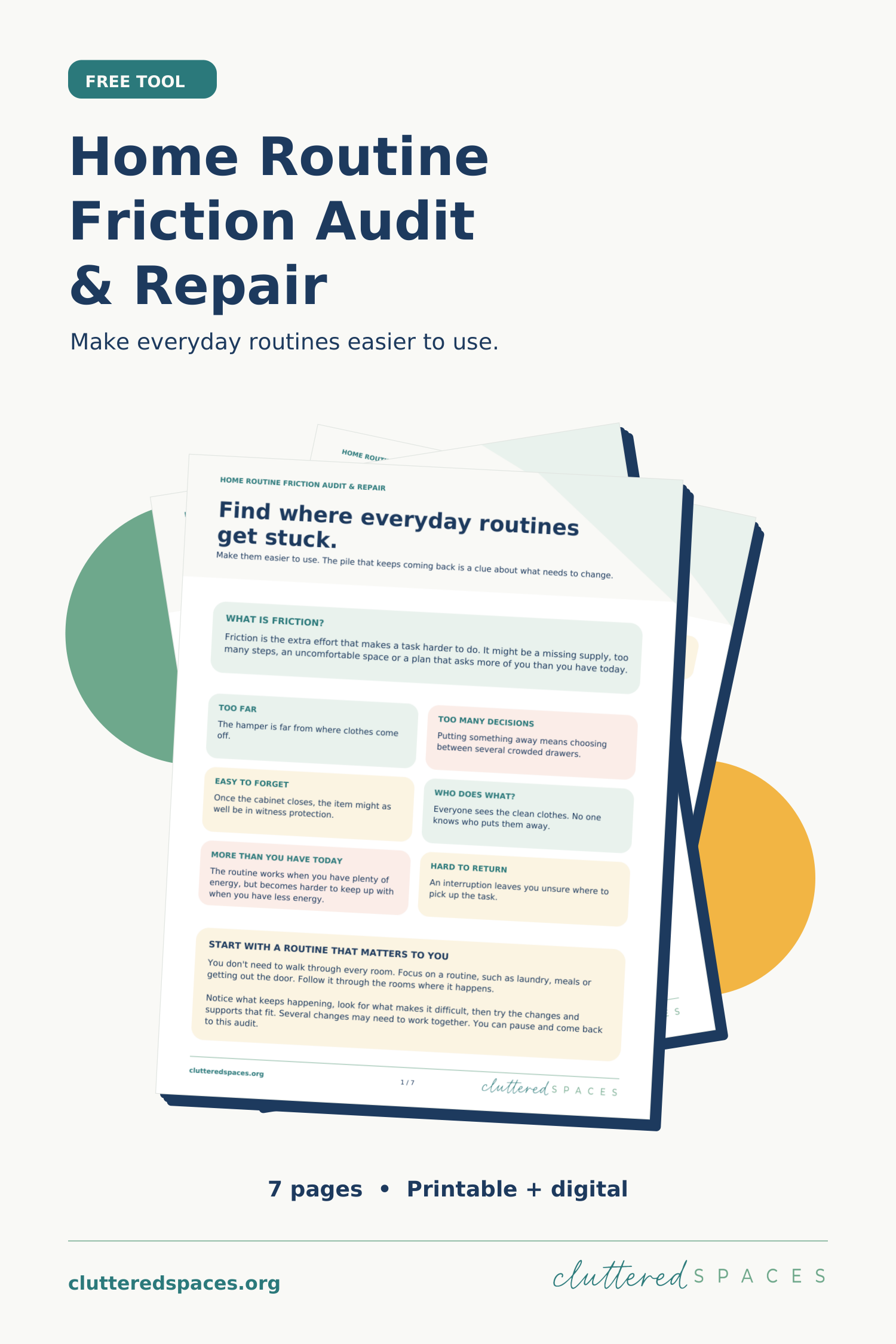
ADHD-friendly home organization begins there: with the actual work of finding, using, and returning belongings. It asks how the home can make those actions easier, including on days when time, attention, or energy are limited. Want to try this with one routine? The free seven-page Home Routine Friction Audit & Repair helps you trace where the routine gets stuck, then test practical changes and supports.
You can still want a home that looks good. You also deserve one you can live in without constantly trying to earn the right to relax.
Why an organized room can still be hard to use
“Put the laundry away” sounds like one task. It can involve noticing the basket, switching away from something else, deciding where to begin, sorting, folding, finding drawer space, and remembering to return after an interruption.
Executive function helps us manage that kind of work: keeping information in mind, directing attention, planning, and adjusting what we do. These skills work together throughout everyday activities.
ADHD can make staying organized, remembering tasks, and following through more difficult. The challenges vary from person to person; a recurring pile does not tell you someone’s diagnosis or how much they care.
At home, the demands of a system matter too. A drawer may be too full. A category may be confusing. The reminder may appear when you cannot act on it. These are problems we can investigate.
That is what we mean by friction: something about the task, setting, or available support that makes the next action harder. Our article on why traditional organizing systems often fail looks more closely at those hidden demands.
To understand the skills your home system is supporting, start with executive function at home.
Choose one part of the day you want to make easier
Before buying another container, choose a specific outcome. “Get organized” is a very large assignment. “Find clean work clothes without searching three baskets” gives you something you can actually build toward.
Other useful starting points might be:
-
Leaving home with your keys, bag, and the thing you meant to return.
-
Finding papers that need action before their deadlines pass.
-
Having enough usable kitchen space to prepare the next meal.
-
Returning everyday supplies without having to rearrange a cupboard.
Choose the one that would bring the most relief right now. You do not need to begin with the room that would photograph best.
Then watch what happens during an ordinary attempt. Where do you pause, set something down, look for information, or leave to find a supply? Ask the person doing the task what feels difficult. If you are supporting a child or partner, their answer may differ from yours.
When the first answer is “I just don’t do it,” the Five Whys approach can help you get more specific. Keep the questions curious. You are looking for a condition you can change or support, not an explanation to argue with.
Try this with the Home Routine Friction Audit & Repair
The free Home Routine Friction Audit & Repair turns those ideas into a seven-page guide you can write on or type into. It helps when the same pile, stalled routine, or workaround keeps returning and you are not sure what to change.
Start with a routine that matters to you, such as laundry or getting out the door. Follow it through the rooms where it happens. Several changes and supports may need to work together.
-
Notice — page 3. Name the routine, where it begins and ends, what keeps happening, and which part gets difficult.
-
Inspect — page 4. Check the difficulties that fit, notice what happens instead, and choose which parts you would like to make easier.
-
Test — pages 5–6. Plan connected changes, supplies, responsibilities and timing. Include a version for harder days, a way to return and what counts as done enough. Review after about a week or a few tries. Page 2 shows a worked laundry example; page 7 offers other routines to explore.
Seven days is a useful check-in point, not a deadline for forming a habit. An unusual week may tell you that you need another attempt under more typical conditions.
Get the free Home Routine Friction Audit & Repair. Enter your email to receive access to the seven-page PDF. Print it and write by hand, or download it, open it in a PDF app that supports form fields, type your responses, and save your copy.
An example with the mail pile
Notice: Mail lands on the kitchen counter. The plan is to open it and handle anything important. You stop when opening one envelope seems to commit you to dealing with the whole pile.
Inspect: You notice several decisions arriving at once. What is this? Who needs it? When is it due? What happens next? For this example, you choose Decide as the biggest demand.
Test: Broaden the first sort to “needs attention” and “ready to file.” Keep the action papers in an existing tray and agree on a review cue, such as after dinner on two chosen days. That review needs to happen often enough for the actual deadlines involved.
The minimum version is keeping action papers together with any known deadline visible. The restart is picking up one paper and identifying its next action. After a week, check whether important papers were easier to find and act on. If the tray simply filled up, look at the review step and the support it needs.
Short on energy? Answer just three questions: What keeps happening? Where does it stop? What is one thing I could make easier? You can do that on a scrap of paper right now.
Six ways to make a home system easier to use
These are options to test. Choose the one that fits the difficulty you noticed.
1. Make the useful information visible
Sometimes the object needs to be easy to see. Sometimes only the next action does. A label, a short reminder, or one clearly defined place for outgoing items may be enough.
If open shelves make the room feel overwhelming, try closed storage with an obvious label. The goal is a cue you notice when you need it. Working memory and clutter explores that balance between hiding everything and keeping everything out.
2. Move storage closer to the action
Look where the item is actually used or set down. A hamper beside the place you change clothes may be more useful than one in the laundry room. A small homework-supply caddy can live near the dining table if that is where homework happens.
Choose a location the person can comfortably reach. The most sensible place on a floor plan may be inconvenient in a real body, carrying a real armful of things.
3. Remove a step
Try returning an item while holding something in your other hand. Does the lid, stack, door, or transfer make the action awkward? A hook may work better than a hanger. A shallow container may make searching easier.
Keep steps that serve a real purpose. Removing unnecessary effort is useful; removing needed protection or making someone else’s access harder is not.
4. Make the categories easier to choose
“Chargers” may be a useful category. “Chargers by connector type, length, and era of purchase” may be asking a lot of Tuesday evening.
Use enough detail to find things without turning every return into a sorting decision. When choices themselves are exhausting, decision fatigue at home offers ways to make them more manageable.
5. Give temporary piles a destination
A landing place needs a purpose, a boundary, and a next step. A tray for incoming mail is useful when someone also knows when it will be checked. A basket for returns needs a plan for leaving the house.
Without that next step, a very attractive basket can become a long-term storage facility for unresolved intentions.
6. Include a smaller version and a way back
Decide what needs to remain usable on a difficult day, then name the first action that will help you restart. For laundry, the smaller version might protect access to clean essentials. The restart might be putting one person’s clean clothes in one accessible place.
The system needs room for ordinary interruptions. You can plan for those before the next difficult week arrives.
What this can look like around the house
Laundry that pauses after drying
You can wash clothes. You can dry clothes. Then the clean basket sits because putting everything away means folding, sorting, and making room in drawers.
Start where the process stops. Try one labeled clean-clothes basket per person, or broad drawer categories for clothes that do not need careful folding. Clear enough drawer space that returning an item does not require compressing everything already there.
Agree on the function you are protecting: clean clothes are easy to find, and they stay separate from clothes that need washing. If neat folding matters to someone, include it where it adds value and decide who will do it.
Keys and bags with several unofficial homes
Before choosing the “correct” location, watch where you put things when you come through the door. Try a hook, small tray, or open basket near that spot. Test the height and reach with the actual people using it.
Then practice the arrival once: come in, put down the bag, place the keys. If the location immediately feels awkward, move it. You do not owe a storage location a lengthy probation period.
A kitchen where one task creates four searches
Packing a lunch may involve containers in one cupboard, lids in another, bags across the room, and food wherever it fit after shopping. Group the items used in that routine within easy reach, working with the space you have.
Give frequently overlooked food a clear area and decide who checks it. If unloading the dishwasher repeatedly stalls because cupboards are full, create room for the dishes you use most before adding a more elaborate cleaning schedule.
This is one way to let the environment carry more of the mental load: make the next action easier to recognize and complete.
Belongings that no longer fit their space
Sometimes there are more items than the available storage can comfortably hold. A different label will not create drawer space. You may need to move less-used items, choose a smaller everyday selection, or decide what you are ready to release.
Make those decisions in manageable amounts. If the objects carry memories, guilt, or a life you are still adjusting to, leave room for that experience. It’s Just Stuff—Until It Isn’t explores why letting go can involve much more than storage.
Make maintenance a shared plan
A system can be easy to use and still stall because everyone thinks someone else is maintaining it.
“We will all keep up with the kitchen” leaves a lot unanswered. Who notices that dishes need attention? Who starts? What counts as enough? Who takes over when the usual person is unavailable?
Choose one routine and agree on a specific version. For example: after dinner, one person puts food away while another loads the dishwasher; each person brings their dishes from other rooms. Adjust the roles for age, ability, schedules, and the support people need.
Make the agreement with the people using it. A system becomes much harder to own when it arrives as someone else’s announcement. Our guide to sharing household responsibilities in a neurodivergent family goes further into making that support clear.
Connect maintenance to a cue that will actually be noticed. “After dinner, check the action tray” gives more direction than “remember to deal with paperwork.” A brief written sequence or agreed reminder can support the start. Building routines when consistency is difficult offers a fuller way to develop that plan.
When the system falls apart, make the return smaller
Illness, travel, deadlines, caregiving, and ordinary exhaustion can interrupt a routine. You may look around and feel as though all the previous work has disappeared.
Before beginning another whole-house rescue, ask: What needs to work today?
In the kitchen, that might mean storing food appropriately and making one preparation area usable. In the bedroom, it might mean finding clean clothes for tomorrow. With paperwork, it might mean locating the item with the nearest deadline.
Choose the first physical action that serves that need: move dishes from one section of counter, gather the clean socks, or open the action tray. Keep the starting point small enough that you can recognize when you have done it.
You can return to regular maintenance while some backlog remains. Waiting until everything is caught up can keep the system out of reach. The minimum-version routine guide can help you decide what to protect and what can wait.
If the same step repeatedly blocks the restart, revisit that step. Maybe the routine needs fewer actions. Maybe the reminder needs to move. Maybe someone needs to begin alongside you, help with physical access, or share an ongoing task.
Support can remain part of a workable system. The question is whether the plan fits the help that will actually be available. A System Isn’t Successful If It Only Works While Help Is There explains how to make that handoff realistic.
For a closer look at practicing the daily skills that use these systems, read our independent living guide.
How Cluttered Spaces helps
Our home function coaching guide explains how we combine practical work with a plan for using the system afterward.
At Cluttered Spaces, we work alongside you to understand where daily life is getting stuck. That can mean looking at the mail pile together, making a cupboard easier to use, practicing a laundry routine, or agreeing on a workable household handoff.
Our process is Assess → Reset → Build → Sustain. We identify the difficulty, restore enough access to begin, build and practice a system with you, and adjust it for real life. Your priorities, preferences, and available support shape the work.
We combine executive-function coaching with environmental design, everyday skill development, and hands-on implementation. We look for useful changes you can notice: finding what you need, starting with less confusion, returning belongings more easily, and knowing how to resume after an interruption.
If you are looking for local help, ADHD home organization support in Atlanta describes what that work can involve.
For today, choose one place you would like to feel less frustrated. Notice where the process stops. Give yourself permission to test a small change before deciding what the whole house needs.
For a closer look at related points of friction, read Decluttering With Kids and Clutter Is Information.
For educational purposes only. Not a substitute for professional medical or mental health advice.
References
-
National Institute of Mental Health. (2024). ADHD in Adults: 4 Things to Know.
-
Center on the Developing Child at Harvard University. A Guide to Executive Function.
-
Center on the Developing Child at Harvard University. (2017). Building the Skills Adults Need for Life: A Guide for Practitioners.
These sources inform the explanation of ADHD, executive function, and supported skill development. Cluttered Spaces developed the household examples and Friction Audit to apply these ideas to everyday routines.