
How Executive Function Skills Develop Through Practice
You know the laundry needs putting away. You know where it belongs. You may even have a perfectly reasonable plan for when you’ll do it. The basket is still there.
A child can explain the morning routine and still need help getting through it. A student can tell you which assignment is due and still struggle to begin. An adult can understand how a budget works and still have trouble sitting down, opening the accounts, and following the plan.

When someone knows the steps, it’s tempting to think the teaching is finished. But understanding a task and managing yourself through it are different abilities. Executive skills need opportunities to develop through actual use, with structure, feedback, and support that fit the person.
Practice also gives us a chance to get to know our own brains with kindness: what helps us begin, where we lose our place, and why one approach fits better than another.
Supported practice helps us do the task and learn about ourselves while we do it.
Skills develop through use, with support along the way
Executive skills develop over childhood and adolescence, and adults can continue to strengthen skills and learn new strategies. Maturation matters, and so do experience, relationships, health, and the conditions in which we’re trying to function.
Practice gives us repeated opportunities to use these skills toward a real goal: holding the next step in mind, pausing to check, choosing a starting point, or changing course when something isn’t working. Structure makes those opportunities more predictable. Feedback helps us decide what to repeat and what to change.
The challenge needs to fit. If someone else carries every decision, there may be little opportunity to practice those decisions. If the person is overwhelmed by the whole task, they may need more help before they can engage. Scaffolding helps us find a workable place between those demands.
Knowing the steps is only part of the work
“Get ready.” “Do your homework.” “Pay the bill.” Each sounds like a single instruction. Each asks someone to manage a sequence of actions: notice it’s time, stop something else, gather what’s needed, choose a starting point, keep track of progress, and follow through.
These are some of the everyday demands supported by executive function. A person can understand the instruction without being able to coordinate all those demands reliably.
They may manage it with someone beside them, then struggle alone. They may do it on a rested Saturday and find it much harder after school or work. That difference is worth understanding. What was helping when the task worked? What changed when it didn’t?
Sometimes the person needs clearer instruction. Sometimes they need a different environment, more accessible materials, rest, or another kind of support. And sometimes they need someone to help them practice the process they already understand.
A checklist can hold the steps. Using it takes practice.
A checklist can be useful. It gives information somewhere to stay while we work. But someone still has to notice it, open it, interpret the next step, begin, and return to it after an interruption.
If those are the very actions that are difficult, handing over a checklist can leave the person with another thing to manage.
Teaching its use might mean opening it together at the start of the task, finding the next action, carrying out that action, and checking back before moving on. Over repeated occasions, the person gets experience using the tool as part of doing the work.
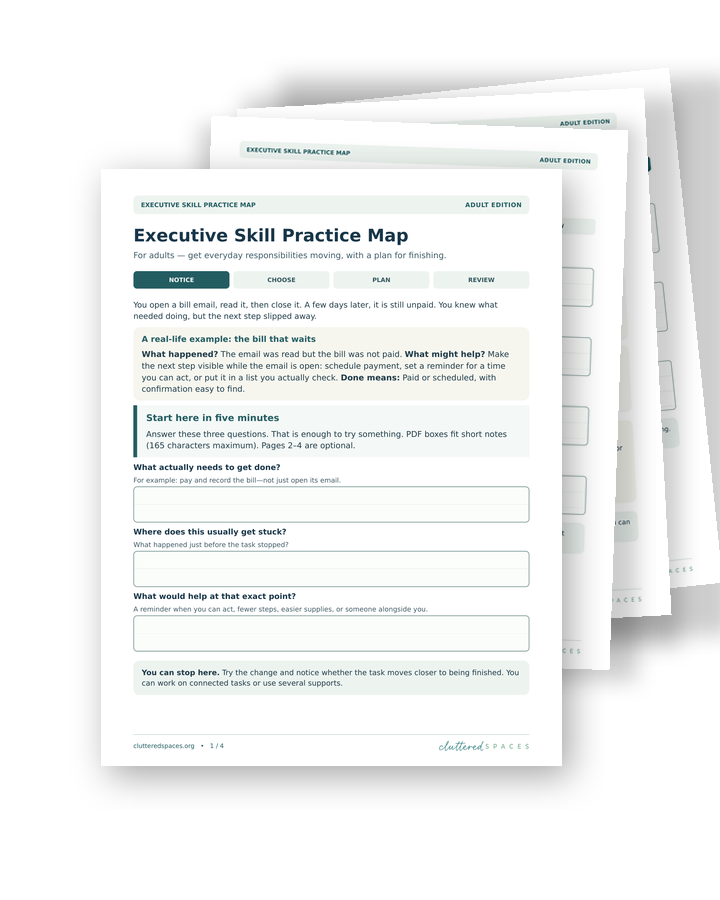
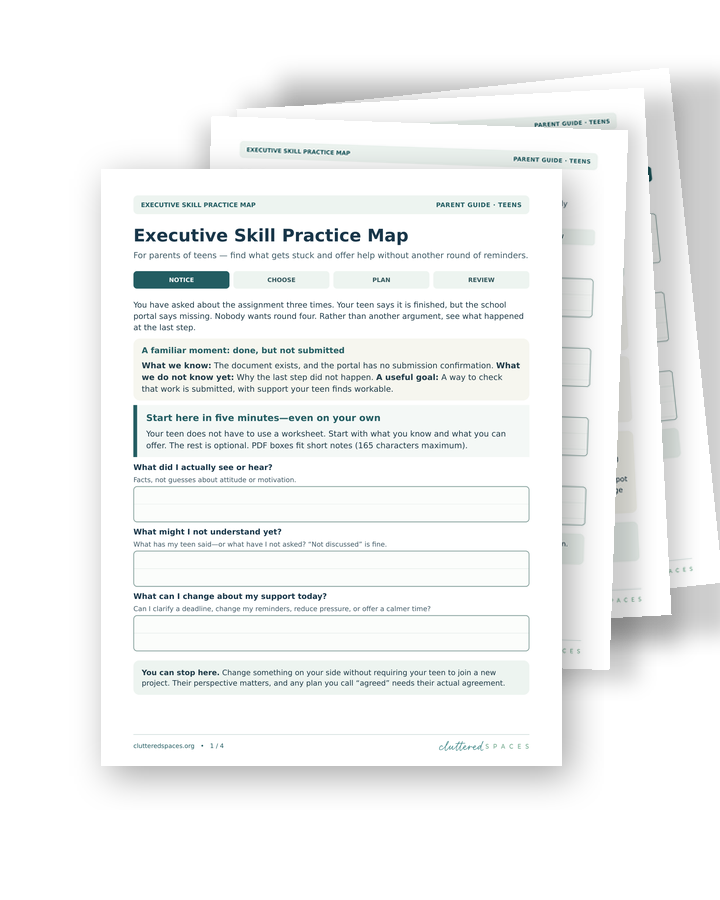
Buying a planner, downloading a worksheet, or agreeing on a routine begins a process; it doesn’t tell us whether someone can use it yet. If you’d like somewhere to record the practice and support you’re planning, the Executive Skill Practice Map offers a starting point. You can use it alongside the work.
Scaffolding helps someone participate while they learn
Scaffolding means providing enough support for someone to take part in a task they cannot yet manage reliably on their own. The support might include demonstrating a step, thinking aloud through a decision, doing the first part together, providing a timely cue, or helping someone recover when they lose their place.
For a child getting ready, that could mean moving through the morning routine together and using pictures to find the next step. For a student, it could mean opening the assignment, identifying what it asks, and choosing where to begin. For an adult preparing meals, it could mean planning and cooking alongside someone while learning how to sequence the work.
The person participates in the actions and decisions they’re learning, with agreed help for the parts that are currently out of reach. A practice session can focus on part of the process; it doesn’t require doing every step alone. Some days, direct help or rest may be what’s needed. The amount and kind of help should make sense to the person using it, including their preferences, access needs, and energy.
Our guide to supporting someone without taking over offers ways to agree on help while keeping the person involved.
What does supported practice actually look like?
Imagine an adult who wants to prepare a few dependable meals but gets overwhelmed before cooking begins. They understand recipes. The difficulty is coordinating the ingredients, equipment, timing, and cleanup.
A coach might begin by asking where the process gets hard, then work alongside the person:
- Make the process visible. Read the recipe together, gather the ingredients, and talk through what needs to happen first. “The oven takes time to heat, so let’s start there.”
- Practice together. The person prepares the food while the coach helps them keep their place or think through a sticking point. The next step stays visible.
- Return to the process. At the next cooking session, use the same workable sequence. Repeated opportunities let the person practice preparing, sequencing, checking, and finishing.
- Use feedback to adjust. If the person keeps searching for equipment, arrange it before starting. If a spoken explanation disappears mid-task, try a visible step or demonstration.
- Shift responsibility as readiness grows. The person might gather ingredients independently while still wanting help with timing. Support changes around what they can now manage.
That is ongoing teaching in the middle of real life. The same approach can apply to packing a school bag, managing appointments, or getting through an evening routine. The details change with the person and the task.
Get curious about how your brain works
When a task keeps getting stuck, it’s easy to turn the difficulty into a judgment: “Why can’t I do this? What’s wrong with me?” Supported practice can make room for a kinder, more useful conversation: “What happened there? What helped? What could we try differently?”
There’s something to learn from the attempts that go well, too. Maybe you started homework more easily because the assignment was open and the materials were within reach. Maybe saying the next step aloud helped you keep your place. Maybe having someone nearby made it easier to ask a question before you became overwhelmed.
Instead of stopping at “That worked,” explore what about it helped:
- Was it easier to begin because there were fewer decisions to make?
- Did seeing the steps help more than hearing them?
- Did you need help understanding the task, getting started, or returning after a break?
- What felt different when you tried it at another time of day?
You don’t need a perfect explanation of your brain. You’re learning from your own experience: “When I can see the materials, I can find a starting point,” or “If I talk through the plan first, I’m less likely to lose track.” These observations give you something specific to try again.
A person supporting you can help you notice patterns and test ideas without deciding what your experience means for you. They might ask, “What felt easier today?” and leave room for your answer. For someone who is used to being corrected, having their own observations taken seriously can be an important part of the practice.
Reflection should fit the moment. A brief conversation, a few words on your phone, or noticing one useful difference may be enough. If you’re exhausted, you can come back to it later.
Consistency means opportunities to return
Agree on when you’ll return to the approach: the next homework session, a regular appointment-planning time, or another occasion that fits your life. Keep enough of the process familiar to practice it, and use what happens to decide what needs changing. Returning after an interruption or handling a missing item can be part of that practice, too.
Consistency doesn’t require an unbroken streak. A missed day can be followed by a supported restart. A difficult week may call for a smaller version of the task or more help.
Repeated struggle deserves a closer look, too. If each attempt ends at the same barrier, keep investigating. The Five Whys approach can help you explore what’s making that part difficult. Practice needs to be workable enough for the person to engage and learn from it.
Learn to choose and adjust your own support
When a routine begins working, ask what the helper is contributing. Are they choosing the starting point, watching the time, remembering the unfinished steps, or noticing when to take a break?
Those contributions tell us what might still need teaching or an external support. Agree on a small handoff: the person might choose the first step, try beginning before a prompt, or ask for a check-in at the end rather than throughout. Notice together what happens.
If things unravel, restore the support and reconsider the next step. Removing help on a calendar deadline tells us little about readiness.
As you learn what helps, you can practice arranging that support for yourself. You might gather materials before beginning, write down your next step before a break, ask someone to sit nearby, or recognize that you need a different approach today. You’re using what you’ve learned about yourself to guide your own actions and efforts.
For example, you might notice that talking through a homework assignment helped you begin. Later, when paperwork feels hard, you could try explaining the next few steps to someone before opening the form. It might help, or you might discover that paperwork needs a different support. Either result gives you something to work with. You’re practicing how to notice, choose, try, and adjust.
Some supports may remain useful indefinitely. Someone can become skilled at managing appointments while continuing to use calendar alerts. They can manage a morning routine while keeping a written sequence. Progress can include knowing which supports to use and when to ask for help.
Look for changes in the process, as well as the result
A completed task matters. It’s also useful to notice how it happened. Did the person choose where to begin? Recognize that they were stuck? Return after a break? Ask a specific question? Check their work before moving on?
A change might sound like, “I lost my place, so I checked the assignment,” or “I knew I needed company to get started, so I asked.” That kind of self-understanding is worth noticing alongside the finished work.
Keep expectations specific. A routine may become easier because a skill has improved, the setup asks less of you, or both. Finishing the task alone cannot tell us which changed. Practicing cooking also doesn’t automatically improve homework management. Similar processes may need practice in other settings. Skill development, effective strategies, and accommodations can work together; practice does not erase ADHD or other differences that affect functioning.
Put what you’re learning into a practice plan
The Executive Skill Practice Map can help you name a recurring difficulty, plan useful support, and review what happens. For appointments, you might record that choosing a time and making the call are where things stall. Your plan could include reviewing the calendar together, keeping the phone number visible, and agreeing on help with the call. At the review, notice which parts you managed and where support still helped.
Choose the Adult Practice Map or the Parent’s Guide. The resource is offered in printable, digital, and phone-friendly formats through email signup, which also subscribes you to occasional Cluttered Spaces emails. You can unsubscribe anytime.
Use the map as a planning and reflection aid alongside practice. A seven-day review is a chance to learn about the approach, not a deadline for mastering a skill.
When you or someone you support keeps getting stuck, ask: What would make this possible to practice, and what can we learn from trying it? Choose an upcoming opportunity, agree on useful support, and leave room to notice what happens. What you learn can guide the next attempt.
You know what needs to happen. Why does it keep getting stuck?
The unfinished tasks. The reminders that aren’t working. The plans that fall apart despite real effort.
The free Practice Map helps you notice where things get stuck, choose practical supports, and try a different approach. Choose the version that fits you.
For educational purposes only. Not a substitute for professional medical or mental health advice.
Suggested next step: Explore Executive Function Coaching. Work with us to understand where everyday tasks get stuck, practice workable approaches, and adjust support as your needs change.
References
Center on the Developing Child at Harvard University. Three Principles to Improve Outcomes for Children and Families. See Principle 2: Strengthen Core Skills.
Center on the Developing Child at Harvard University. Enhancing and Practicing Executive Function Skills with Children from Infancy to Adolescence.
Diamond, A. (2013). Executive functions. Annual Review of Psychology, 64, 135–168.
Diamond, A., & Ling, D. S. (2016). Conclusions about interventions, programs, and approaches for improving executive functions that appear justified and those that, despite much hype, do not. Developmental Cognitive Neuroscience, 18, 34–48.