Clutter Is Information: What Your Piles May Be Telling You
You clear the dining table. You sort the mail, carry away the cups, relocate three things that belong upstairs and finally see the surface again.
Then, somehow, the pile comes back.
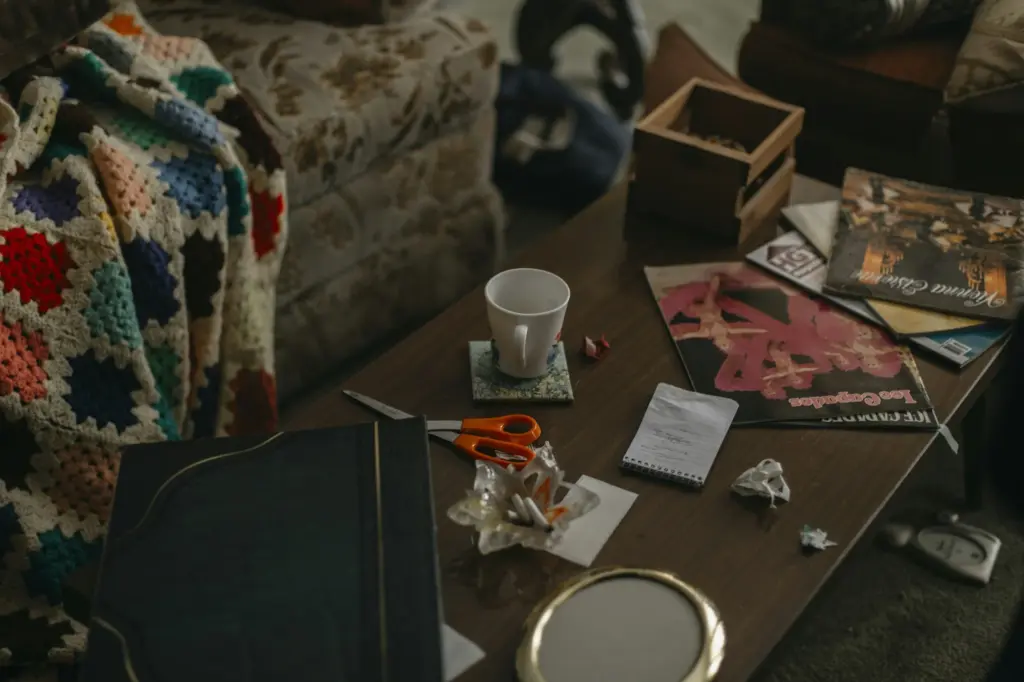
It is tempting to see that return as proof that you are disorganized or that nobody in the house follows through. But the pile may be telling a more useful story. It may contain bills waiting for decisions, school papers that need signatures, records without a home, things someone is afraid to forget and envelopes that arrived during a week when the household had absolutely nothing left to give.
The pile is not a character assessment. It is often the visible result of several unfinished processes sharing one convenient landing spot.
Before You Clear the Pile, Read It
When the same clutter keeps returning, clearing it again may solve today’s surface without solving tomorrow’s problem. The better question is not only, “Where should this go?” It is, “What is this pile waiting for?”
That small shift matters. Instead of beginning with blame, you begin with curiosity. You can look for the decision, missing step, memory demand or capacity problem underneath what you see.
If the answer is still fuzzy, the Five Whys guide can help you follow one recurring problem back to the point where it actually gets stuck.
What a Recurring Pile May Be Telling You
The item does not have a clear home
If several locations seem equally possible, putting something away requires a fresh decision every time. That is a lot to ask of a person holding groceries, answering a question and wondering why the dog is suspiciously quiet.
A broad, obvious home is often easier to use than a beautifully specific one. “School papers needing action” may work better than separate categories for forms, permission slips, notices and papers you are apparently supposed to remember next Thursday.
The assigned home asks for too much effort
A storage location can make perfect sense on paper and still fail in real life. If backpacks are used by the door but stored upstairs, they may live on the floor halfway between those two ideas. If the hamper has a lid, sits in a closet and requires sorting clothes into three categories, the floor may win.
The pile often marks the point where the effort required became greater than the capacity available. Moving storage closer to the behavior or removing one step may help more than another reminder.
The item is trying to remain visible
Sometimes an item stays out because it is carrying a reminder: return this, pay this, bring this, ask someone about this. Putting it out of sight can make the unfinished action disappear with it.
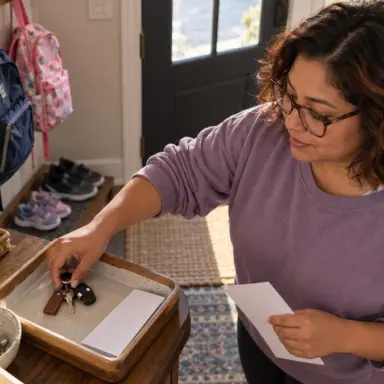
The answer is not necessarily to hide everything. It may be a small, bounded action tray, a clear container or a separate reminder that lets the object be stored safely. Our article about working memory and clutter looks more closely at that middle ground.
A decision is still open
Returns, repairs, donations, forms, sentimental belongings and “I might need this” objects are not simple put-away tasks. Each one may require information, permission, emotional energy or a decision you are not ready to make while walking through the room.
A temporary holding place can be useful. The important word is temporary. Give it a purpose, a size limit and a time to review it so “Not Sure Yet” does not quietly become a permanent department.
The process stops here
Mail comes in, but there is no next step for papers requiring action. Laundry gets washed, but clean clothes do not have an acceptable landing place. Groceries enter the kitchen, but the storage space is already full.
When a process has an entrance but no workable continuation, belongings collect at the break. The most helpful change may be to design the next transition—not reorganize the entire room.
The household is operating beyond capacity
Clutter often grows during illness, grief, caregiving, travel, schedule changes and prolonged stress. A system that worked during an ordinary month may not survive the month you are actually having.
In that season, the goal may be containment, access and safety—not a comprehensive organizing project. A smaller routine can preserve what matters most until more capacity returns. If a major disruption has changed what home can currently hold, our guide to household support during major life transitions offers a gentler place to begin.
Try This With One Pile
Choose one pile that returns often. Do not begin with the pile that requires a family summit, three legal opinions and a conversation with your 2007 self. Choose something ordinary enough to study.
Before sorting it, ask:
-
What is here? Are these things connected by location, person or unfinished action?
-
Why here? What happens immediately before an item lands in this spot?
-
What is still open? Is a decision, reminder, supply or next step missing?
-
What would make the next move easier? Could you shorten the trip, reduce a choice, make the action visible or agree on who owns it?
The location may already contain part of the answer. A pile by the door may be about arrival and departure. A pile on the stairs may be waiting to move between floors. Clothes on a chair may be neither clean enough for the closet nor dirty enough for the hamper. The chair did not create the category, but it has been doing its best to host it.
Match the Support to What the Pile Is Saying
If the problem is an unclear home, choose one broad and obvious location. If the location is inconvenient, move storage closer to where the item is used. If visibility is supporting memory, create a defined place for active items. If the pile contains unfinished actions, sort by next step rather than object type.
If every object seems to require a new decision, reduce the number of choices before asking yourself to make them faster. Our guide to decision fatigue at home can help identify where those choices are accumulating.
Then test the change in ordinary life. A system is not successful because it looked lovely on setup day. It is successful when people can find it, use it and return to it without needing ideal energy or a daily motivational speech.
Clutter Is Not a Character Reference
Clutter can be stressful. It can block useful space, hide important items and sometimes create genuine health or safety concerns. Those effects deserve practical attention. They still do not prove that someone is lazy, irresponsible, unintelligent or uncaring.
Clutter is also not automatically hoarding disorder. Hoarding disorder is a specific mental-health condition involving persistent difficulty discarding possessions and significant distress or impairment. Severe accumulation, safety concerns or intense distress may call for specialized clinical and community support. A respectful home-function approach does not diagnose a person by looking at a room.
What Progress Can Look Like
The dining table may not stay empty forever. But perhaps action papers now have one visible tray, the tray has a weekly review time and everyone knows who handles the school forms. When the pile returns, you know what question to ask instead of assuming the household has failed again.
At Cluttered Spaces, we work alongside clients to understand what recurring clutter is communicating, reset the immediate environment and build systems around the way the household actually functions. The final question is not only, “Does this look organized today?” It is, “How will you maintain this when we leave?”
This challenge is part of building ADHD-friendly home systems that are easier to use and maintain.
For educational purposes only. Not a substitute for professional medical or mental health advice.
References
American Psychological Association. Why Clutter Stresses Us Out.
American Psychiatric Association. What Is Hoarding Disorder?