My Teen Knows the Material. Why Isn’t the Homework Getting Turned In?
You open the school portal and find another missing assignment. Your teen insists they understand the material. They may even explain it to you right there in the kitchen, with enough confidence that you briefly wonder whether you are the one who needs help with algebra.

And yet, there is the zero. If neither of you can tell what is missing, use REAP to clarify what the assignment requires before deciding what needs to happen next.
If they know how to do it, why didn’t they do it? If they did it, why didn’t they turn it in? And how have you become the person who spends dinner asking whether a document has been uploaded?
It is a frustrating place to be. You can see their ability, and you want their schoolwork to reflect it. Your teen may be just as tired of the gap, even if what you hear is “I don’t know” or “Stop asking.”
Knowing the material gets your teen part of the way there. They still have to get the assignment out of the portal, onto the page, and back to the teacher. If one of those steps keeps falling apart, another reminder to “do your homework” may leave both of you having the same conversation tomorrow night. Looking at where it went wrong gives you something more useful to try.
The work around the homework
Before your teen answers the first question, there is already work to do. Where is the assignment? Does it need the textbook, the worksheet, or the link the teacher posted somewhere else? What is due tomorrow? Once they finally start, a confusing direction or a phone notification can send them off course. And when the last answer is finished, there is still the small but rather consequential matter of turning it in.
We tend to bundle all of this into one sentence: “Do your homework.” To a student who struggles with the process, that sentence can contain several problems they do not yet know how to solve.
This is where executive functions come in: the skills we use to keep track of things, get started, and come back when we lose our place. Your teen can know exactly how to solve an equation and still struggle to get the assignment from “I know how” to “My teacher has it.”
Planning and keeping track of assignments can be especially difficult for some students with ADHD. But you do not need a diagnosis to look more closely at what is happening on a Tuesday evening. A missing assignment is a reason to ask a few questions, not enough information to decide your teen does not care.
The same missing-assignment notice can represent very different evenings. One student never found the directions. Another spent an hour working and got stuck on the final question. A third finished everything, closed the laptop with genuine relief, and left the file sitting quietly in a folder. The portal cannot tell you which story happened.
See all the steps between assigned and turned in
This one-page map helps you and your teen follow one assignment from the moment it is assigned to confirming the teacher received it. Use it when “I forgot” leaves you both unsure what happened. Look through the steps together and find the last one that happened before things got stuck.
For example, if the work was saved but never submitted, you can focus on that last handoff instead of starting another conversation about studying harder.
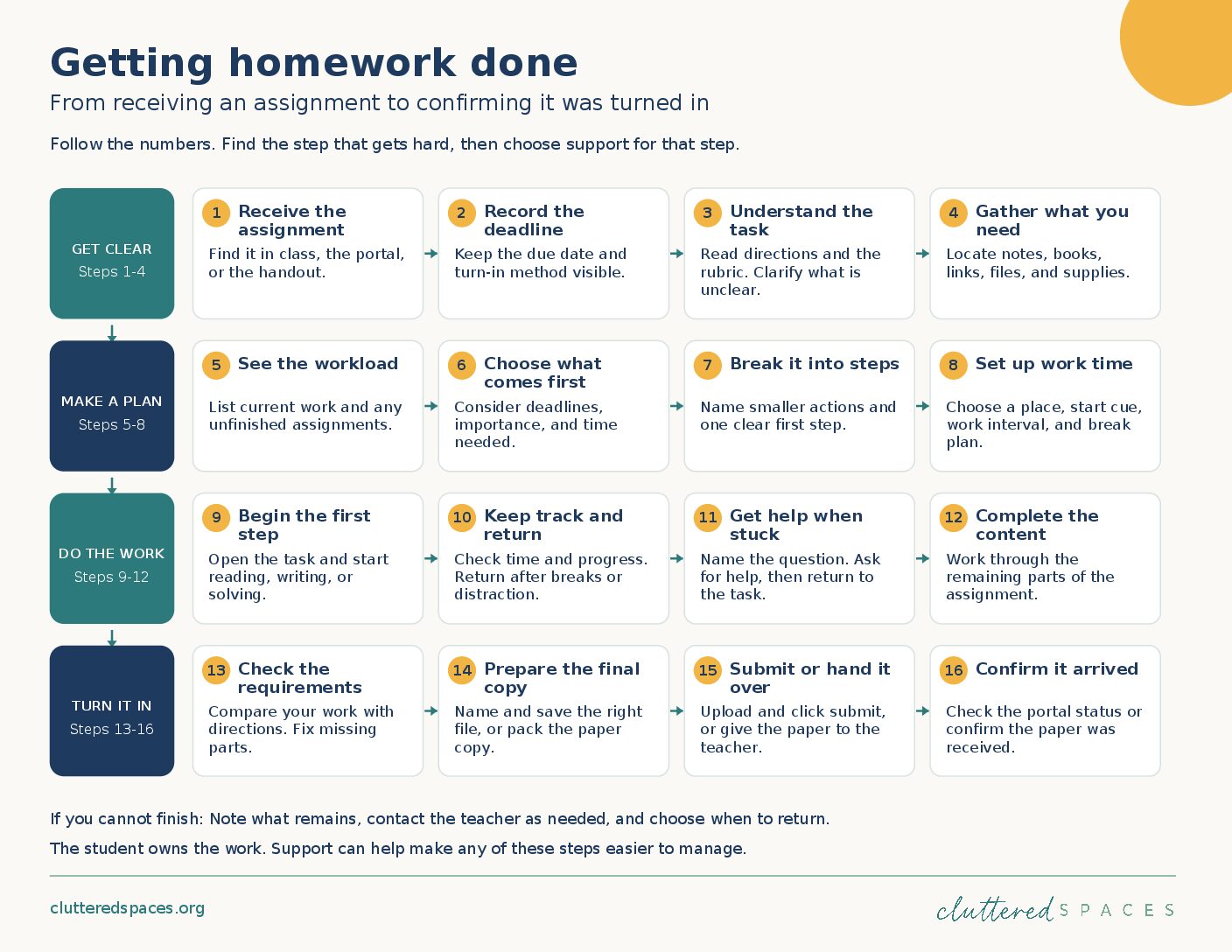
Open the homework map full size
Download the map image. For printable and digital planning tools, use the email signup below.
Find out what happened to one assignment
A portal full of missing work can make you want to clear the evening, spread everything across the table, and fix the whole situation before bedtime. Understandable. Also, quite a lot to put on two people who may already be running on fumes. Pick one recent assignment and a moment when neither of you is in the middle of an argument.
Try something like, “I believe you know this stuff. Can you show me what happened with this assignment? I want to see where you got stuck.” You do not need a perfect script. The point is to make it possible for your teen to tell you what happened without first having to defend themselves.
Let them walk you through it, starting with where they saw the assignment. If you get “I forgot,” that may be as much as they can explain at first. You could ask, “Did you forget it was there, forget to go back to it, or forget to hit submit?” An imperfect answer can still help you find the next thing to try.
You might discover that the assignment was in one place and the directions were in another. Or they opened four assignments and could not choose where to start. Maybe one question stopped them, and emailing the teacher felt embarrassing. The portal labels all of these “missing.” At your kitchen table, they are very different problems.
If the conversation starts feeling like a cross-examination, take a breath and give it some room. “Would later be better?” or “Could you just show me the part that was hard?” may get you further than a fifth version of “But why?” Our guide to executive function support for teens has more ideas for working through this together.
Put support where the process gets stuck
Now you have something to work with. If finding the assignment is the problem, that calls for a different kind of help than sitting in front of it for forty minutes without starting. This is also why a lovely new planner can be helpful—or become one more thing nobody wants to open.
Suppose your teen opens the portal, sees the entire week, and immediately closes it. You could help pull out just what is due tomorrow, then let them choose where to begin. Keep that short list in sight. Tonight, they may need help seeing one manageable evening instead of the whole week staring back at them.
Or maybe things go reasonably well until the after-school break stretches into the rest of the evening. Try agreeing on a first action together: “At 5:30, open the history assignment and read the directions.” Ask what would help them notice the time and leave the break. An alarm they choose or a quick check-in may be worth trying. Our attention-shifting guide looks more closely at that awkward moment between resting and restarting.
If one confusing question brings everything to a halt, make a plan for that moment before it arrives. Could they mark the question, move to another part if the assignment allows it, and ask a teacher or tutor for help? You might help them turn “I don’t get any of this” into “I’m stuck on what the second paragraph is asking.” Asking for help can feel exposing, so leave room for that conversation too.
If the work is done but never reaches the teacher, keep the assignment open until it is actually sent. Check the directions, upload the right file, and look for confirmation before closing the laptop. For paper work, decide together where it goes and what will help it make the trip from backpack to teacher. A finished worksheet can spend an impressive amount of time in a backpack without anybody receiving credit for it.
Try one change for a few school days, then ask, “Did that make anything easier?” If it did not, you have learned something useful. You can adjust the plan without turning the experiment into another thing your teen failed. For more possibilities, see what to check when finished homework receives a zero.
Your teen can own the work and still use support
Parents often worry that helping with the process means their teen will never learn to manage it. That concern makes sense, especially when you are already remembering deadlines for two people and would very much like to retire from one of those positions.
You can help without becoming responsible for every answer and deadline. Maybe you help make the assignments visible, and your teen chooses what to tackle. A teacher clears up a direction, and your teen does the thinking. You agree on one check-in instead of spending the evening asking whether they are done yet. The work stays theirs, with help where they need it.
Learning a routine takes practice, and practice can include help. A student may need someone to walk through saving and submitting a file with them several times before it becomes familiar. Taking away the reminder does not automatically teach the step they keep missing.
Ask your teen, “What would help you keep track of this without me asking so much?” Their answer might be a written cue, a short check-in, or a regular time to work with someone nearby. Try it together and see what happens. Some help may become less necessary over time; other support may keep being useful. You are looking for a system your teen can use and have a say in.
When the homework process needs more help
Sometimes a small change at home helps. Sometimes everyone needs another person in the mix, especially when homework has become the subject of nearly every evening conversation. The Homework Room is being developed with that in mind: a predictable place to show up, help figuring out where to begin, and someone available when a student gets stuck. The student still does the work, with support for the steps around it.
It also matters what kind of help your teen needs. If the material itself is confusing, a subject tutor or teacher may be the right person to ask. If assignments keep falling apart even with practical help, check in with the school about what they are seeing and whether accommodations or an assessment could help. Ongoing distress, sleep difficulties, or a sudden change in how your teen is doing are worth bringing to a healthcare professional too.
For tonight, you can leave the whole semester out of it. Pick one assignment and ask your teen to show you where it got stuck. Maybe you will find a small change to try. Maybe you will understand a little more about why the last plan did not help. Either is a useful place to begin—and a better use of dinner than another round of “Did you turn it in?”
Return to the homework process map when you want to look at another assignment together.
For educational purposes only. Not a substitute for professional medical or mental health advice.
Make the homework workload visible.
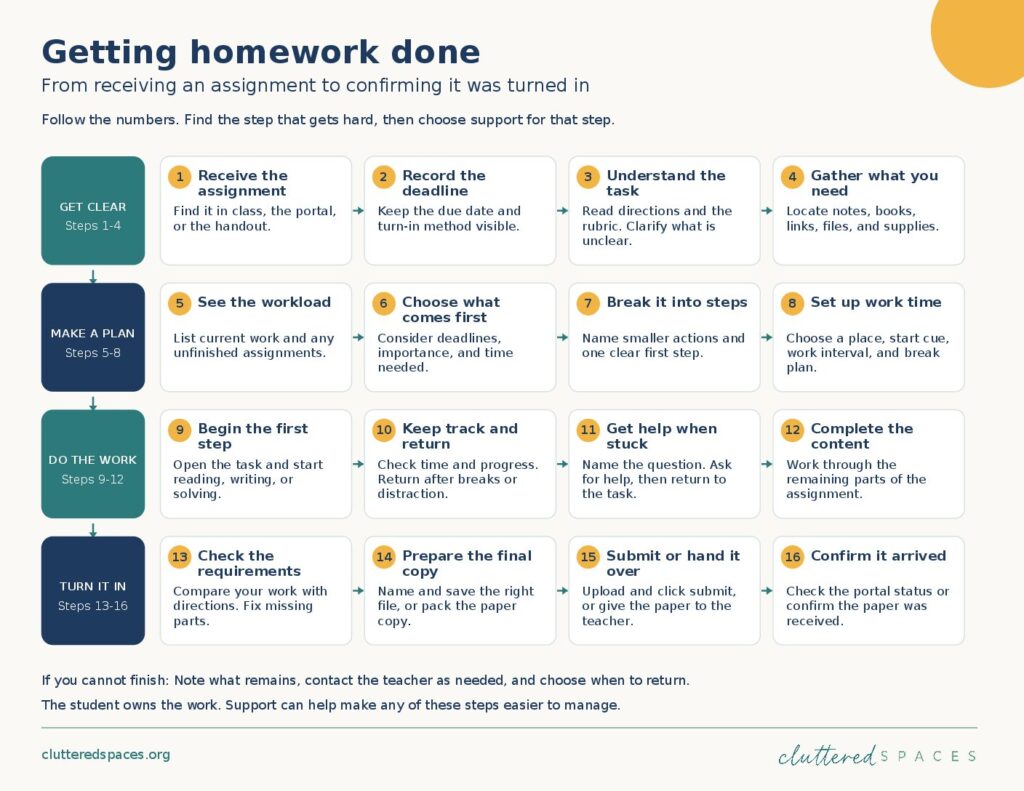
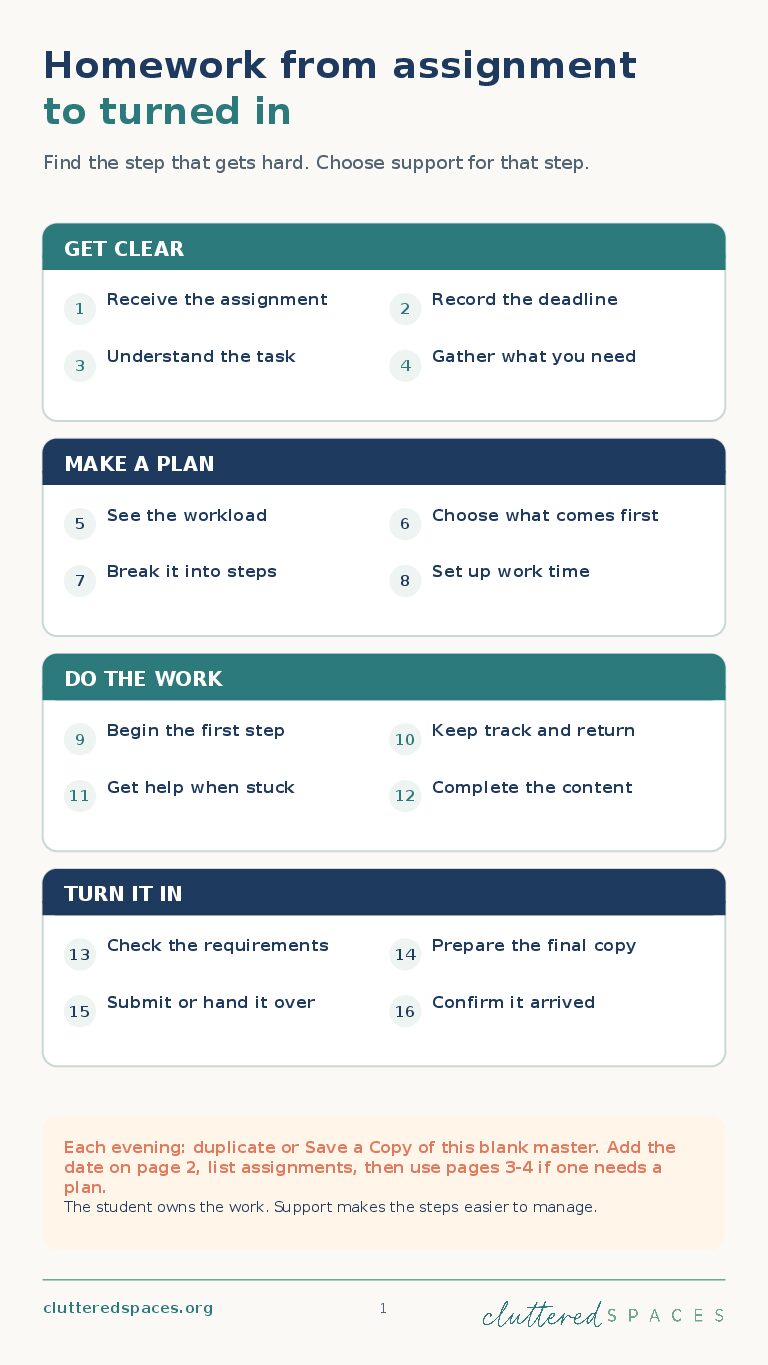
Get Homework From Assignment to Turned In: a printable process map and digital planning tools for computer, tablet, and phone. Follow one assignment and find the last step that happened. Use only the part of the planning page that helps with what comes next; the map is a guide, not sixteen new jobs. You receive the process map and planning page, plus a separate phone version with a homework dashboard.
Enter your email to get the free planning tools.
This does not enroll you in The Homework Room or any paid service. It’s a helpful tool as you figure out what works for your family.
References and further reading
Langberg, J. M., Dvorsky, M. R., & Evans, S. W. (2013). What specific facets of executive function are associated with academic functioning in youth with attention-deficit/hyperactivity disorder? Journal of Abnormal Child Psychology, 41, 1145–1159. https://doi.org/10.1007/s10802-013-9750-z
Langberg, J. M., Epstein, J. N., Becker, S. P., Girio-Herrera, E., & Vaughn, A. J. (2012). Evaluation of the Homework, Organization, and Planning Skills (HOPS) intervention for middle school students with ADHD as implemented by school mental health providers. School Psychology Review, 41(3), 342–364.
Center on the Developing Child at Harvard University. (2018). Building the Core Skills Youth Need for Life: A Guide for Education and Social Service Practitioners.
Research on these specific organizational interventions supports the background principles discussed here; it does not establish outcomes for The Homework Room. The family examples are illustrative.