When Organizing Isn’t Enough: What Home Function Coaching Looks Like
You finally clear the kitchen counter. For a few days, there is room to make lunch. Then the mail returns, a school form needs a signature, and the bag of things to return settles into what appears to be permanent housing. You can organize the counter. Keeping it usable is the part that keeps getting away from you.

Maybe you have tried a new system, watched the videos, or bought the containers. You understand the advice. What you need is help turning it into something that works in your actual home, with your actual energy and the other people who live there.
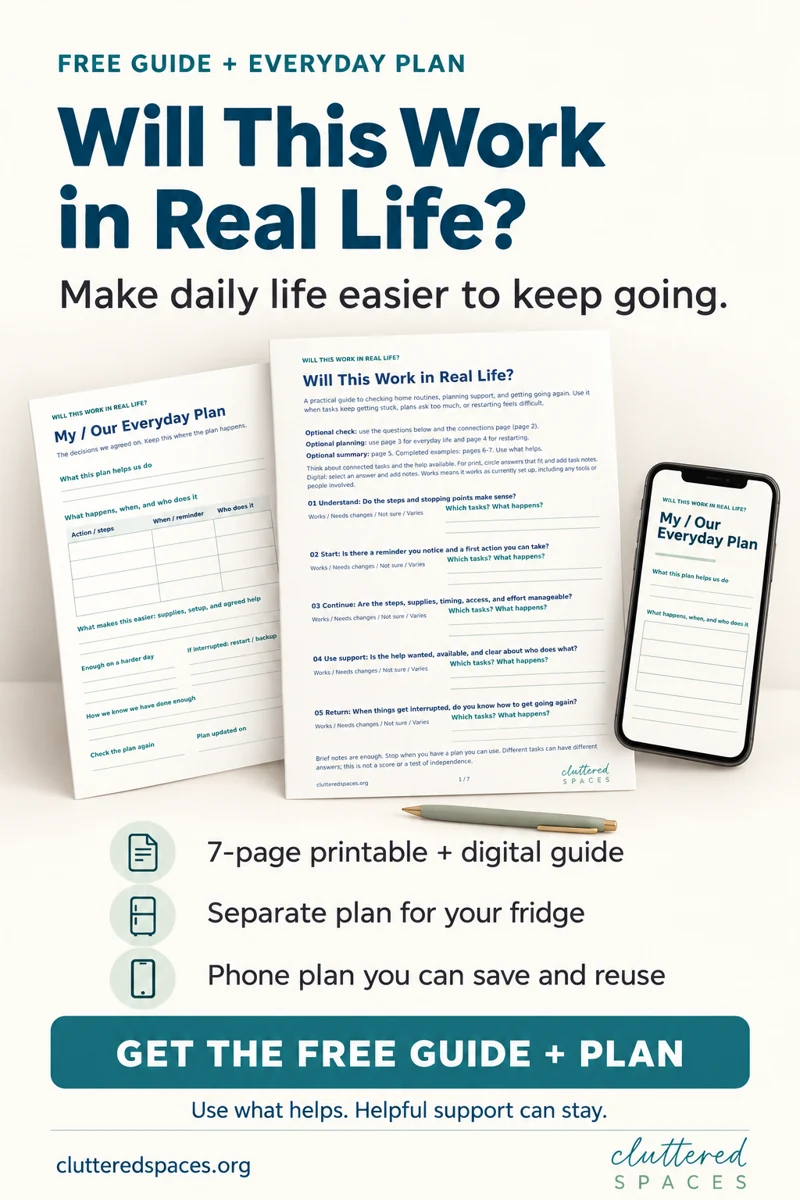
At Cluttered Spaces, Home Function Coaching combines practical coaching with hands-on work. We look at where daily life gets stuck, work alongside you to change what is getting in the way, and practice a plan you can use after the session ends. Organizing may be part of that work. So may figuring out who opens the mail, how laundry reaches a usable place, or what dinner looks like during a difficult week. Wondering how this could work in your home? Start a conversation about the routine or space that keeps getting stuck. You can also explore the free Will This Work in Real Life? guide and everyday plan below.
When the room is only part of the problem
A professional organizer can help you sort belongings, make storage more accessible, and create a space that is easier to use. Many also teach skills and provide ongoing support. Services overlap, so it helps to ask what a particular professional actually does.
Home Function Coaching may fit when the physical space and the daily routine need attention together. Perhaps the paperwork gets sorted but never acted on. Perhaps a plan works while someone is beside you, then becomes difficult to restart. Or several routines have become tangled during illness, caregiving, a move, or a loss.
You do not need to arrive with a diagnosis or a perfectly explained problem. “Mornings keep going sideways” gives us somewhere to begin.
Everyday chores involve more than knowing how to do them. You also have to notice, choose, remember, start, and adjust. Our Executive Function at Home guide explains those hidden demands. A crowded shelf, pain when reaching, too many decisions, or a reminder nobody sees may add another obstacle.
That is why “try this system” can be an incomplete answer. Sometimes the useful next step is to stand in the kitchen together and find out why the system is hard to use.
Start with what you want home to let you do
Before choosing containers or making a schedule, name an outcome that matters to you. “I want to sit at the table for dinner” tells us more than “I need to be better at housekeeping.” So does “I want to find tomorrow’s clothes without searching three rooms.”
We look at what already works, where the task stops, and what support is realistically available. The fastest-looking solution may not be the easiest one for you to live with. A storage location must fit your reach and movement, the way you remember things, and the place you actually use them.
Your preferences belong in that conversation. Which decisions do you want to make yourself? Would company help, or would you rather someone handle an agreed physical step? Are there belongings or spaces you do not want to work on today? Help should leave you with a clearer voice in your home.
Try the Will This Work in Real Life? guide and everyday plan before changing everything
If a system repeatedly stops working, our Will This Work in Real Life? guide and everyday plan offers a useful starting point. The seven-page printable and digital guide helps you connect tasks, clarify useful support, and plan how to get going again. It also comes with a separate My / Our Everyday Plan for your fridge or phone.
For each task or routine you want to examine, ask: Can I begin it, complete enough of it, maintain it with the support available, and restart after an interruption? “Needs support” identifies something to plan for; it is not a grade.
Then name the outcome you need, the usual version, a smaller version for harder days, and the first action that helps you return. A lunch-packing system, for example, may look organized while quietly depending on one parent to remember every missing supply. A shared evening check and a familiar backup lunch may work better. The essential outcome is having lunch ready, not making the pantry look impressive.
Try the plan during ordinary life, then notice what helped and what stalled. Adjust the parts that need it, and check which changes make the next attempt easier. Read about Will This Work in Real Life? and choose the printable or digital guide and everyday plan, or begin with three questions on paper: What needs to work? Where does it stop? What support would help at that point?
 Requesting this free tool also subscribes you to Cluttered Spaces emails. Unsubscribe anytime.
What working together can look like
Our process is Plan → Reset + Work → Build → Hand Off → Check In. The steps overlap. Something we discover during the hands-on work may change the plan, which is exactly why trying it in the real space is useful.
Plan around outcomes that matter
Imagine the goal is to make incoming paperwork manageable. This is an illustrative example, not a client story. Instead of beginning with every document in the house, we might agree to find the papers that need action soon and create one place for new mail.
We would look at what happens when mail comes through the door. Where does it land? Which part is difficult: opening it, understanding what it asks, deciding what to keep, or returning to it later? The answer shapes the work.
Reset + Work on the barriers together
We might clear a small working area, separate obvious recycling with your agreement, and identify a few papers needing attention. You decide what happens to your belongings and information. If a decision needs more time, we give it a clear place to wait.
You might want someone beside you while you open envelopes, help turning a letter into a next action, or physical assistance moving a box. We make those roles explicit instead of assuming all help means the same thing. If company adds pressure or distraction, we adjust.
Build a system you can find and use
Once the immediate pile is smaller, we test where the next piece of mail will go. A reachable action tray near the existing landing place may be more useful than a detailed filing system in another room.
Then we practice the next step with a real item. “Deal with insurance” might become “Find the contact number and write down the question.” We can support organizing information and preparing for a call; decisions requiring legal or financial advice belong with the appropriate professional.
Hand off the next attempt
Before the session ends, we identify what you will do next, what help remains available, and when you will return to the task. We check whether the cue is noticeable and the action is small enough to begin.
For the mail example, that might mean placing new mail in the tray and reviewing it during an agreed check-in. If the tray fills, the return plan could begin by finding the nearest deadline with support. Completing the entire filing backlog does not have to become the price of restarting.
For meals, laundry, appointments, and other everyday responsibilities, explore executive function skills for independent living.
The amount of help can change
Some days you may need a cue. Other days you may need someone to model a step, work beside you, or take on an agreed task. Physical assistance can remain part of a workable home. So can reminders, shared starts, or ongoing coaching.
We discuss changes to support instead of treating its removal as the measure of success. If something has become easier, you might lead the next attempt while help remains available. If circumstances change, adding support again can protect the progress you have made.
For families, this includes the less visible work. Who notices that supplies are low? Who checks the calendar? Who follows up if the plan is missed? A system can look shared while one person is quietly managing all of it. Our guide to sharing household responsibilities can help make those agreements clearer.
Check in: what progress can look like between sessions
A useful result might be less time looking for clothes, a counter available when you need to prepare food, or knowing which paper needs attention next. You may still have unfinished work. The question is whether daily life has become more manageable in a way that matters to you.
Review the task you actually tried. Did you find the cue? Could you reach the supplies? Was the plan too large? Did the support fit? These questions give us something specific to adjust.
For a harder week, choose a minimum-version routine that protects essential needs. That might mean making clean clothes available without folding everything or using a familiar easy meal. The plan should include where to resume when more capacity returns.
Choosing the right kind of support
Start with the problem you need help solving, then ask a provider about their scope. For a defined storage or decluttering project, an organizer may be a good fit. For recurring cleaning, a cleaning service may meet the need. When planning and practice need to happen alongside changes in the home, a combined coaching and implementation approach may be useful.
If emotional distress, symptoms, or safety concerns need assessment or treatment, an appropriately qualified clinician belongs in the support plan. Home Function Coaching does not diagnose or treat ADHD or other conditions, provide psychotherapy, or replace occupational therapy, skilled care, or emergency services. Different kinds of support can work alongside one another.
Our guide to organizers, therapists, and home function coaches goes further into those distinctions. Titles alone will not tell you everything a provider offers.
Useful questions include:
-
Will we work together on real tasks, and how will I stay involved in decisions?
-
How will you account for my access, energy, and communication needs?
-
What happens if the plan does not work between sessions?
-
What support will remain, and what work is outside your scope?
You can also ask about the proposed cost, pace, and number of sessions before agreeing to work. There is no universal timeline that makes a home sustainable.
You can begin with the part that keeps getting stuck
You do not have to solve the whole house before naming a useful starting point. It might be the chair you want to sit in, the paperwork you keep avoiding, or the morning routine that asks too much of everyone before breakfast.
At Cluttered Spaces, we bring planning and practical work into the same conversation. We work alongside you, test the system in the place it needs to function, and ask what the next ordinary day will require.
If you want to review the routines that keep getting stuck, use the Will This Work in Real Life? guide and everyday plan. If you would like help doing the work, tell us what keeps getting stuck. You do not need a better label for it before we can start talking.
If you are deciding what kind of support fits, read Do I Need a Professional Organizer or an Executive Function Coach?
For educational purposes only. Not a substitute for professional medical or mental health advice.
References
Diamond, A. (2013). Executive functions. Annual Review of Psychology, 64, 135–168. Background on executive functions and factors affecting their use. It does not evaluate the Cluttered Spaces service model.
Center on the Developing Child at Harvard University. (2017). Building the Skills Adults Need for Life: A Guide for Practitioners. Background on adult skill development and supportive service delivery.
Administration for Community Living. Person-Centered Planning. Principles of planning directed by the person receiving support, with attention to preferences, goals, participation, and review.