
Why Everyday Tasks Feel Harder Than They Should: Executive Function at Home
You walk into the kitchen to make dinner, spot the school form on the counter, remember the laundry, and pick up your phone to check tomorrow’s schedule. A few minutes later, you are reading about something entirely unrelated. Dinner remains theoretical.

You knew what needed doing. You may even have spent much of the day thinking about it. Getting from that intention to a finished task can still take more effort than anyone watching would guess.
Executive function helps explain some of that gap. Understanding it gives you a more useful place to begin than another promise to “get organized this weekend.” You can look at where the task becomes difficult and put support at that exact point. Try this before reorganizing everything: Choose one task, write down where it stops, and test one support. The free Executive Skill Practice Map can help you plan and review that experiment.
The work hidden inside an ordinary chore
Executive functions are mental processes that help us guide our attention and actions toward a goal. They are involved in keeping information in mind, pausing before responding, and adjusting when circumstances change. Planning and problem-solving draw on these processes. Research on executive functions describes several related abilities working together.
At home, that might mean remembering that the dryer is running while making lunch, resisting the urge to reorganize a drawer halfway through unloading the dishwasher, or choosing another dinner when the ingredient you were certain you had is missing.
Researchers often describe three core functions:
Working memory: holding and using information in the moment. You read a recipe step, turn toward the cupboard, and keep track of what you need.
Inhibitory control: pausing or resisting a competing response. A notification appears, and you stay with the form you are completing.
Cognitive flexibility: adjusting your thinking or approach. The original plan falls through, and you find another workable way forward.
These are interconnected processes, not separate switches you turn on for different chores. Everyday labels such as starting, organizing, estimating time, and following through help us describe what is happening; they do not identify a single cause by themselves.
You do not need to master the terminology before making a change. You need enough information to choose something useful to try.
For a broader explanation of the skills underneath these everyday moments, read Understanding Executive Function.
Why knowing how can still leave you stuck
You may be perfectly capable of washing clothes and still struggle to move a load through the entire sequence. Knowing the settings does not automatically tell you when to start, remind you to transfer the load, or make room in an overfilled drawer.
A task can also change dramatically with its setting. At work, there may be a deadline, a colleague waiting, and a clear next step. At home, “sort out the paperwork” is waiting patiently for you to define the entire project. It has excellent stamina.
For some people with ADHD, organizing, finishing tasks, and remembering everyday responsibilities are recurring difficulties. But a household struggle alone does not establish ADHD. Sleep problems, stress, anxiety, depression, and other conditions can produce similar difficulties; persistent concerns deserve an appropriate assessment. NIMH’s ADHD overview explains this distinction.
The immediate question can stay practical: Where did the task stop, and what was happening there? An inaccessible shelf, an unpleasant texture, an unclear instruction, or exhaustion may matter as much as the reminder you forgot.
Try one small household experiment
Choose something that would make tomorrow a little easier: finding clean socks, locating the permission form, or leaving without a last-minute search for your keys. Leave the whole-house improvement project for another day.
Find the exact stopping point
Describe the last attempt as if you were watching it happen. “The clean clothes reached the bedroom, then stayed in the basket” tells you more than “I never finish anything.”
If the answer is still broad, our Five Whys guide can help you ask what made that particular step hard. Stay curious; this is not an interrogation with a required number of whys.
Make one action easier to do
Choose an action you can see, then give it a cue and the support it needs. For example: “After I change into pajamas, I’ll put tomorrow’s socks and shirt in the getting-dressed basket.” Keep the basket where you dress, with room for the clothes.
That experiment addresses tomorrow’s clothing search. It does not require you to fold every towel first.
Check what happened and adjust
Try the action on a few relevant occasions. Did you notice the cue? Could you reach the supplies? Was the action manageable? Did it help with the problem you chose?
If it did not happen, make the next attempt smaller or change the support. A missed attempt can reveal that the basket was in the wrong room or the cue came after you were already too tired.
Use the Executive Skill Practice Map
The Executive Skill Practice Map offers Adult and Parent editions in printable, digital, and phone-friendly formats to help you turn everyday difficulties into a workable practice plan. It is useful when you know the problem but keep ending up with a vague resolution to “do better.”
Use it to describe where things stop, choose practical supports, and notice what helps the task move toward completion. The planning and review pages are optional; you can use the map for connected tasks and keep supports that help.
For the clothing example, the practice focus could be preparing the next step. The action is placing tomorrow’s essentials in the basket. The cue is changing into pajamas. At review, ask whether getting dressed required less searching—not whether the bedroom became immaculate.
Read about the Practice Map and request it by email. You can also try the same experiment on an ordinary note. The useful part is making the plan specific enough to use.
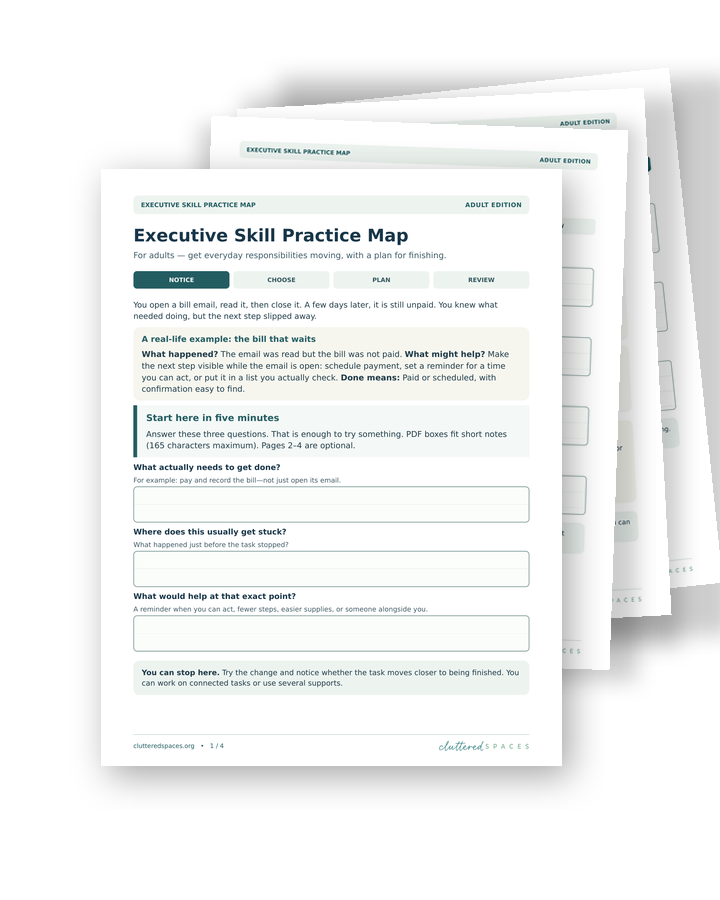
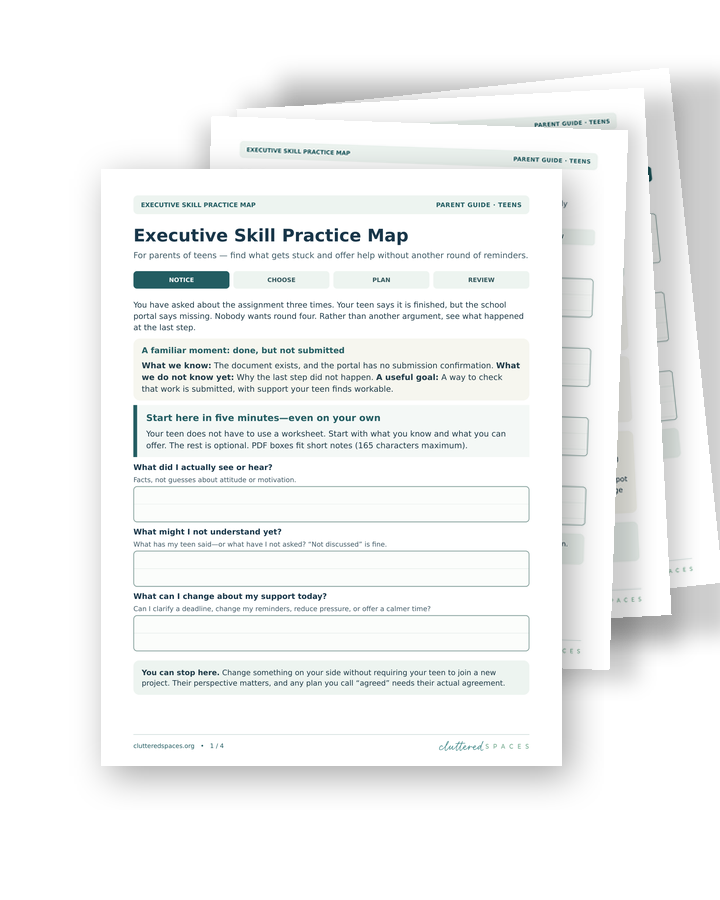
You know what needs to happen. Why does it keep getting stuck?
The unfinished tasks. The reminders that aren’t working. The plans that fall apart despite real effort.
The free Practice Map helps you notice where things get stuck, choose practical supports, and try a different approach. Choose the version that fits you.
Match the support to the part that gets hard
The same unfinished chore can need different help on different days. Use the examples below as possibilities to test, rather than a checklist of things you should already be doing.
When the next step disappears
You begin making dinner, answer a question, and return to the counter with no idea which ingredient you measured. Or a form goes into a drawer and stops existing in your day until someone asks for it.
Try keeping the current step visible: a recipe marker, a short list beside the supplies, or one clearly labeled place for papers needing action. Keep that place small enough that it can still tell you something. An entire counter cannot remind you of everything equally well.
Our article on working memory and clutter explores why visible reminders can feel necessary—and how to make them more usable.
When starting feels bigger than the task
“Clean the kitchen” leaves a lot undecided. Does it include the refrigerator? The lunch containers? Whatever is happening behind the toaster?
Try naming one physical beginning: put the plates into the dishwasher, or clear the space needed to prepare lunch. Agree with yourself about where this attempt stops.
Sometimes the barrier includes a feeling: uncertainty about a bill, embarrassment about replying late, or fear that you will do the task badly. In Why We Procrastinate Even When We Care, we explore that emotional friction. A smaller step might be opening the message to find out what is being asked, without promising an immediate answer.
When stopping one thing is the difficult part
You want to leave on time. You also want to finish the thing you are doing. A reminder to “get ready” arrives, but the unfinished task still has your attention.
Try creating a stopping place before the transition: save the document, write the next sentence you intend to work on, or leave a note saying where to resume. Then make the first action of the next task visible, such as putting on shoes.
When Your Brain Isn’t Ready to Switch Gears offers more transition supports for children, teens, and adults.
When something else keeps winning your attention
You reach for the phone while waiting for a page to load, then lose the task you were doing. Or an urgent feeling pushes you toward a purchase before you have considered the plan for your money.
A support worth testing is distance or delay: park the phone beyond easy reach for one short task, or save an item to a list and choose when to review it. If a feeling is driving the moment, pause long enough to name it before choosing what to do next.
For families with teens, our impulse-control guide and PAUSE resources explain how to practice that moment with support. Discuss the plan together rather than introducing it only during conflict.
When time stays vague until it becomes urgent
Getting out the door includes more than the drive. There is also finding the bag, using the bathroom, gathering the return, and remembering that shoes are part of the arrangement.
Time one familiar routine once, then use that information to choose a starting cue. Label the reminder with the action—“shoes and bag”—so you do not have to interpret an unexplained alarm.
Our guide to time blindness and household tasks explores ways to make time easier to see.
When the environment adds work
A system can demand a decision at every turn. Which container? Which category? Where does the container go? What has to move before you can reach it?
Try reducing one repeated obstacle: a hook where the bag lands, a broad category for everyday clothes, or supplies beside the task. If the physical setup is the main barrier, begin with ADHD-friendly home organization systems. A better-fitting environment can reduce how much you have to remember and coordinate.
Build a routine with a way back in
A routine needs somewhere to resume after a late meeting, a sick child, or an ordinary Tuesday that got away from you.
For meals, you might keep one familiar, low-effort dinner available for evenings when the original plan is too much. For laundry, your next useful action might be washing the clothes needed tomorrow. For paperwork, it might be finding the nearest deadline before sorting the whole pile.
Choose the essential outcome first. A smaller routine still needs to protect safety and basic needs; it can let optional tidying wait. Our minimum-version routines guide helps you define what counts as enough for a harder day.
Then name the return point. “At the next evening reset, I’ll check tomorrow’s essentials” is easier to use than “I’ll catch up on everything.” Building household routines when consistency is difficult goes further into cues and repeatable steps.
Stress and insufficient sleep can affect executive functioning. A routine that becomes harder during a demanding stretch may need less load or more support. Repeating the same plan with greater determination is not the only option.
Share the responsibility for making the plan work
If you live with other people, decide together who will notice the task, do it or arrange help, and check that the essential outcome happened. Otherwise, a chore chart can leave one person doing all the remembering behind the scenes.
Keep the agreement concrete: “You’ll check the lunch supplies after dinner. If we’re missing something, add it to the shared list.” Agree on what support is welcome and what happens when the task is missed.
Our guide to sharing household responsibilities in a neurodivergent family helps make that less visible work explicit. For teens, helping without taking over explores how support can leave room for growing ownership.
Needing a list, a reminder, or another person beside you does not make the accomplishment less yours. Supports can remain part of an independent life. Adjust them according to usefulness and the person’s goals, rather than removing them to prove a point.
What progress can look like
You may still have laundry in a basket. But now you can find the clothes you need. The paperwork may still take effort, but you know where to begin and who can help. A missed day may lead to a restart instead of abandoning the plan.
Adults can continue learning practical skills, and supportive environments matter. That does not mean one exercise will improve every executive function or remove ADHD. Look for changes in the task you are actually practicing: less searching, an easier beginning, fewer repeated decisions, or a clearer way to return.
At Cluttered Spaces, we work alongside people to understand those sticking points, adjust the environment, and practice a workable approach. The support might include planning a routine together, arranging supplies where they are used, or trying the first steps side by side. Coaching and implementation can complement clinical care; they do not diagnose or treat ADHD.
For a closer look at planning and practicing in the actual household, explore our guide to home function coaching.
Start with the part of home that keeps asking more of you than you can reliably give. What is one thing that would make the next attempt easier?
If you would like a place to capture that experiment, request the Executive Skill Practice Map through the practice guide.
For a closer look at related points of friction, read Movement Helps ADHD—but First You Have to Get Started, Decision Fatigue at Home, Why Starting Household Tasks Can Feel So Hard With ADHD, When Not Trying Feels Safer and Why Am I Avoiding This?.
For related examples, read ADHD and Anxiety in Adults: When Everyday Life Feels Like Too Much and When Trust Gets Broken: Repair, Boundaries, and ADHD.
For educational purposes only. Not a substitute for professional medical or mental health advice.
References
Diamond, A. (2013). Executive functions. Annual Review of Psychology, 64, 135–168. Overview of core executive functions, their interrelationships, and the effects of stress and sleep on performance.
National Institute of Mental Health. (2024). Attention-Deficit/Hyperactivity Disorder: What You Need to Know. ADHD symptoms, assessment, and practical supports; distinguishes ADHD from other possible causes of similar difficulties.
Center on the Developing Child at Harvard University. A Guide to Executive Function. Overview of executive function and developmental supports.
Center on the Developing Child at Harvard University. (2017). Building the Skills Adults Need for Life: A Guide for Practitioners. Adult skill development and the importance of supportive environments.