
It Was Important—Then It Became a Requirement. Now I Can’t Start.
The email has been sitting there for three days. You know the answer. You may even have rehearsed it in the shower. Then someone asks, “Have you replied yet?” and the small window you had for doing it slams shut. Now you are annoyed with them, annoyed with yourself, and still staring at the email. That’s one way demand avoidance in adults can show up: the task matters to you, but the pressure around it makes starting harder.

If you have lived this scene, you know it can sound absurd when you describe it out loud. You wanted to do the thing. Why did being reminded make it harder? Sometimes the reminder adds pressure. Sometimes the task was already hard to start, and the reminder simply shines a bright light on it. Either way, “just do it” tells you very little about what would help. When the next action is still unclear, REAP can help you clarify what is being asked and choose a workable next step without someone else taking over the plan.
There is more than one reason a demand gets stuck
Demand avoidance is an everyday description, not a diagnosis. The “demand” may come from another person, a deadline, or your own list. You might put off the email because the first step is fuzzy, because you dread the response, because switching tasks is hard, or because someone choosing the timing for you makes your shoulders rise. A hobby can even become strangely difficult once your brain files it under Things I Am Supposed To Do.
For some people the resistance is persistent and intense across many ordinary demands, including things they genuinely want to do. PDA, or pathological demand avoidance, is one proposed name for that pattern, most often discussed in relation to autism. Some people prefer “persistent drive for autonomy,” because “pathological” sounds like a judgment. The label can be useful to someone who recognizes their experience in it. It does not explain every delayed task, or every neurodivergent person.
PDA is not a standalone diagnosis in the DSM or ICD, and researchers have not agreed on a reliable way to identify it as a distinct condition. That uncertainty deserves honesty, not dismissal. Demand avoidance is real as an experience, while its sources may include executive function difficulty, anxiety, uncertainty, sensory strain, burnout, past experiences, and the way a request is made. More than one can be true at once.
The invisible work inside a simple task
Let’s go back to the email. Replying may mean finding the message, deciding what to say, tolerating a possible follow-up, and switching away from what you were doing. Starting, holding steps in mind, and changing course all draw on executive function. People with ADHD may run into friction at those steps and put off a task even when they care about it. If a reminder then makes you feel watched or rushed, that can be another layer; it does not turn ordinary ADHD-related avoidance into PDA.
The pattern matters more than guessing from one unfinished email. Do you resist many ordinary requests because they feel imposed, including enjoyable plans? Or is the trouble concentrated in long, unclear, boring, or emotionally loaded tasks? Our guide to executive function in everyday life looks more closely at the mental work behind familiar tasks. If your pattern feels more like getting stuck before you begin, you may also recognize yourself in why tasks can feel impossible to start.
You might be able to write the reply but not while someone stands over you. You might be fine with the timing but unsure what the first sentence should say. Those are different problems, and they deserve different supports. You are not required to solve the label before making the task easier.
Give the question somewhere to land
If you have an email-shaped problem of your own, the guided journal pages let you follow one moment of resistance on paper. They borrow the curious part of the Five Whys: what changed, what part got hard, and what might be underneath that? You can stop as soon as you learn something useful. The two guided journal pages include a shorter version for a tired day, in printable and digital formats delivered by email.
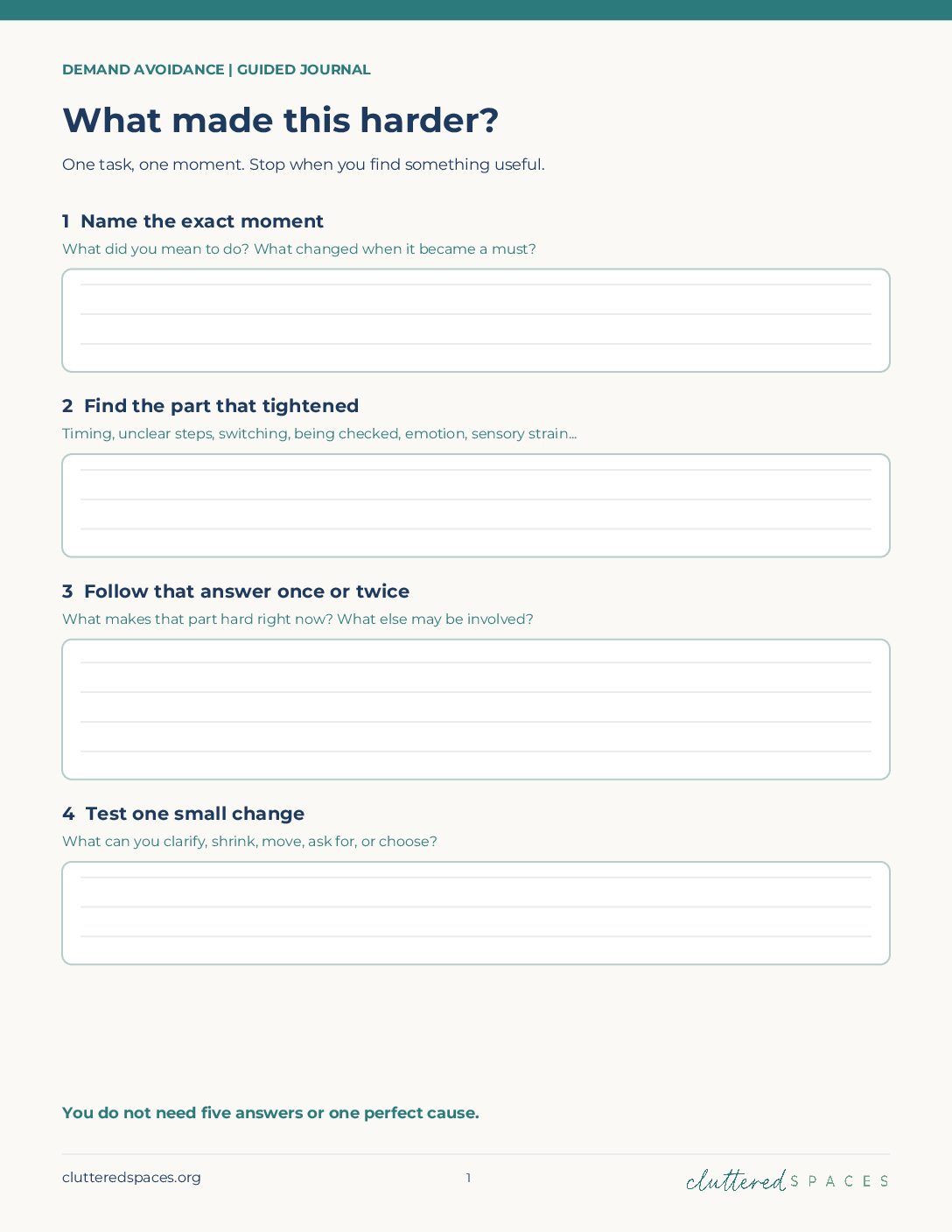
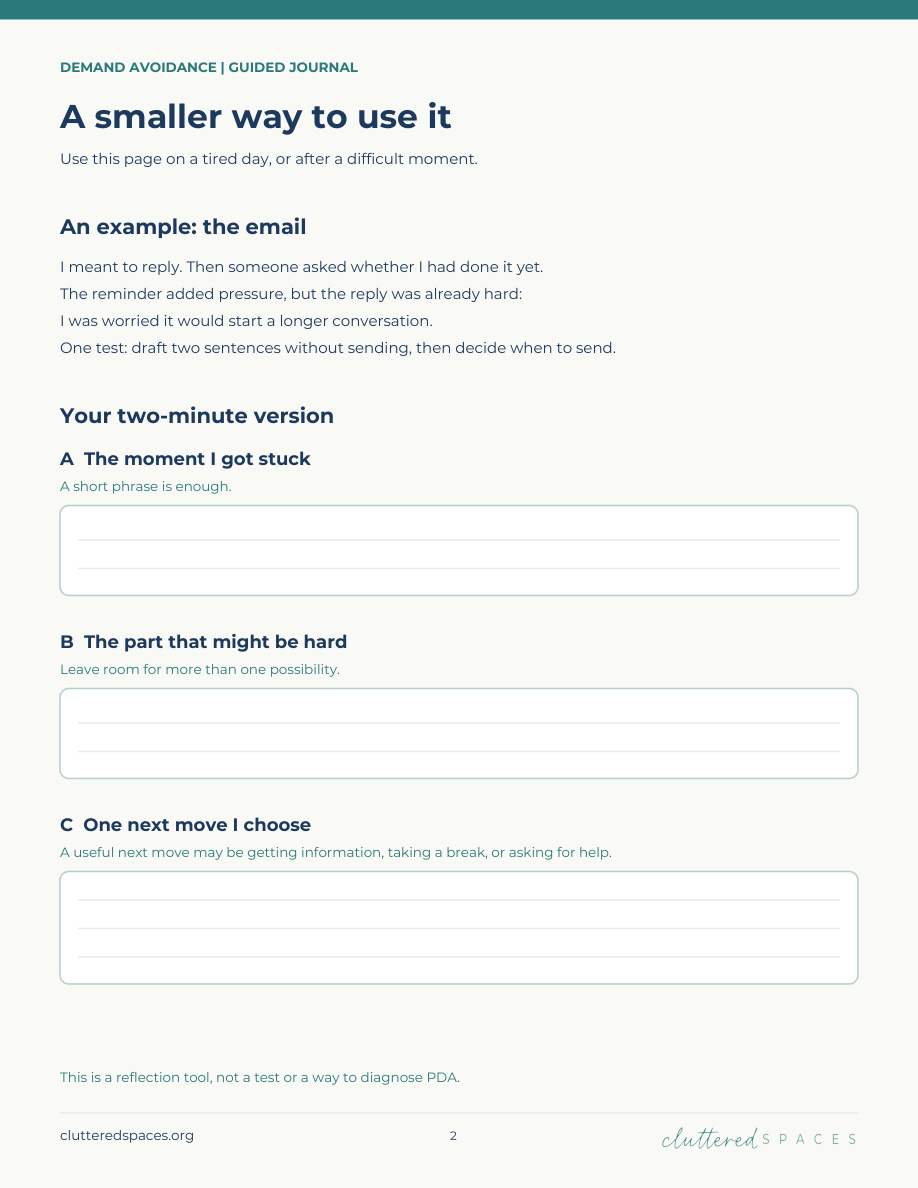
Find what made the task harder. These two guided journal pages help you notice what changed when the task became a must, then choose something to try. Use the shorter page if that fits today. Enter your email for the free printable and digital versions.
You’ll also receive Cluttered Spaces emails. Unsubscribe anytime.
A small experiment in getting some room back
The next time you notice yourself resisting, pause before making a new rule for yourself. What got tight: the timing, the wording, the number of steps, the possibility of being judged, or the sense that you cannot change your mind? You can be curious without conducting a full investigation while the laundry waits. One useful observation is enough.
If you need a quicker first pass, the NEST Avoidance Reset can help you notice the detour, explore the feeling, separate facts from predictions, and take one small step. Its printable chart and phone card are free direct downloads. See the NEST Avoidance Reset.
Match the change to the snag. If the task is unclear, write the first sentence or ask what the form means. If starting is hard, put the materials in reach and try two minutes with no promise to finish. If the pressure of being directed is the hard part, see whether you can reclaim a real choice: call or use the online form, begin now or after dinner. The obligation may remain. A choice about how to meet it can still matter.
You can also remove some of the work around the task: put the form where you can see it, write the first sentence in a note, or ask someone to send the information once instead of checking repeatedly. Try one change, then notice whether it helped. Our article on shifting between tasks may help if transitions are the hardest part; a minimum-version routine can give you a way back when the full plan is too much.
You deserve support that fits the problem
If avoidance is affecting eating, hygiene, work, relationships, or needed medical care, bring a few specific examples to a qualified clinician. They can consider ADHD, autism, anxiety, trauma, burnout, health, and your environment without requiring one label to explain everything. Coaching can help with practical task design and practice alongside clinical care when that is useful.
The email may still need an answer. You deserve to find out what is actually blocking it, then try a way forward that fits that problem and still leaves your hand on the steering wheel.
If you want to put this into words before trying another reminder or rule, the guided journal pages are there for one small, honest pass. Get the printable and digital pages by email.
Suggested next step: Explore Executive Function Coaching for practical help with the stuck points in everyday tasks and routines.
References
Company, D., & Rotella, J. A. (2026). A systematic review of pathological demand avoidance.
White, R., et al. (2022). Trait autism, anxiety, and extreme demand avoidance in adults.
Kenny, N., & Doyle, A. (2024). Lived experience of adults experiencing PDA.
Suriano, R. (2026). ADHD and procrastination: A systematic review.