Why Can My Teen Focus on Video Games but Not Schoolwork?
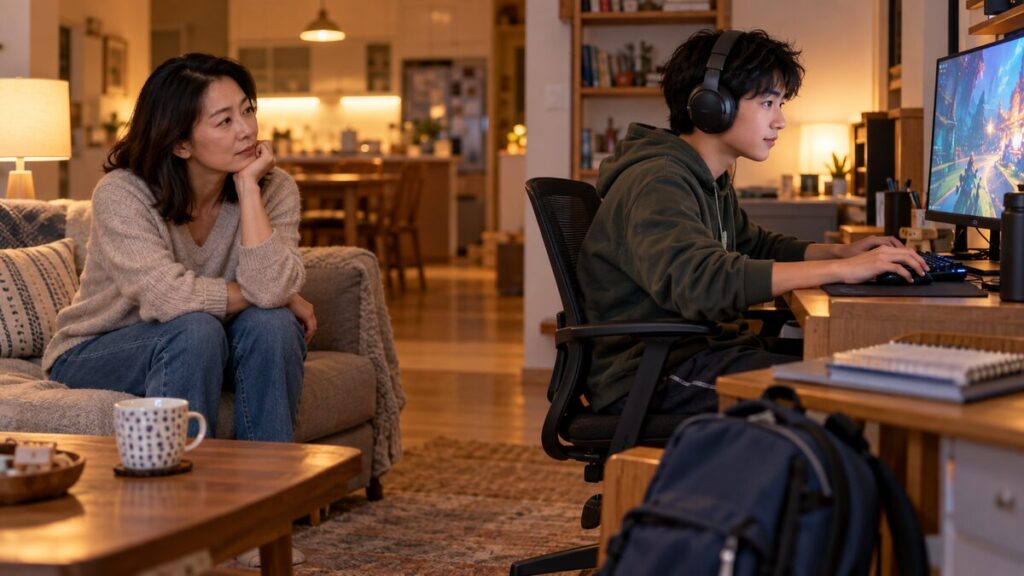
A teen can spend an hour learning a complicated game, remember dozens of rules, recover after losing, and stay intensely focused. Then a ten-minute homework assignment appears, and everything stalls.
From the outside, this can look like a choice: If you can focus on a game, you can focus on school. But that conclusion overlooks how differently the two activities are designed.
Games and schoolwork can draw on overlapping executive-function skills while placing different demands on them. Games may provide visible goals and feedback; an assignment may ask the student to organize more of the process. Interest, familiarity, and the kind of challenge matter too.
Executive function is not an on-off switch
Executive function helps us hold information in mind, resist distractions, shift strategies, plan actions, and stay with a goal. These skills are involved in gaming and academic work. They are also sensitive to context.
A student may use executive-function skills successfully when the goal is visible, feedback is immediate, and the next action is clear. The same student may struggle when instructions are scattered, the reward is distant, and several invisible planning steps must happen before the academic work even begins.
Performance in one setting does not automatically transfer to another setting with different demands and supports.
What makes the game easier to stay with?
Structure is part of the explanation, but it is not the whole story. Your teen may enjoy the game, know it well, feel capable playing it, or be spending time with friends. An assignment may feel unfamiliar, confusing, or discouraging before they start. Games and schoolwork vary; neither tells us everything about what your teen can manage.
At a calm moment, ask your teen to show you how they know what to do next in a game they enjoy. You might notice a visible goal, a chance to practice, or feedback that arrives while it can still help. Let them explain what matters to them without turning the conversation into a test.
For a closer look at the steps an assignment asks a student to manage, see how to make the work around homework visible.
What gaming focus does not prove
Gaming focus does not prove that a student is lazy, oppositional, or capable of directing attention the same way in every setting. It also does not mean that every game is beneficial or that limits are never needed.
It tells us that this student can engage deeply under certain conditions. That is useful information. Instead of using gaming as evidence against the student, we can study the conditions that make engagement more accessible.
Turn what you notice into something useful
Look at an actual assignment together. You do not need to redesign the evening before trying something that helps.
- Starting: If “work on history” leaves your teen staring at the screen, find the instructions together and identify the required output. Their first action might be opening the document and writing a heading.
- Remembering: If directions disappear when they switch tabs, keep the relevant instructions beside the work. Let the page hold the information instead of asking your teen to remember it all.
- Returning attention: Agree on a manageable work period and a break. Before the break, leave a note such as “Next: find evidence for paragraph two.”
- Getting unstuck: Decide where help will come from. A teacher’s example, a tutor, or a specific question can be more useful than another reminder to keep going.
- Finishing: Include saving, submitting, and checking confirmation in the plan. If the work is finished but the gradebook says zero, check what happened between completion and credit.
Use the supports that fit the problem. Sometimes a visible first step is enough; sometimes your teen needs directions, a check-in, and help with the material. If the conversation keeps returning to whether they care, look beyond the argument about trying harder.
And how do we get from the game to the homework?
Understanding the difference does not make that transition disappear. Before play begins, agree on a stopping point that fits the game and the time available, a cue your teen will notice, and what happens afterward. A game with long rounds may not fit a short break.
For example, your teen might finish the agreed round, get a snack, and come back to the history instructions already open on the table. If the plan keeps running late, revisit the timing together. Our guide to switching between activities explores this transition in more detail.
For the wider picture of schoolwork, transitions, and family support, explore our teen executive function guide.
You can keep reasonable boundaries around gaming while becoming more curious about what helps your teen begin schoolwork. If you are carrying every reminder, plan how to share the work of managing homework.
For educational purposes only. Not a substitute for professional medical or mental health advice.
References & Further Reading
Center on the Developing Child at Harvard University. A Guide to Executive Function.
Centers for Disease Control and Prevention. ADHD in the Classroom: Helping Children Succeed in School. https://www.cdc.gov/adhd/treatment/classroom.html
Center on the Developing Child at Harvard University. (2019). How to Motivate Children: Science-Based Approaches for Parents, Caregivers, and Teachers.
Diamond, A. Executive Functions. Annual Review of Psychology. https://pmc.ncbi.nlm.nih.gov/articles/PMC4084861/