
A System Isn’t Successful If It Only Works While Help Is There
A room can look completely transformed on Friday and begin sliding back by Monday. A new routine can make perfect sense while a coach, organizer, parent, or caregiver is standing beside you—then disappear the first time the week gets busy.
That does not automatically mean the person failed. It may mean the system was never designed for the person who had to live with it.
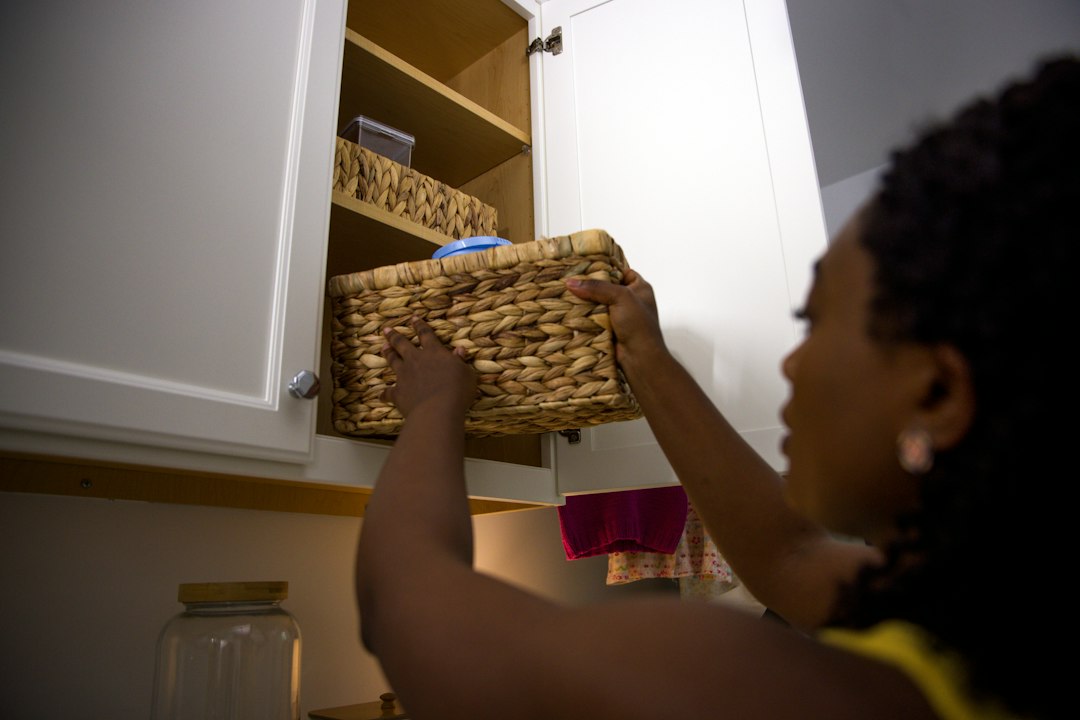
A helper may be able to remember every category, make decisions quickly, notice what needs attention, and complete all the hidden steps without thinking about them. The client may be managing working-memory demands, decision fatigue, limited energy, sensory discomfort, physical access needs, competing responsibilities, or uncertainty about where to begin.
When help makes a routine work, name what that help provides: remembering, beginning, decisions, physical assistance, or follow-through. Plan how that support will remain available or what will replace it if circumstances change.
The essential question: How will this keep working with the support that will realistically be available?
A Finished Project and a Sustainable System Are Not the Same Thing
Finishing the project matters. A cleared counter, a working laundry area, or a visible school-preparation station can create immediate relief. But the finished result is only one part of the work.
The next question is whether the person can use the result during an ordinary week—not an ideal week. Can they tell where things belong? Can they begin the routine without someone narrating every step? Can they complete enough of it on a low-capacity day? Do they know what to do when the routine breaks?
Sustainable functioning is not the same as permanent tidiness or perfect consistency. It is the ability to use a system, notice when it is no longer working, make an adjustment, and return after disruption.
Why Good Systems Still Fail
Many systems are designed around what should happen rather than what actually happens. They assume the person will remember, notice, decide, initiate, sequence, and finish at the right time. Those are executive-function demands, even when the task itself looks simple.
A labeled bin does not solve the problem if it is too far from where the item is used. A morning checklist does not help if no one sees it during the morning transition. A weekly reset may be too large to begin after a demanding day. A storage system may be beautifully organized but require more sorting decisions than the household can reliably make.
When a system stalls, the difficulty is information. It shows us where the design is asking for more memory, activation, flexibility, time, movement, or decision-making than is available.
The answer is not automatically more reminders or more effort. The first move is curiosity: What part of the system is the helper currently doing that the environment, routine, or support plan needs to carry?
Five Tests for a System That Can Survive Real Life
1. Can the person understand it?
The system should make sense to the person using it. Categories, labels, steps, and standards need to reflect their language and priorities—not only the helper’s logic. Check understanding in a way that fits the person’s communication. Showing a step, using pictures, or trying it with support may tell you more than asking for a verbal explanation.
2. Can the person begin it?
A routine needs a cue the person can notice and a first action they can take. Cues may be visual, auditory, tactile, or provided by another person. “Keep the kitchen clean” is vague. “After dinner, put food away and load dishes for ten minutes” gives the brain a starting point and a stopping point.
3. Can the person complete enough of it?
A system needs both a full version and a minimum version. The minimum version protects the essential function when capacity is low. Laundry might mean completing every load on a good day and making sure wet clothes reach the dryer on a difficult day. The smaller version is not cheating. It prevents a temporary limitation from becoming a larger problem.
4. Can the person maintain it with their actual support?
Maintenance should reflect the help that will genuinely remain. That may include reminders, shared starts, body doubling, transportation, physical assistance, a family handoff, or scheduled coaching. A plan that quietly assumes this support will disappear is not more independent; it is incomplete.
5. Can the person restart it after disruption?
Every home system will eventually be interrupted by illness, travel, grief, deadlines, caregiving, changing schedules, or a week when capacity is simply lower. A sustainable system includes a return path: what to contain first, what can wait, the smallest useful reset, and when to ask for help.
Support Is Not the Opposite of Independence
The essential question is not “How quickly can we remove every kind of help?” Independence does not mean doing everything alone. It means having meaningful choice, clear ownership, usable supports, and as much control as possible over everyday life.
For some people, support will decrease as the routine becomes more familiar. For others, ongoing assistance is part of the sustainable system. Capacity can also change with stress, disability, illness, grief, sleep, or major transitions. Restoring support when circumstances change is an adjustment—not a failure.
A good handoff makes the support visible and intentional. Who notices that the task is needed? Who begins it? Who completes each part? What happens when one person cannot do their portion? When will the plan be reviewed?
Those questions protect both agency and stability. They prevent a helper from taking over by default, and they prevent the client from being left with responsibilities the system never prepared them to manage.
Design the Handoff From the Beginning
Maintenance should not be discussed only after the space is finished. It should shape the work from the first decision.
• Assess the person, environment, demands, strengths, and points of friction.
• Reset enough of the immediate barrier to create usable space and stability.
• Build the routine or system with the client, using real decisions and real practice.
• Sustain it by simplifying, adjusting, clarifying support, and planning for return.
In Home Function Coaching, the delivery process follows the same logic: Plan, Work, Build, and Hand Off. The handoff is not a final reveal. It is the gradual transfer of decisions, skills, routines, and ownership—with appropriate support still available.
A useful design rule: If a routine depends on help, that help belongs in the plan—including a backup if it becomes unavailable.
Explore our home function coaching guide for a worked example of planning the handoff while doing the work.
Use the “Will This Work in Real Life?” guide
Look at the routines, spaces, and recurring responsibilities you want to make more workable. Include the tasks and people they depend on; daily life rarely happens in isolated pieces. Ask:
• What function are we trying to protect?
• Who will actually use this system?
• What usually makes the task difficult?
• Does the system rely too heavily on memory, noticing, or decision-making?
• Are the tools visible, accessible, and located where the task happens?
• Is the first action obvious?
• Is there a clear definition of done or stopping point?
• Who owns each part, and what support will remain?
• What is the minimum version?
• How will the person restart after disruption?
Try the plan during relevant opportunities in ordinary life. A week may suit daily tasks; less frequent routines need more time. Observe where it becomes easier, where it stalls, what workaround appears, and which support is actually used. Change the parts that need to work together, and note what you changed so you can review what helped. The goal is not to prove that the system works. The goal is to learn what it needs in order to work better.
A Home System Should Be Allowed to Change
People change. Families change. Schedules, health, responsibilities, rooms, and available support change. A once-useful routine may eventually create new friction.
That does not erase the progress that came before it. It means the system is giving new information. Sustainable systems are reviewed, simplified, replaced, or supported when the conditions around them change.
The goal is not to create a perfect home that never needs attention. The goal is to build a more workable home—one where the next step is easier to see, essential functions are protected, support is clear, and there is always a way back in.
For practical storage and routine examples, use our ADHD-friendly home organization guide to adjust the system you are evaluating.
How Cluttered Spaces Helps
Cluttered Spaces works with clients rather than taking over. We combine executive-function coaching, environmental design, daily-living skill development, and hands-on implementation to identify friction and build practical systems in the places where they must actually work.
We do not measure success only by what a room looks like when a session ends. We look at whether the client understands the system, can participate in using it, has the right level of support, and has a realistic plan for maintenance and return.
Our independent living guide shows how to practice a daily routine while deciding which supports should remain.
Our life-transitions guide shows how to adapt support and handoff when household roles or capacity change.
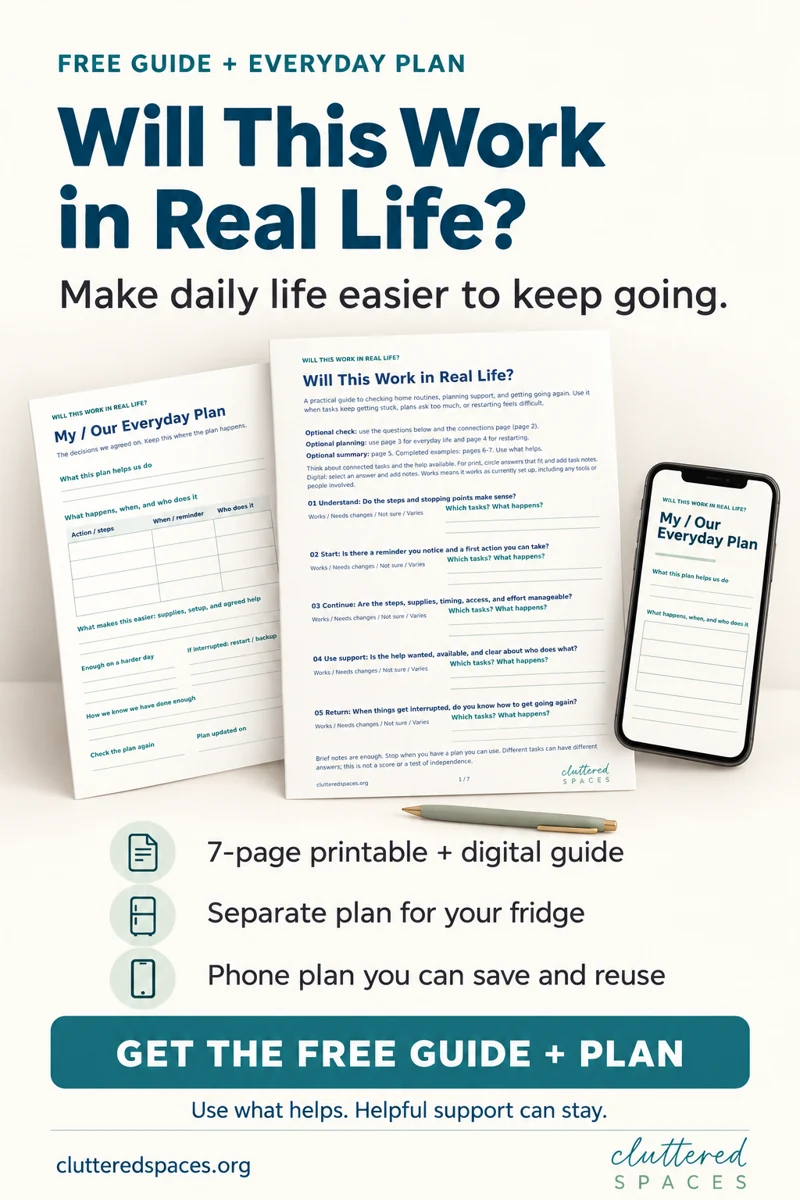
Try “Will This Work in Real Life?”
The printable and digital tool includes five reusable worksheet pages and two completed example pages. Use it for connected routines, spaces, and responsibilities. Start with the pages that help; brief notes are enough.
Page 1: Find a starting point. Use the page guide and five checks. Add notes about which tasks each answer describes. Working systems can include people, tools, and ongoing support.
Page 2: See the connections. Name what you want to be easier, what would change, which tasks depend on each other, where the process becomes difficult, and what already helps.
Page 3: Choose changes that fit. Use practical repair examples. Plan usual and lower-capacity versions, reminders, first actions, responsibilities, agreed help, and stopping points.
Page 4: Make restarting easier. Separate what can wait, where it will wait, and when to revisit it. Plan backups with available help and when nobody else is available. Decide when to check the plan and what would tell you it helped.
Page 5: Keep a usable action summary. Bring together what you are trying, who is involved, when you will try it, and what needs to be ready. A separate section is for reviewing what happened after trying it.
Pages 6-7: See completed examples. Follow sample answers under the same worksheet labels for clothes, lunches, bags, shared responsibilities, and realistic backups.
Request the free guide in printable and digital formats. Requesting the tool also subscribes you to Cluttered Spaces emails. Unsubscribe anytime.
Also included: My / Our Everyday Plan. A separate printable and digital fridge sheet keeps your agreed actions beside their timing and responsible person, with space for supports, harder-day options, and a restart plan. A phone-friendly plan page is also available.
Download the digital PDF and open it in an app that supports PDF forms. Save your entries and reopen the saved copy to check them.
For educational purposes only. Not a substitute for professional medical or mental health advice.
References & Further Reading
Center on the Developing Child at Harvard University. A Guide to Executive Function.
Administration for Community Living. Person-Centered Planning.
Administration for Community Living. Supported Decision Making Program.
This article provides general education and practical coaching guidance. It does not diagnose, treat, or replace medical, mental-health, occupational-therapy, legal, financial, emergency, or other licensed professional services. Individual capacity, access, safety needs, and support requirements vary.