
Your Routine Fell Apart Again. How Do You Start Over?
You create a morning routine, follow it for several days, miss one difficult morning, and then stop using it. The routine may have depended on a specific wake time, full energy, no interruptions, and remembering every step in order. Once one condition changed, there was no way back in.
Consistency is often treated as repeating the same actions every day. A more durable goal is return: the routine has enough structure to begin, enough flexibility to fit current capacity, and a clear place to restart after disruption.
A routine that can be resumed is more useful than one that works only under ideal conditions. Bedtime is a familiar example: you can intend to sleep earlier and still struggle to stop what you are doing. For that particular transition, explore winding down when you are exhausted but still awake or building a workable evening routine with your teen.

Start with what you need next
Suppose clean clothes are still in the basket and another wash is waiting. You don’t have to put everything away before using the clothes you need tomorrow. Check what is already clean, wash and dry any missing essentials, and agree on help with the transfer if that is where laundry usually stops.
If lunch containers and packed bags are part of the same morning scramble, include them in the plan. Choose when to revisit the postponed work. Getting tomorrow covered can be enough for now.
Make the routine easier to return to
A routine can lower cognitive load by connecting a cue to a small sequence. But a routine can also become another source of pressure if it is vague, too long, hidden, dependent on memory, or designed around a capacity level that is not consistently available.
Executive-function differences can affect noticing the cue, shifting into the routine, remembering steps, estimating time, sustaining effort, and recognizing completion. Household routines also fail when responsibility is unclear or the environment does not support the actions.
A few questions to help the routine hold together
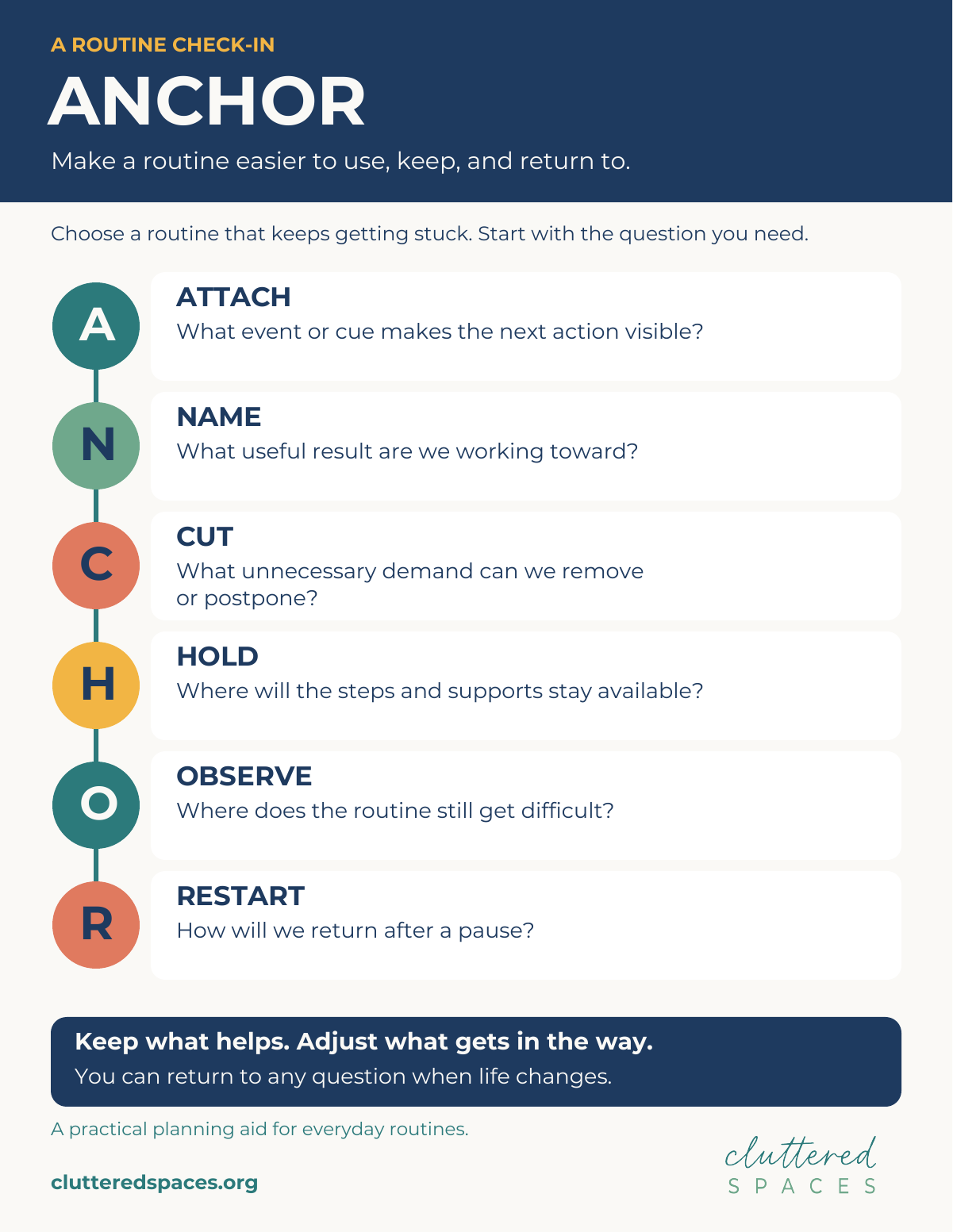
ANCHOR is an optional memory aid for the questions below, not another form you need to complete.
- Attach: What event could remind you—finishing dinner, getting home, or starting coffee?
- Name: What needs to be different when you stop? For the kitchen, that might mean food stored and a usable place to prepare breakfast.
- Cut: What can wait without leaving an essential need uncovered?
- Hold: Where could the steps stay visible—a card, a reminder, prepared supplies, or agreed help?
- Observe: Where does the routine slow down, and what might make that part easier?
- Restart: What will help you return after an interruption?
You can change several connected steps or supports together. Try them where the routine actually happens, then notice what helped.
Build a Minimum Version and a Full Version
The minimum version protects the most important function on a low-capacity day. The full version adds useful actions when time and energy are available. Both versions are legitimate parts of the same routine.
For an evening kitchen routine, the minimum might be refrigerate food, contain dishes, clear one preparation space, and start or soak what is needed. The full version might add wiping appliances, sweeping, preparing breakfast supplies, and taking out recycling.
The smaller version should ask less of you. If it still feels out of reach, check which steps really need doing now and whether a different setup or more help would make them possible.
Examples of Resilient Household Routines
Laundry: Attach the routine to changing clothes or a chosen weekly event. Keep hampers where clothing comes off. Define one load as the unit of work. Use a clean-clothes landing place so the routine can pause without losing function.
Leaving home: Attach preparation to the evening meal or bedtime. Put essential belongings in one launch zone. Use a visible three-item check rather than relying on memory during the morning transition.
Family reset: Use a ten-minute stopping point, defined roles, and a shared anchor. Everyone returns personal items, one person contains dishes, another handles trash, and each person prepares for tomorrow. Stop at the agreed time and notice what improved.
Medication or self-care: Pair the action with an existing cue, keep supplies safely accessible, and use an external confirmation method when appropriate. Medical questions and medication changes belong with a healthcare professional.
Practice Before Expanding
A routine becomes more accessible through use, feedback, and adjustment. Practice it at the time and place where it will happen. If another person is supporting the routine, agree on what help is wanted: a reminder, shared start, model, body double, or physical assistance.
Keep ownership clear. A family routine may be shared; an independent-living routine may include ongoing support. The goal is not to remove help automatically. It is to make the routine and support plan understandable, chosen, and sustainable.
If the routine keeps getting stuck on storage or access, the ADHD-friendly home organization guide can help you adjust the environment around it.
For educational purposes only. Not a substitute for professional medical or mental health advice.
References & Further Reading
CHADD. Organizing the Home and Office Space. https://chadd.org/for-adults/organizing-the-home-and-office-space/
Center on the Developing Child at Harvard University. Executive Function & Self-Regulation. https://developingchild.harvard.edu/resource-guides/guide-executive-function/
National Institute of Mental Health. Attention-Deficit/Hyperactivity Disorder: What You Need to Know. https://www.nimh.nih.gov/health/publications/attention-deficit-hyperactivity-disorder-what-you-need-to-know
American Psychological Association. Why Clutter Stresses Us Out. https://www.apa.org/news/podcasts/speaking-of-psychology/clutter