
Done Is Better Than Perfect. So Why Is It So Hard?
You’ve written the email. The information is there. You’ve checked the name, attached the document, and read it through. Then you change the opening sentence. Read it again. Wonder whether you sound demanding. Change it back.

Twenty minutes later, the email is still sitting there. You’re tired, and what looked like a small task has taken over your afternoon.
“Done is better than perfect” sounds reasonable. You might even say it to other people. But when it’s your turn to press send, hand something in, or let someone see your work, the words don’t necessarily help.
For some people, perfectionism carries a quiet promise: If I get this right enough, maybe I can avoid criticism, embarrassment, or letting someone down. Finishing means giving up some control over what happens next. That can feel risky.
When getting it right starts to feel like protection
Wanting to do something well can be satisfying. You care about the result, put thought into it, and learn as you go.
Perfectionism can become painful when the result seems to say something much bigger about you. An awkward sentence becomes “They’ll think I’m incompetent.” An untidy room becomes “They’ll see that I can’t manage my life.” A correction becomes “I should have known better.”
Now the task has two jobs: accomplish something useful and protect you from being judged. The second job has no reliable finish line. There is always another sentence to adjust or another possible reaction to prepare for.
There’s a difference between wanting a good result and feeling unable to risk a less-than-perfect one. Research makes a similar distinction: concern about mistakes and falling short is associated with more procrastination. High standards alone don’t show the same pattern.
You might be trying to protect your place in a relationship, your reputation at work, or the feeling that people can count on you. That’s what safety means here. People arrive at perfectionism for different reasons; fear of getting something wrong is one part worth noticing.
Why this may feel familiar when you’re neurodivergent
Perhaps you’ve been told, “You’re so capable. Why did you miss that?” Or someone has treated a forgotten step, a processing delay, or a misunderstood instruction as evidence that you didn’t care.
If those experiences are familiar, you may find yourself trying to leave no room for another misunderstanding. You rehearse the conversation. Check the work repeatedly. Delay asking a question until you can phrase it perfectly. The effort can make sense in the context of what you’ve experienced, even when it leaves you exhausted.
Some autistic adults describe masking—hiding or compensating for autistic characteristics to navigate social expectations. Research documents both the desire for connection and the effort this can require. Camouflaging and perfectionism are distinct, but someone may experience pressure to monitor both their work and how they come across.
You can also enjoy detail, care about precision, or need predictable expectations without being afraid of judgment. Those preferences deserve respect. A useful place to get curious is when your approach leaves you unable to begin, finish, or move on after a mistake. Neurodivergent people have different experiences; this pattern won’t fit everyone.
When everyday difficulty starts to feel like a personal verdict, our article on shame and everyday struggles looks more closely at that experience.
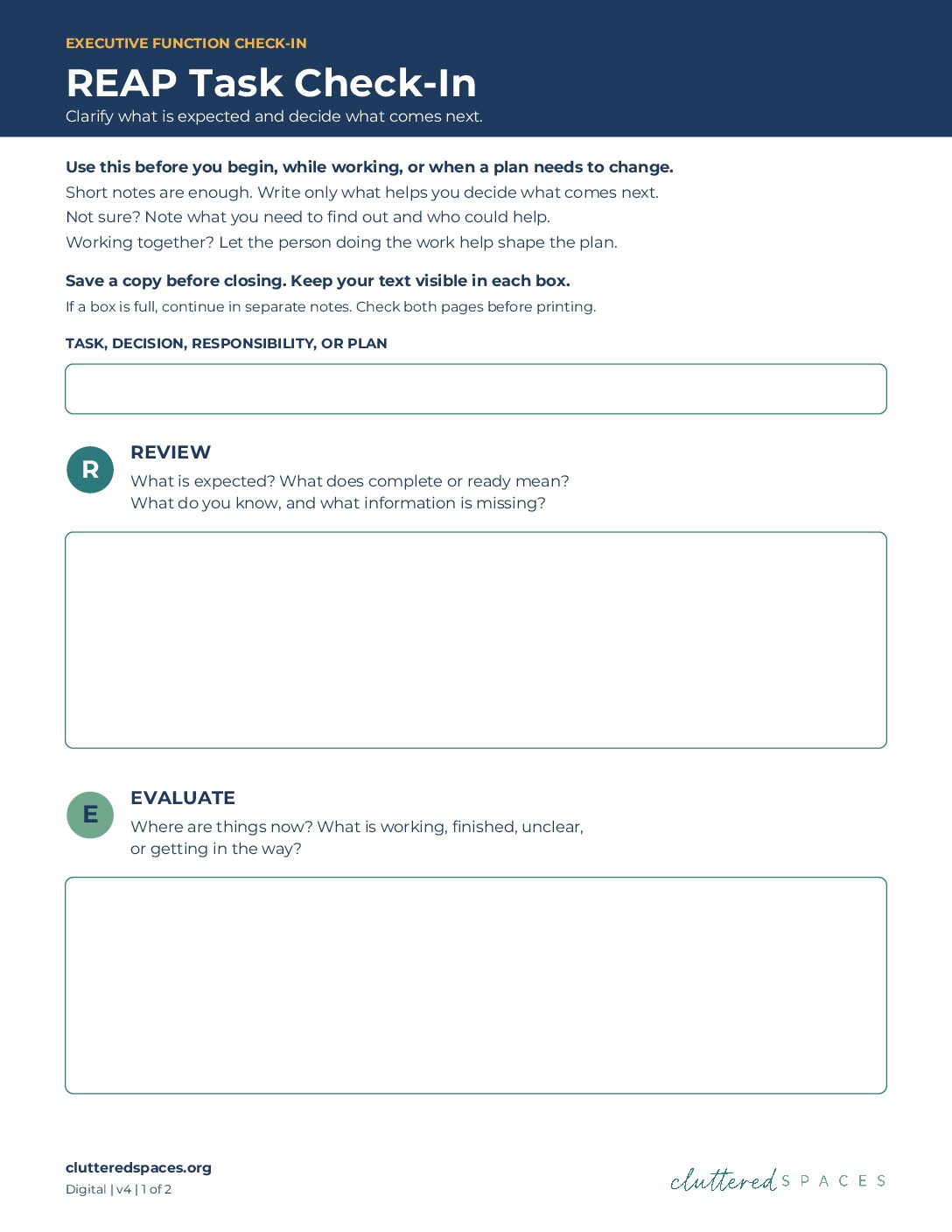
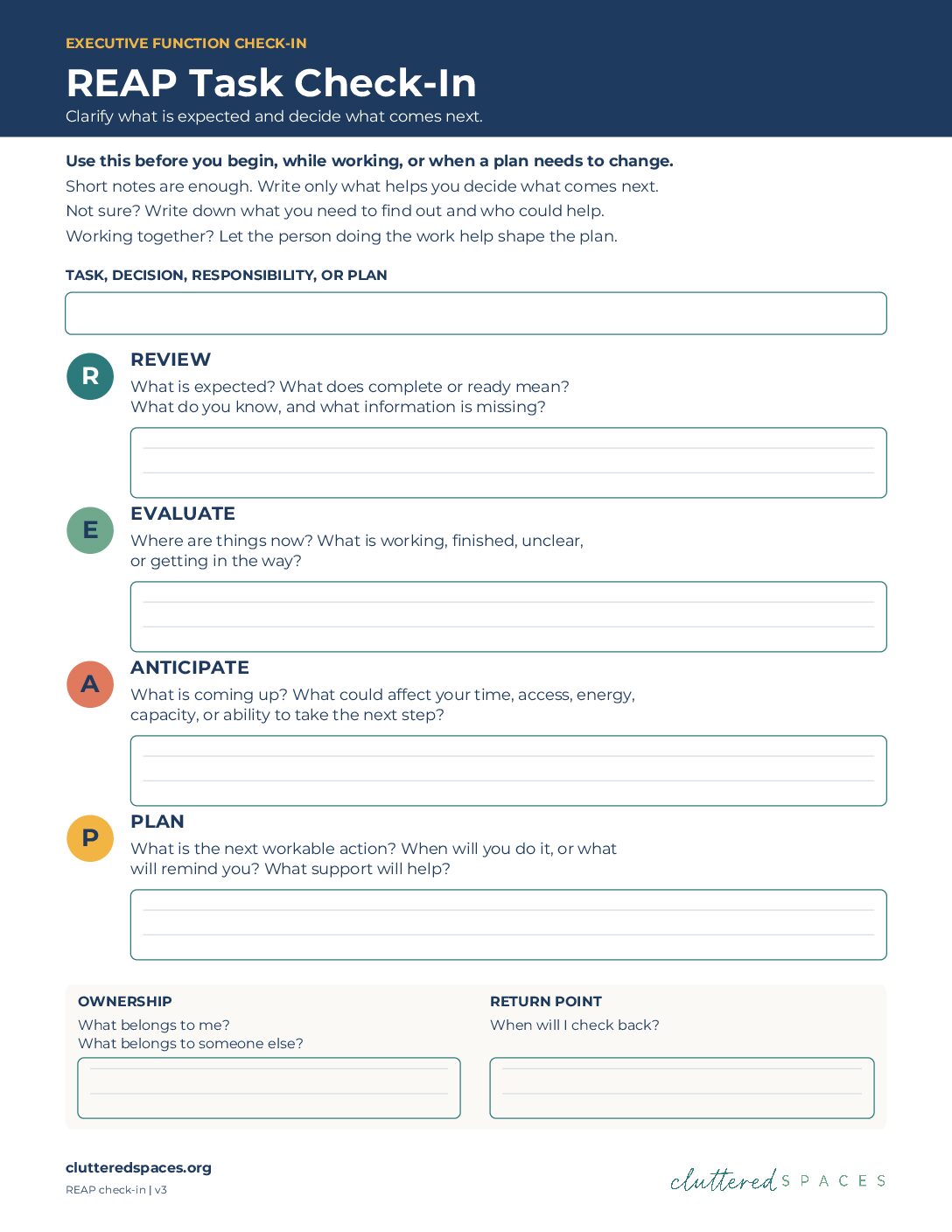
If you’d like somewhere to put the circling thoughts, the REAP Task Check-In can help you name what the task needs and what comes next. It comes as a one-page printable PDF and a two-page digital PDF for typing. There’s an email example below. Short notes—or talking through a useful prompt—are enough.
A task can be finished and still not feel finished
You may have completed the work without reaching the feeling you hoped would arrive: certainty that it’s good enough and nobody will be disappointed.
That feeling may keep moving. You fix the paragraph and notice the heading. You organize the drawer and decide the labels need replacing. The email has now undergone more revisions than the meeting it is arranging.
Meanwhile, finishing has practical demands of its own: deciding which details matter, shifting from editing to submitting, and remembering the final step. If those parts are difficult, another round of polishing can be easier to enter than the unfamiliar act of stopping. Our executive function overview explains why knowing what to do and carrying it through can require different supports.
Perfectionism can also look like not beginning. If the only acceptable outcome feels far beyond today’s capacity, avoiding the task may offer temporary relief. When Not Trying Feels Safer explores that related pattern. Here, the question is how to reach a useful stopping point without waiting to feel completely certain.
Give “done” a job you can actually recognize
“Good enough” is hard to use when nobody has said what enough means. Try defining the task by its purpose before you begin, or when you notice yourself circling.
For an email arranging a meeting, done might mean: the request is clear, the date is correct, the attachment is included, and the message is sent. It does not have to express every possible nuance of your personality.
For putting away laundry, done might mean clean clothes are in places where you can find and use them. Matching folds may matter less than having clothes available tomorrow.
For a school assignment, use the actual directions or rubric. Done includes meeting the requirements and confirming submission. If the directions are unclear, clarification or an accommodation may be the next step.
The standard should fit the consequences. Medication instructions, food safety, and other high-stakes tasks need their required checks. “Done is better than perfect” is useful when extra polishing has stopped helping the task do its job.
Use REAP when you’re going around again
Choose a task with modest consequences that you already know how to do. The REAP Task Check-In gives you four places to look: Review, Evaluate, Anticipate, and Plan. It helps you decide what to do next; it cannot promise that nobody will criticize the result.
For the email you keep rewriting, it might look like this:
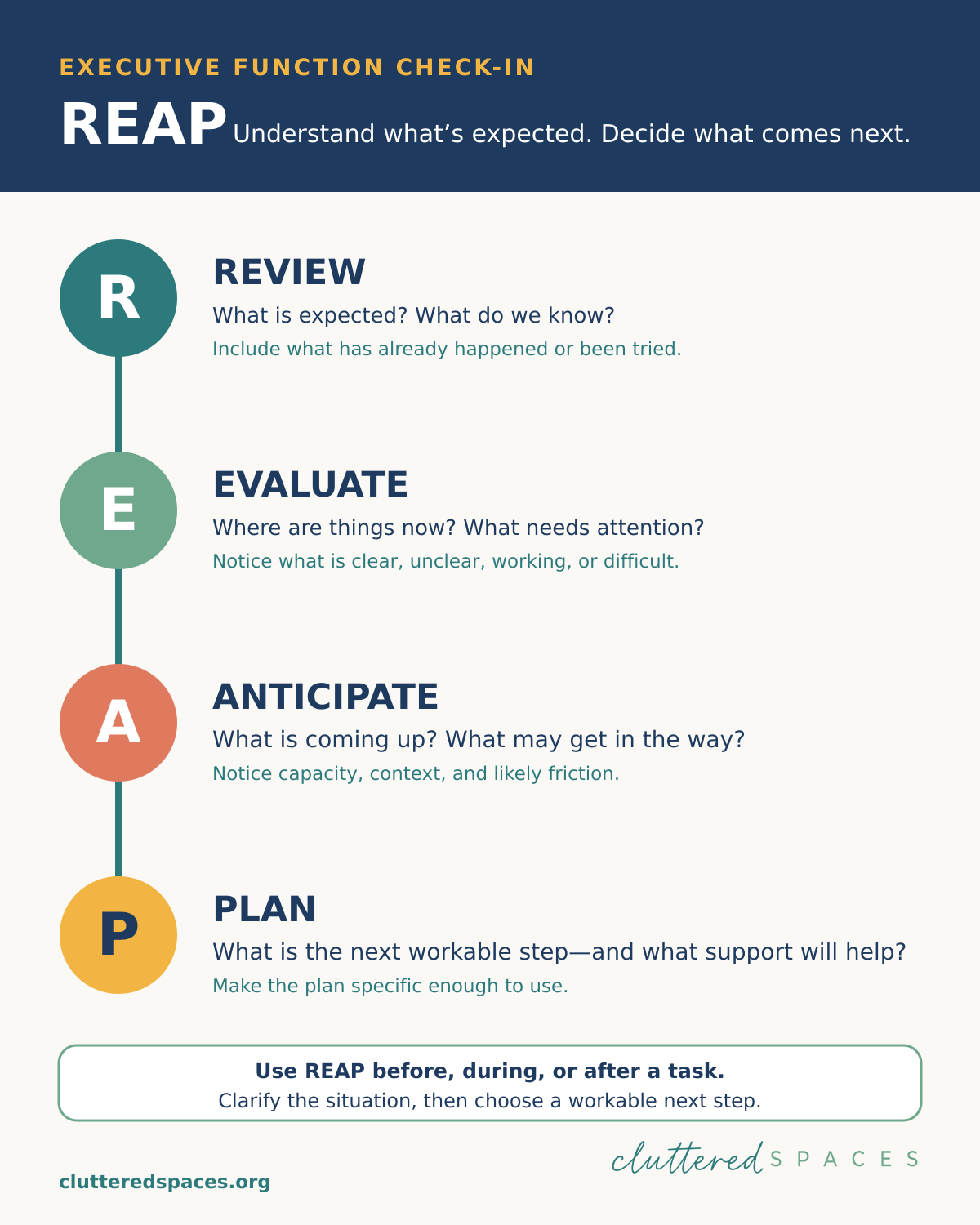
R — Review: What does this need to do?
“I need to ask about a meeting. The date, request, and attachment need to be correct. Complete means sent.”
Agree on the requirements before polishing the presentation. If someone else sets the requirements, ask for clarification rather than trying to guess what will satisfy them.
E — Evaluate: What’s actually unfinished?
“The information is there. I’m rewriting because I worry I sound rude.”
That worry deserves attention. Is the request unclear or unkind, or are you trying to find wording that guarantees a positive reaction? If there’s a real problem, address it. If the message already says what it needs to say, name that too.
A — Anticipate: What might make the next step hard?
“I may want to reopen the draft when I feel unsure. Having my stopping point written down will help.”
Keep this close to the next action. You don’t need to predict every possible misunderstanding. Consider practical barriers too: missing information, an interruption, limited energy, or difficulty switching from editing to sending.
P — Plan: What will help me finish?
“After lunch, I’ll check the details against my short list and send. I can ask someone to sit nearby if that helps.”
Match the checks to the task. A time limit can help contain optional polishing, but it doesn’t replace required checks. The tool’s ownership box can hold a useful distinction: “I’m responsible for a clear, respectful message. I can’t choose the recipient’s reaction.”
Use the return point only when something needs following up: “Check for a reply tomorrow afternoon.” It does not have to mean reopening and inspecting what you’ve already sent. If you discover an actual error, you can address it then.
The check-in can be short, too
You don’t have to fill every box or write polished answers. If Review makes the next step clear, use that information. REAP should help you leave the task, rather than give you another page to get right.
On a low-capacity day, try: “What does this need to do, and what would help me finish that part?” You can say it aloud, ask someone to write with you, or use a few words in the digital version. A smaller agreed scope or a clear request for more time can also be a responsible next step.
Afterward, notice whether the result did its job. You might still feel uneasy. That feeling matters, but it doesn’t automatically mean the work needs more editing. If feedback reveals something missing, you can use it to make a correction.
If you’re helping someone else, keep the finish line still
“Just turn it in” can miss the part that feels risky. Ask, “What are you worried will happen if you submit this?” Then listen before deciding what support would help.
Agree on the requirements together. If you tell a teen that completing and submitting the assignment is the goal, avoid greeting the submitted work with a surprise critique of its presentation. Predictable expectations make your definition of done more trustworthy.
You can acknowledge completion and still address a genuine problem: “You sent it. The attachment didn’t go through, so let’s resend that.” A repair does not need to become a review of the person’s character.
Sometimes the environment needs to change too. Someone facing ridicule, discrimination, or constantly shifting standards needs support with those conditions. Encouragement to tolerate imperfection cannot do that work by itself.
Let the result be useful
A sent email can get an answer. Submitted work can receive feedback. A workable laundry system can get you dressed tomorrow. Completion lets the task serve the purpose you started it for.
You can care deeply and still decide where the work ends. If that feels difficult, begin with a clear standard, a manageable task, and enough support to reach the finish. There is room to learn from what happens next.
If perfectionism or repeated checking causes significant distress or takes over daily life, a qualified mental health professional can help you understand what is happening. Coaching can support task clarity, practical systems, and follow-through alongside that care.
If you’re at the “nearly finished” stage, try the REAP Task Check-In with the task in front of you. Use the printable page for handwritten notes or the two-page digital version for typing. Save a copy of the digital file, and keep answers visible in each box if you plan to print it. You can leave sections blank once you know what comes next.
FREE REAP TASK CHECK-IN
Give “done” a finish line you can use.
Name what the task needs, notice what is actually unfinished, and choose the support that will help you hand it over.
Receive a one-page printable PDF and a two-page digital PDF for typing. Use the email example above to get started. Short notes are enough; stop once your next action is clear.
Enter your email below to receive both PDFs.
Having trouble with the form? Open the signup form in a new tab.

Suggested next step
Recommended service: Executive Function Coaching. If tasks keep getting stuck between nearly finished and handed over, we can work beside you to clarify expectations, support the final steps, and build a way to finish that fits your everyday life.
References
- Shafran, R., Cooper, Z., & Fairburn, C. G. (2002). Clinical perfectionism: A cognitive–behavioural analysis. Behaviour Research and Therapy, 40(7), 773–791. Read the paper summary.
- Sirois, F. M., Molnar, D. S., & Hirsch, J. K. (2017). A meta-analytic and conceptual update on the associations between procrastination and multidimensional perfectionism. European Journal of Personality, 31(2), 137–159. Read the research record.
- Hull, L., et al. (2017). “Putting on My Best Normal”: Social camouflaging in adults with autism spectrum conditions. Journal of Autism and Developmental Disorders, 47, 2519–2534. Read the study.
- For the REAP framework and its source note, see When a Task Is Unclear or Keeps Getting Stuck: Use REAP to Find the Next Step.