
When One Hard Moment Makes Everything Feel Impossible
A gentler way to slow down the story and find your next step
Your friend answers with one word. A teacher writes, See me, on an assignment. Your boss sends, Can we talk tomorrow? A family member sighs while looking at the kitchen.
There may be several possible explanations. Your brain selects one immediately: They are upset with me. I embarrassed myself. I am in trouble. I have failed again.

Now the feeling is real, even though the meaning is not yet confirmed. Your stomach drops. Your face gets hot. You reread the message eleven times, draft a three-paragraph explanation no one requested, or decide never to speak again. A two-word message has become a much larger story before you know what the other person meant.
You can begin with three questions: What do I know? What is my brain adding? What would help next? Say the answers, leave yourself a voice note, or write a few words. The fuller thought check below offers more room when you want it. This practice is often called cognitive restructuring: looking at the meaning you attached to a moment, keeping what is true, and deciding what to do next. You do not have to feel better before choosing that next step.
The Space Between What Happened and What It Means
Most of us do not experience an event as a neat set of facts. We experience the facts and the meaning our brain attaches to them almost at the same time.
- The fact: My friend has not answered for five hours. The meaning: She is angry and does not want me around.
- The fact: I earned a 68 on the test. The meaning: I am not smart enough for this class.
- The fact: The laundry is still on the sofa. The meaning: I cannot manage basic adult responsibilities.
- The fact: My parent asked whether I turned in the assignment. The meaning: They do not trust me and think I am lazy.
Sometimes the interpretation is correct. Sometimes it is partly correct. Sometimes it is the brain filling an uncomfortable gap with the most threatening explanation available. The purpose of a thought check is not to shame the brain for doing that. It is to create enough room to ask whether the first explanation is the only one.
What Cognitive Restructuring Is and Is Not
Cognitive restructuring is a technique commonly used in cognitive behavioral therapy. In plain language, it means noticing an automatic thought, examining the information around it, and creating a more complete thought that you can actually believe.
It is not positive thinking. It is not replacing I failed this test with I am amazing at chemistry when you do not believe that. It is not letting someone debate you out of your feelings. And it is not proof that the problem exists only in your head.
A more complete thought keeps the part that is true without turning one moment into a permanent verdict:
- That grade is disappointing. It shows that something in my preparation, understanding, pacing, or test-taking did not work this time. It does not tell me which one yet.
- My friend may be upset, busy, tired, distracted, or unsure what to say. I do not have enough information to choose among those explanations.
- The kitchen is difficult to use right now. That is a functional problem to address, not a complete description of me.
The goal is accuracy, not optimism. A useful thought leaves space for both the feeling and the next piece of information.
A thought check you can reach for in the moment
Start with one moment. This one-page chart keeps the five steps in view when the first conclusion feels like the whole story.
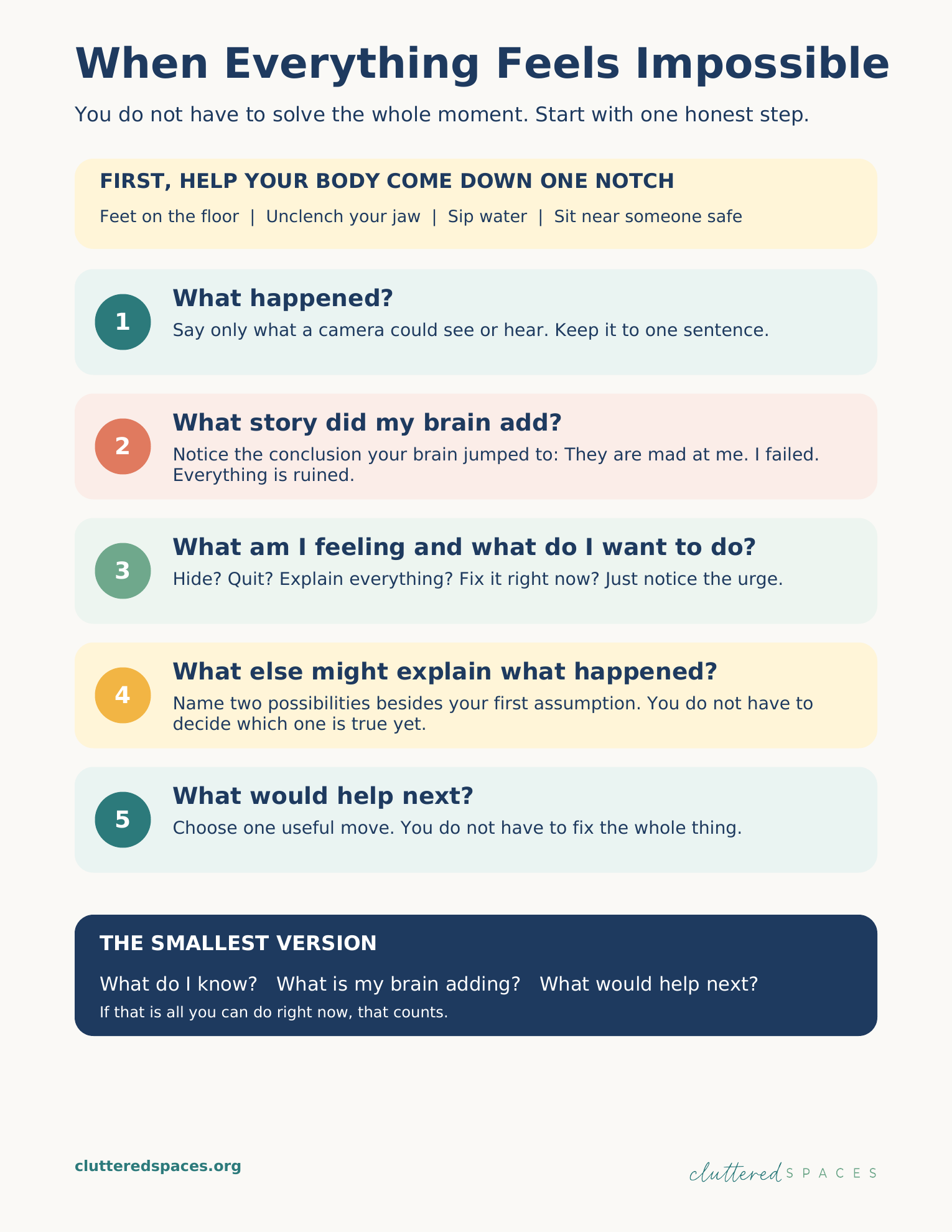
Open the thought-check chart full size · Download the printable chart
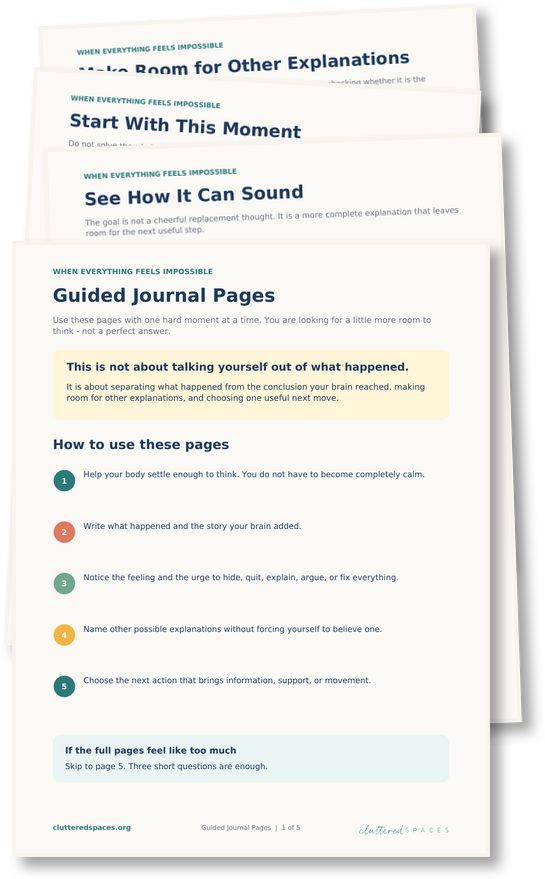
A little more room to work through one hard moment.
The guided journal pages help you name what happened, notice the story your brain added, and choose one useful next step. Use the printable pages to write by hand, or the digital PDF to type your answers.
Enter your email to get the printable and digital guided journal pages.
When Rejection Sensitivity Takes Over the Story
Rejection sensitivity describes an intense response to rejection, criticism, disapproval, or the possibility that one of those things is happening. People may feel sudden shame, sadness, panic, anger, or an urgent need to repair the relationship. The term rejection sensitive dysphoria is widely used, especially in ADHD conversations, but it is not a separate formal diagnosis and the research is still developing.
For a more focused look at this experience, read When Rejection Feels Certain.
The experience can still be powerful. A delayed reply, changed tone, correction, canceled plan, or neutral facial expression may feel less like uncertain information and more like immediate social danger.
That can create protective actions that make sense in the moment:
- Overexplaining before anyone has accused you of anything.
- Apologizing repeatedly to make sure the relationship is safe.
- Becoming defensive because criticism feels unbearable.
- Withdrawing first so the other person cannot reject you.
- People-pleasing, masking, or avoiding situations where you might be evaluated.
Cognitive restructuring does not make the hurt imaginary. It helps ask two different questions: What am I feeling? What do I actually know about what the other person meant? Both questions matter.
If the emotion is at full volume, begin with regulation rather than analysis. Put down the phone. Move your body. Get water. Breathe slowly. Sit beside someone safe. When the alarm system has the microphone, logic rarely wins by speaking louder. The thought check can come after your nervous system has enough room to use it.
For parents, partners, teachers, and coaches, this matters too. Beginning with But that is not what they meant can feel like an argument against the person’s experience. Start with the impact: That landed hard. I can see why you feel hurt. Then, when the person is ready, help look at what is known, what is assumed, and what clarification might help.
When One Grade Becomes a Verdict
School offers a steady stream of evaluation: grades, missing-assignment alerts, teacher comments, rankings, auditions, applications, and public comparisons with classmates. For a student who has struggled with attention, processing speed, working memory, organization, or inconsistent performance, feedback may arrive carrying years of meaning.
A low grade can quickly become I am dumb. A missing assignment can become I have already ruined the semester. A teacher’s request to meet can become I am about to be humiliated. Asking for help can feel like confirming everyone’s worst opinion.
Those conclusions make it harder to look at the assignment long enough to learn from it. Avoidance protects the student from the immediate sting, but it also blocks the information needed to improve the next attempt.
A thought check turns the grade back into data:
- What did I understand and where did I lose points?
- Did I know the material but run out of time?
- Did I misunderstand the directions, forget part of the assignment, rush, or avoid asking a question?
- Is the problem knowledge, planning, initiation, pacing, memory, anxiety, or some combination?
- What support would change the next attempt: office hours, notes, tutoring, a visible plan, an accommodation, or help getting started?
The goal is not to convince a student that grades do not matter. It is to keep one result from becoming an identity statement before anyone has examined what happened. A grade can show that something needs attention without proving that the student is incapable or does not care.
A Five Step Thought Check
Use this when the emotional meaning of a moment begins growing faster than the available facts. One sentence per step is enough.
1. Describe what happened like a camera
Name only what could have been recorded: The message says okay. I received a 68. The teacher asked me to stay after class. There are three unopened envelopes on the table.
2. Catch what your brain decided it means
Write the first conclusion without making it sound more reasonable: They are angry. I am stupid. I am in trouble. I ruin everything. This is the thought you are checking, not a confession.
3. Name the feeling and the protective urge
Notice what happened next. Do you want to hide, explain, quit, argue, fix everything immediately, or ask for reassurance again and again? The urge often tells you what your brain believes is at risk.
4. Build a more complete thought
Ask what you know, what you are predicting, what else could be true, and what information is missing. Keep the true part. A believable thought might be: The grade is real and disappointing. I do not yet know whether the main problem was preparation, understanding, pacing, or anxiety.
5. Choose the next useful move
Wait before sending the long explanation. Ask one clarifying question. Review where the points were lost. Open one envelope. Request help. The new thought should lead toward information, support, or action – not a demand to feel better immediately.
How the Thought Check Can Sound
| Moment | The fast conclusion | A more complete thought and next move |
|---|---|---|
| A friend has not replied | She is avoiding me because I said something wrong. | I feel exposed and worried. I do not know why she has not replied. I will wait until tomorrow before deciding whether to send one simple follow-up. |
| A test grade posts | I am stupid, and there is no point trying. | This grade is lower than I wanted. It cannot tell me why. I will review the missed questions and choose one support before the next test. |
| The mail keeps piling up | A capable adult would not let this happen. | The pile shows that opening and acting on mail has too much friction right now. I will open the newest envelope and identify only the next action. |
When the Painful Thought Is True or Partly True
Sometimes the person really is disappointed. The teacher’s feedback is accurate. The deadline has passed. The friend is pulling away. The workload is greater than the time or energy available.
Cognitive restructuring is not supposed to erase reality. A more complete thought can include the truth and remove the extra verdict:
- They are upset with me. That feels awful, and I can listen, take responsibility for my part, and decide what repair is possible.
- I did not turn in the assignment. That affects my grade. It does not prove that I cannot recover or that I will always do this.
- I cannot complete the whole task today. I can choose the most important part, renegotiate the deadline, or ask for support.
Sometimes the new thought does not change the feeling very much. It may simply keep the feeling from deciding every next move. That still counts.
Make the Tool Easier to Use
A traditional thought record can ask for a surprising amount of attention, writing, memory, and emotional regulation. That can make a useful tool inaccessible at the exact moment it is needed. The practice should reduce friction, not become homework you can fail.
Try the smallest version:
- What do I know?
- What is my brain adding?
- What would help next?
Say the answers out loud, use a voice note, text them to a trusted person, or write three short lines. Stop after one thought. Keep the more complete thought visible if you need it near the assignment, message, or task.
Pair the thought work with practical support. A student may still need notes, tutoring, a clearer assignment plan, or a teacher check-in. An adult may need body doubling, a timer, fewer decisions, or the supplies placed at the point of action. A different thought can lower emotional friction, but it cannot perform executive functions on your behalf. Once the situation feels clearer, REAP can help turn that understanding into a practical next step.
If avoiding the task brings immediate relief, Why We Procrastinate Even When We Care explains why the delay may continue even when the outcome matters deeply.
If the task is crowded with too many choices, Decision Fatigue at Home can help reduce the decision load around it.
When a Thought Check Becomes Another Trap
A thought check should create movement or clarity. If you keep reviewing the same evidence, asking others to confirm that everything is okay, or trying to reach absolute certainty, the exercise may be feeding rumination or reassurance-seeking instead.
This is especially important with obsessive or intrusive thoughts. Cognitive restructuring is not the right self-help tool for every pattern, and repeated checking can strengthen some cycles. Persistent hopelessness, trauma-related beliefs, severe anxiety, eating-disorder thoughts, self-harm, suicidal thinking, or distress that significantly affects safety or daily functioning belongs with a qualified mental-health professional.
If you are in immediate danger or thinking about suicide or self-harm, call or text 988 in the United States, or contact local emergency services. This article provides general education and does not diagnose or treat a mental-health condition.
How Cluttered Spaces Helps
Cluttered Spaces does not provide psychotherapy. In executive-function coaching, we can help notice when rejection, feedback, or a difficult task has become tangled with an all-or-nothing conclusion. Then we connect that insight to the practical work: clarifying what happened, identifying the executive-function demand, reducing friction, making support visible, and practicing the next step in the setting where it needs to happen.
We are not trying to talk someone out of caring. We are helping separate the event from the verdict so there is enough room to learn, repair, ask for help, or begin again.
For the smallest version, ask: What do I know? What is my brain adding? What would help next? Return to the one-page thought check, or get the printable and digital journal pages when you want more room.
For educational purposes only. Not a substitute for professional medical or mental health advice.
References and further reading
- American Psychological Association. Cognitive restructuring.
- American Psychological Association. Cognitive therapy.
- Rowney-Smith, A., Sutton, B., Quadt, L., and Eccles, J. A. (2026). The lived experiences of rejection sensitivity in ADHD: A qualitative exploration. PLOS One.
- Babinski, D. E., Kujawa, A., Kessel, E. M., Arfer, K. B., and Klein, D. N. (2019). Sensitivity to peer feedback in young adolescents with symptoms of ADHD. Journal of Abnormal Child Psychology, 47(4), 605–617.
- Weiss, M., Murray, C., Wasdell, M., Greenfield, B., Giles, L., and Hechtman, L. (2012). A randomized controlled trial of CBT therapy for adults with ADHD with and without medication. BMC Psychiatry, 12, 30.
- William, S., Horrocks, M., Richmond, J., Hall, C. L., and French, B. (2024). Experience of CBT in adults with ADHD: A mixed methods study. Frontiers in Psychiatry, 15, 1341624.
Photo by Borja Verbena on Unsplash.