
When a Task Is Unclear or Keeps Getting Stuck: Use REAP to Find the Next Step
A supervisor asks for a report without explaining which numbers matter most. A teacher says to finish a project, but “finished” may include finding the directions, answering questions, building the slides, checking the citations, and remembering to submit the work. A medical appointment ends with recommendations, decisions, and a follow-up you are supposed to remember next month.

The request may sound simple while the actual expectations, missing information, and next action remain unclear. Sometimes the difficulty begins before anyone takes action. At other times, a plan is already underway but needs to be checked or adjusted.
REAP gives you a repeatable way to clarify the situation, assess where things stand, look ahead, and choose a workable next step. You can use it before a task begins, while work is in progress, or after something did not go as expected.
What REAP means
REAP stands for Review, Evaluate, Anticipate, and Plan. Cluttered Spaces uses these four questions to begin a new task, check a plan already in motion, or learn from what happened before trying again.
Begin with these four questions. Brief answers are enough; the longer prompt lists below are there if you need them. Stop when you have a next action, the support it needs, and a time to check back:
- Review: What is expected? What do we know, and what has already happened or been tried?
- Evaluate: Where are things now? What is clear, unclear, working, or getting in the way?
- Anticipate: What is coming next, and what may affect it?
- Plan: What is the next workable action, when will it happen, and what support will help?
Simple does not mean shallow. A good REAP conversation can begin with expectations, current information, or the result of an earlier plan. It does not assume that confusion or an unfinished task proves laziness, defiance, or a lack of commitment.
You can use REAP on your own or talk it through with a coach, parent, teacher, supervisor, or another support person. When more than one person is involved, the person doing the task should still help define the problem and own the plan.
Review gathers the information. Evaluate makes sense of it.
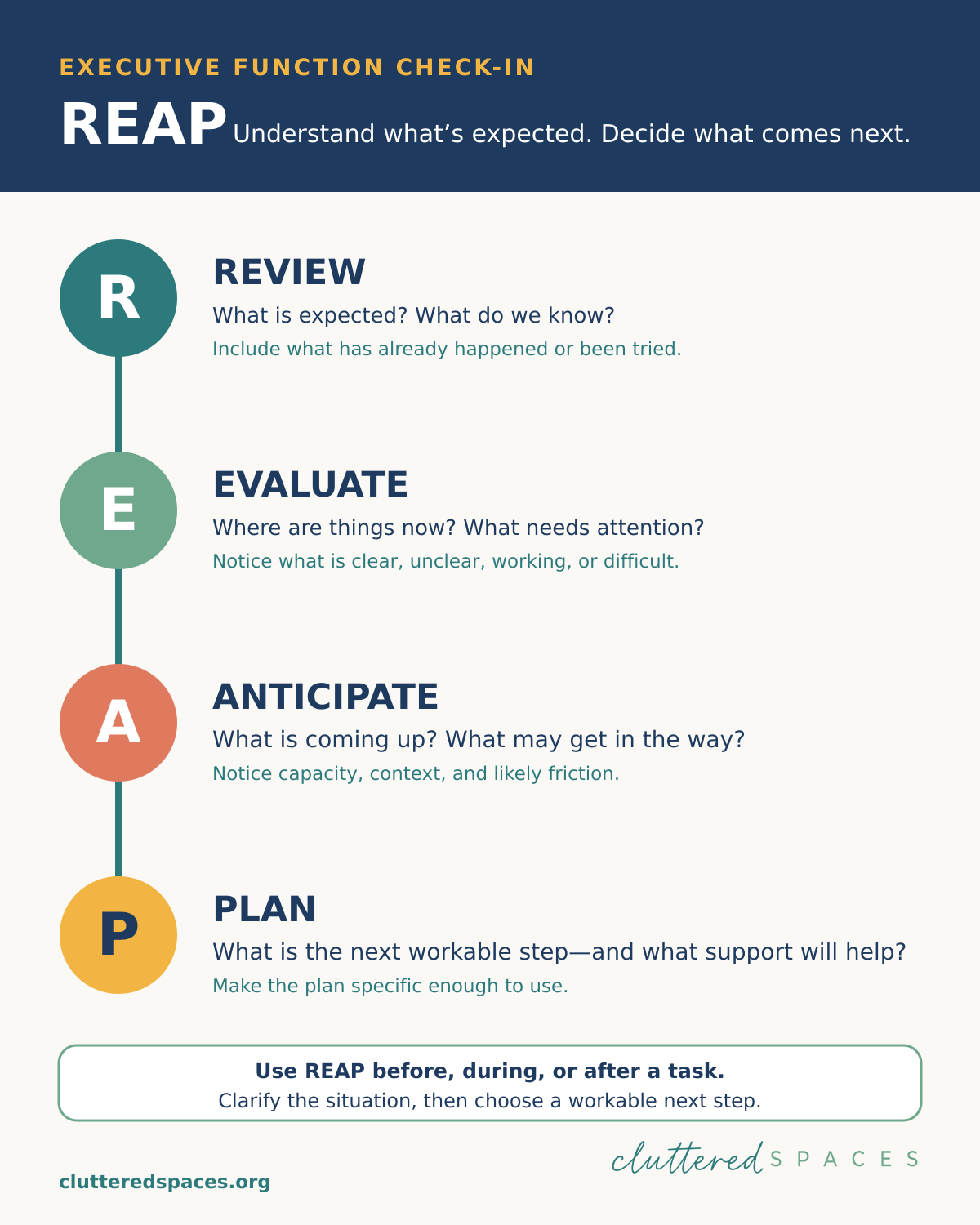
Open for full-size viewing and easy download
Why tasks need a check-in loop
Planning asks several executive functions to work together. You have to hold the goal in mind, choose among competing tasks, estimate time, sequence steps, resist distractions, shift when circumstances change, and notice whether the plan is still working. Those demands can change with stress, sleep, sensory load, pain, interest, clarity, and the amount of support available.
If you want a broader explanation of those skills, start with Understanding Executive Function. The important point here is that a plan is a prediction made with incomplete information. Reviewing it is how you improve the prediction.
Without a check-in loop, people may act on an incomplete understanding, keep rebuilding essentially the same plan, or decide the person is the problem. REAP creates another option: study the fit between the expectation, the available information, the person, the environment, and the moment.
The emphasis can change with the timing. Before a task, REAP clarifies expectations and prepares for likely demands. During a task, it helps you check progress and adjust. Afterward, it helps you learn from what happened and improve the next plan.
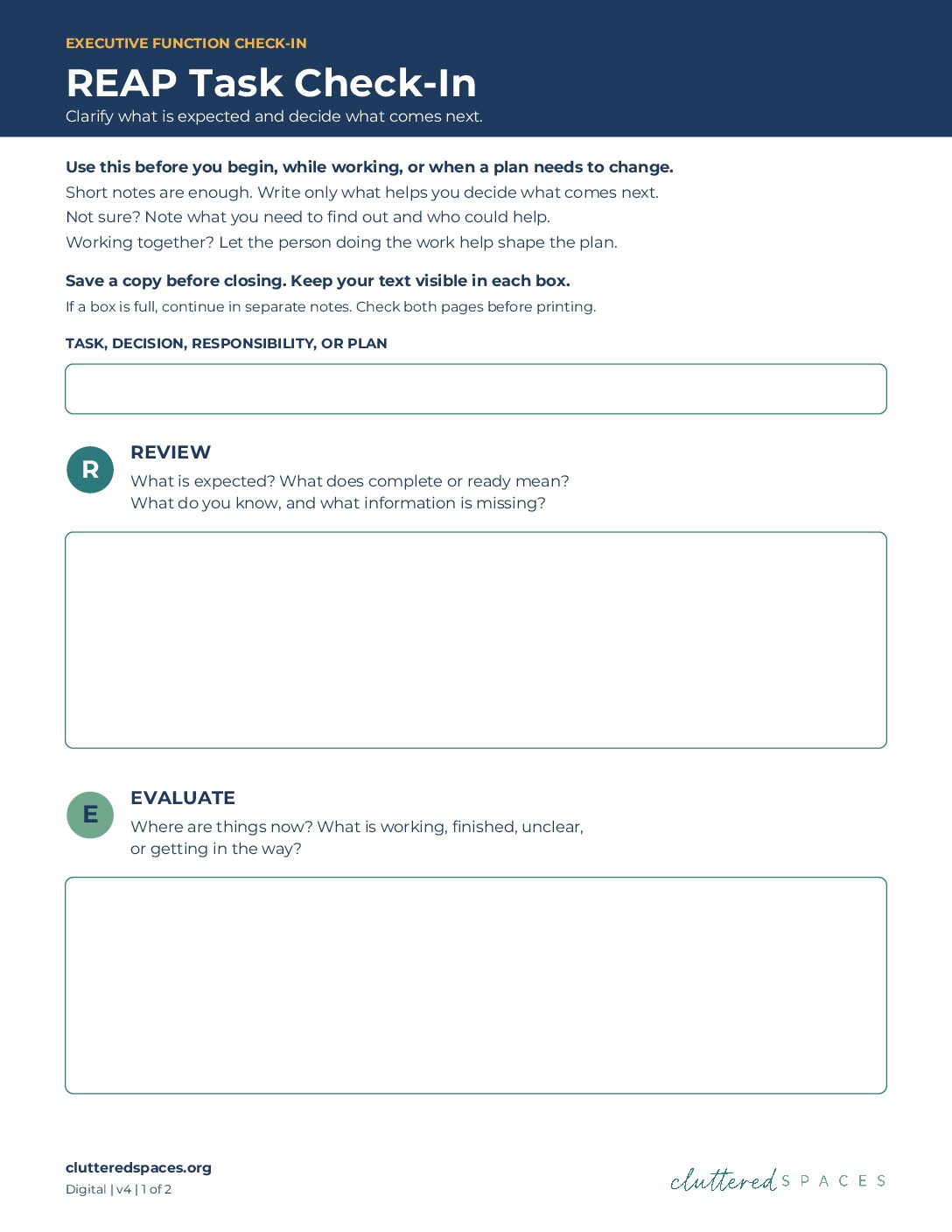
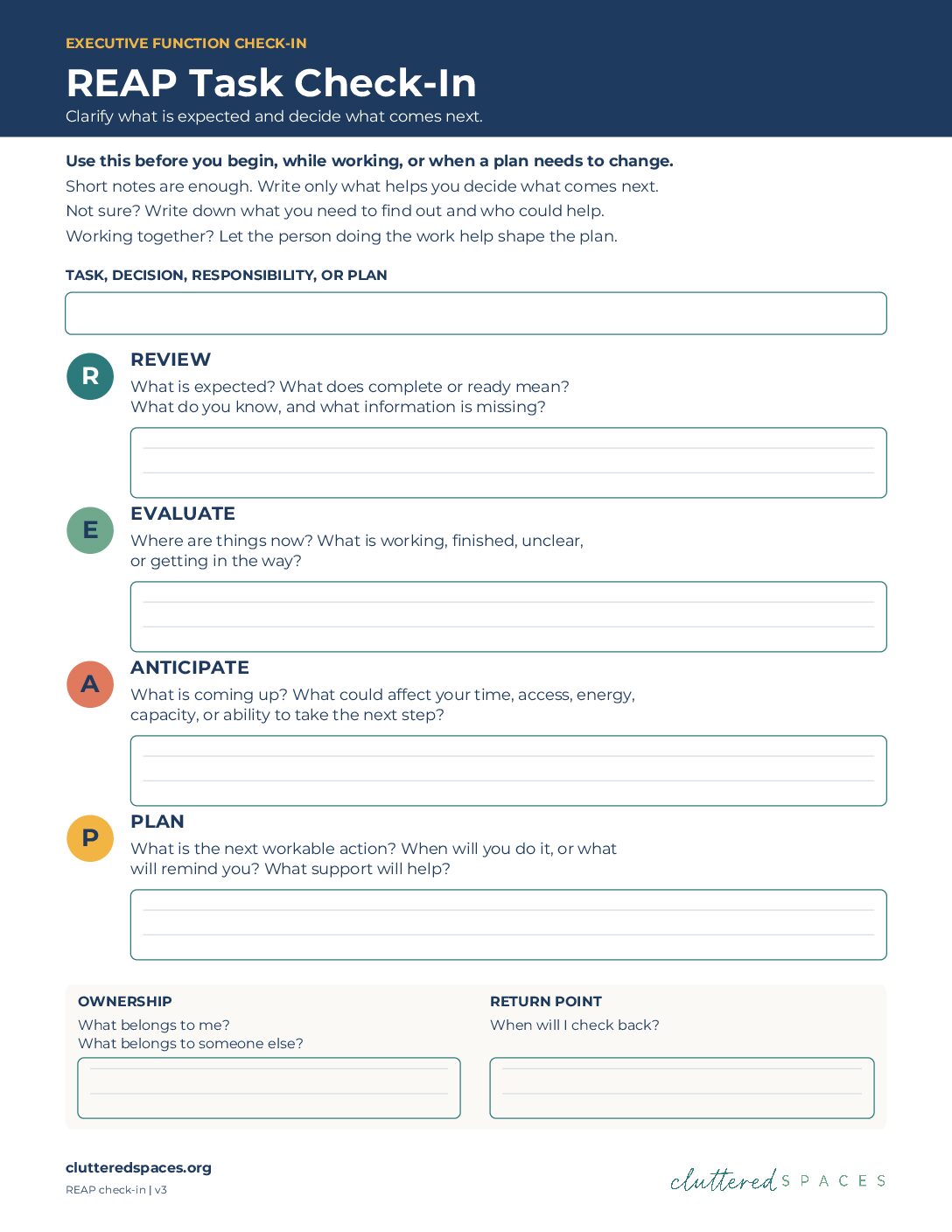
FREE REAP TASK CHECK-IN
Turn “I don’t know where to start” into a clear next step.
Sort out what’s expected, what’s getting in the way, and what would help you begin or return.
Get the REAP Task Check-In in printable and digital PDF formats. Use it before you begin, while working, or when a plan needs to change. Short notes are enough.
Enter your email below to receive both PDFs.
Having trouble with the form? Open the signup form in a new tab.

R is for Review
Begin by establishing the situation. What is expected? What information do you have? What has already happened or been tried? If there was an earlier plan, include it—but Review does not require one.
Keep this part factual. “Finish the project” may turn out to mean six separate actions that were never named. “Clean the kitchen” may mean dishes, counters, trash, the floor, and finding somewhere to put the things that do not belong there.
Try asking:
- What is being asked, recommended, or decided?
- What does complete or ready mean in this situation?
- What do we already know, and what information is missing?
- What has already happened, been attempted, or been ruled out?
- Who else is involved, and what belongs to them?
E is for Evaluate
Now assess where things stand. This is not the part where the coach, parent, or internal critic presents the evidence for the prosecution. Evaluation works best when clarity, uncertainty, progress, difficulty, and competing priorities are all useful data.
Maybe the reminder appeared at the wrong time. Maybe the first step was still too vague. Maybe the task required materials that were upstairs, the available time was shorter than expected, or the person used all their capacity getting through the school or workday. Maybe part of the plan worked beautifully and should stay.
Try asking:
- What is clear, and what still needs clarification?
- What has been completed or decided?
- What is working or making progress easier?
- Where is attention, action, or a decision getting stuck?
- What should we keep, change, remove, or support?
If you keep reaching a vague answer such as “I just did not do it,” the Five Whys can help you find the friction underneath the visible problem.
A is for Anticipate
Next, look forward. What is coming before the next check-in? Anticipating does not mean finding every possible problem. It means noticing the demands you can reasonably see and making room for real life.
A school week may include a test, rehearsal, and a schedule change. An adult may have two late meetings, a medical appointment, and lower energy after travel. A household plan may collide with an empty refrigerator or a washing machine that has begun making a noise no appliance should make.
Try asking:
- What has a real deadline?
- Which days already have a heavy load?
- What interruption or transition is likely?
- What materials, information, energy, or help will the task require?
- What would a lower-capacity version look like?
P is for Plan
Only now do you make the next plan. Use what you learned. A workable plan names the action, the likely time or cue, and the support that makes starting or returning easier.
“Work on science” is not yet a plan. “After snack on Tuesday, open the assignment on the school’s online class page, read the directions, and highlight anything unclear” gives the brain somewhere to begin. If Tuesday goes sideways, the plan also needs a return point: “At the Wednesday check-in, decide the next step from whatever is complete.”
A plan can include support without taking ownership away from the person. Support might be a written sequence, body doubling, a calendar block, supplies placed at the point of use, a quieter location, a text reminder, or help defining the first action.
A REAP check-in in real life
At work, a supervisor might ask for a report by Friday without explaining which information matters most. Review identifies the stated deadline, the available data, and the examples from previous reports. Evaluate shows that most of the information is ready, but the employee still needs to know whether the supervisor wants a short summary or a detailed analysis. Anticipate accounts for a Wednesday meeting and the supervisor being out Thursday afternoon. The plan is to send a two-sentence clarification question Tuesday morning, build the report outline while waiting, and confirm the final scope before completing the analysis.
The same framework works for homework without turning the conversation into another lecture. If your teen understands the material but the assignment still shows as missing, look at the steps between knowing the answer and turning in the work before deciding what support to try.
Suppose a teenager planned to submit two missing assignments by Thursday. Neither was turned in.
- Review: Two assignments are marked missing in the school’s online assignment system. One requires a paper response and an upload; the other has written directions the student does not understand. The teacher accepts late work through Thursday.
- Evaluate: The paper response is already complete, but the submission link is hard to find. The second assignment cannot move forward until the directions are clarified.
- Anticipate: There is a quiz Friday and rehearsal Thursday night. The teacher is available during lunch Wednesday.
- Plan: Photograph and upload the completed paper during Tuesday study hall. Write one question about the unclear assignment and take it to the teacher Wednesday at lunch. Put both actions in the phone calendar with the needed link attached.
The missed work still matters. REAP does not erase expectations. It makes the response more precise. Instead of “be more responsible,” the next plan addresses submitting, asking for clarification, remembering a future action, and protecting time around a known schedule demand.
For more on preserving ownership while providing structure, see Executive Function Support for Teens.
REAP can also help someone prepare for a medically guided decision by organizing recommendations, missing information, questions, insurance steps, and follow-up. In that setting, the framework supports communication and follow-through; it does not replace advice from a qualified healthcare professional.
What keeps REAP from becoming another pressure system
The questions matter, but the tone matters too. A check-in stops being useful when “evaluate” means “explain why you failed” or “plan” means accepting a plan someone else already chose.
A few guardrails help:
- Keep the check-in short enough to repeat. Ten focused minutes may be more useful than a forty-five-minute postmortem.
- Let the person doing the task speak first and help define the problem.
- Notice what worked, including partial progress and supports that helped.
- Change the environment or level of support when the plan demands more than current capacity.
- Make room for a minimum version and a way to return after interruption.
- Treat repeated difficulty as a reason to investigate further, not as proof that more pressure is needed.
Executive skills grow through supported practice, reflection, and adjustment—not through shame. You can read more about that process in Executive Function Skills Grow Through Practice—Not Pressure.
Try one REAP conversation
Choose one situation that needs more clarity—a new task, a plan already underway, or something that did not go as expected. Use the four questions once. You do not need to redesign the entire week or solve every recurring problem.
- Review: What is expected? What do we know, and what has already happened?
- Evaluate: Where are things now? What is clear, unclear, working, or difficult?
- Anticipate: What is coming next?
- Plan: What is the next workable step, and what support will make it easier to begin or return?
The goal is not a flawless plan. It is a plan informed by what you now know.
Suggested next step
If understanding expectations, planning, starting, or following through keeps breaking down across school, work, or home, Executive Function Coaching from Cluttered Spaces can help you identify the stuck point, test practical supports, and build a repeatable way to clarify, plan, review, and adjust.
References
- Dawson, P., & Guare, R. (2013). Coaching Teenagers (and Younger Children). Smart but Scattered Kids.
- Diamond, A. (2013). Executive functions. Annual Review of Psychology, 64, 135–168.
- Center on the Developing Child at Harvard University. Executive Function & Self-Regulation.
- Dechausay, N. (2018). The Future of Executive-Skills Coaching and Behavioral Science in Programs That Serve Teens and Young Adults. MDRC.
Source note: Dawson and Guare describe REAP as a recurring student-coaching check-in that begins by reviewing the previous plan. Cluttered Spaces uses the same sequence more broadly before, during, or after a task, with Review beginning by clarifying expectations, known information, and what has already happened.