You’ve Heard the Advice. You Still Need Help Getting It Done.
You already know the advice. Break the task into steps. Put it on the calendar. Give everything a place. But the papers are still on the table, the appointment still needs booking, and you may be wondering what another conversation could change when you need help making something happen.

Sometimes the plan is useful, but the distance between the plan and the first action is too large to cross alone. Working alongside someone can give you a way to begin, try the system in the place you'll use it, and find out what needs adjusting.
Find out what is keeping the plan on paper
The same unfinished task can have different barriers. You might be missing information, making too many decisions, working around a crowded space, or trying to start at a time when your energy is gone. You may understand the task but lose your place as soon as something interrupts you.
The support should fit the barrier. More instructions won't make a full drawer easier to use. Clearing the drawer won't explain an unfamiliar form. Looking at the real task together helps separate what needs teaching, what needs changing in the environment, and what needs practical help today.
Work on one real thing together
Hands-on support might mean sorting a small group of papers with you, setting up a place for incoming mail, or practicing how to move an appointment from a conversation into your calendar. The work gives you a chance to make decisions and try the next action while support is available.
Some people find another person's quiet presence helpful when starting or staying with a task. Others need less conversation, more privacy, or a different kind of help. Working side by side should adapt to your preferences; it shouldn't assume that a technique such as body doubling helps everyone.
You can agree on the roles before beginning. What do you want to decide yourself? What kind of help is welcome? What would feel like someone taking over? A useful session leaves room for those answers to change.
Make the plan work in the room
A system can sound sensible until you use it. The folder might be too hard to reach. The labels may take too much thinking. The step you planned for Sunday might happen more easily when the mail arrives.
When you try it together, those details become visible. You can move the supplies, simplify a decision, or reduce the number of steps while the problem is in front of you. The aim is a system you can use on an ordinary day, including a day with less energy.
Here is what that can look like for incoming mail:
- Plan: choose what needs attention and what can wait, with you making the decisions about your papers.
- Work: process a small batch together and notice where you get stuck.
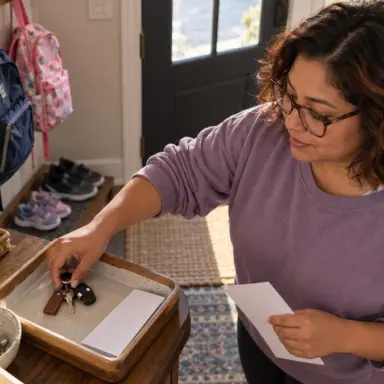
- Build: give the next action a clear place, such as one tray for mail that needs a response.
- Hand off: agree on what you'll try before the next check-in, what support will remain, and when to adjust the plan.
At the end, you might have an action tray for new mail, a time to check it after dinner, and an agreement that someone will help with unfamiliar papers. If a review is missed, check the nearest deadline at the next agreed time; the whole backlog does not have to be cleared first. That sequence does not have to finish in one visit. A slower pace can leave more room for decisions that need time.
Decide what kind of help you need
You may need coaching and practical implementation together. You may also need a cleaner, an organizer, clinical care, or another service. The question is what you want help doing and who is equipped to help with it.
Coaching can support routines, skill practice, and follow-through. It doesn't diagnose or treat a mental health condition. Hands-on implementation isn't a promise to clean or organize everything, and it shouldn't be sold as a substitute for the service your situation actually needs.
Before starting, clarify the scope, your role, and what a useful result would be. That might be one clear place for incoming papers and a next action you understand, rather than a picture-perfect room.
Build a handoff you can use
A handoff needs more than “keep doing this.” It helps to know what happens next, where the supplies live, and what to do if the routine breaks down. You might keep a visible cue, ask someone to work alongside you occasionally, or schedule another review.
Some supports will remain useful. The goal doesn't have to be doing every task without another person. It can be having more choice, less friction, and a clearer way to get the help you need.
Our Home Function Coaching explanation describes how assessment, practice, and practical support fit together. Support Without Taking Over explores keeping your decisions and agency central to the work.
For educational purposes only. Not a substitute for professional medical or mental health advice.
Suggested next step
If you've heard plenty of advice and still need help getting started, explore Home Organization & Environmental Reset or start a conversation. We can discuss what's getting in the way and whether hands-on support fits the help you're looking for.