
When Everyday Struggles Start to Feel Like Personal Failures
You were going to answer that text.
You read it while doing something else, thought about your reply, and somehow your brain filed “thought about replying” under “replied.” By the time you remember, three days have passed.
Now you want to respond. But first, apparently, you need to write an apology, explain your entire personality, and become a better person.
It was a text. How did it become all of that?

Sometimes the hardest part of an everyday struggle is what we believe it says about us. The forgotten message becomes “I’m a bad friend.” The unfinished paperwork becomes “I can’t handle being an adult.” Asking for help becomes “Everyone else can do this. Why can’t I?”
If that sounds familiar, you may be carrying more than the task itself. You may be carrying shame.
When “this is hard” becomes “something is wrong with me”
Shame can feel like wanting to disappear. Like hoping nobody asks how things are going. Like hearing a perfectly ordinary question and feeling your stomach drop because you are already disappointed in yourself.
There is a difference between “I wish I had handled that differently” and “I am the problem.” The first leaves room to do something. The second can make it hard to imagine where to begin. If a particular mistake starts to feel like a verdict on your whole life, our guide to separating one hard moment from the meaning attached to it offers a way to examine that conclusion without dismissing what happened.
For some neurodivergent people, that second message has had a lot of practice.
Maybe you were told you were careless when you lost things. Maybe people assumed you were not listening when you needed instructions repeated. Maybe you were doing everything you could to get through a noisy classroom, while the adults around you were discussing your attitude.
Or maybe nobody said anything particularly cruel. You simply kept noticing that certain things seemed easier for other people, and you filled in the explanation yourself.
They can do it. I should be able to do it. If I can’t, it must mean something about me.
Research with adults with ADHD has found a connection between greater perceived criticism and lower self-compassion. It does not explain every person’s experience, but it gives us a reason to pay attention to the messages people receive—and the ones they begin repeating to themselves.
Shame is not an inevitable part of being neurodivergent. But being repeatedly misunderstood, compared, or expected to manage without useful support can give it plenty of material.
And when your abilities vary from situation to situation, it can be especially confusing. You can solve a complicated problem at work and still forget the form sitting beside your keys. One ability does not cancel out the other difficulty.
Why people may never see how much you are carrying
You can look capable and feel ashamed. You can be funny, generous, successful, and the person everyone calls in an emergency—and still hide the unopened mail.
Sometimes hiding looks like cleaning before someone comes to help you organize. Sometimes it means saying “I’m fine” because explaining feels too exposing. Sometimes you stay up late fixing a mistake so nobody knows it happened.
Or you stop checking. The inbox, the school portal, the bank statement. You know looking would give you information, but you are afraid it will confirm something painful about you.
People may see avoidance. They may miss how much you care.
For some autistic people, hiding also includes masking parts of how they naturally communicate or respond to the world. Research describes efforts to fit in and avoid negative reactions, along with the exhaustion that can come with them. Masking has different meanings for different people; it does not automatically mean someone feels ashamed.
If hiding has helped you get through difficult situations, it makes sense that you would be cautious about letting someone see more. You get to choose who has earned that trust. You do not owe everyone an explanation of your brain.
We explore another version of this in When Not Trying Feels Safer: how protecting yourself from disappointment can make it harder to move toward something you want.
You do not have to talk yourself out of the feeling
Being told “Don’t feel bad!” rarely gives a painful feeling somewhere to go.
You may already know that forgetting a message does not make you a terrible friend. Knowing it and feeling it can take different amounts of time.
Start by acknowledging what is happening: “Oof. This hit a tender spot.” Or, “I’m embarrassed, and I really don’t want to look at this right now.”
You can pause there. Get some water. Move somewhere quieter. Ask someone you trust to sit with you. You do not have to turn a hard moment into a personal development project before lunch.
When you have a little more room, try looking at one experience with curiosity.
Try the reflection guided journal page
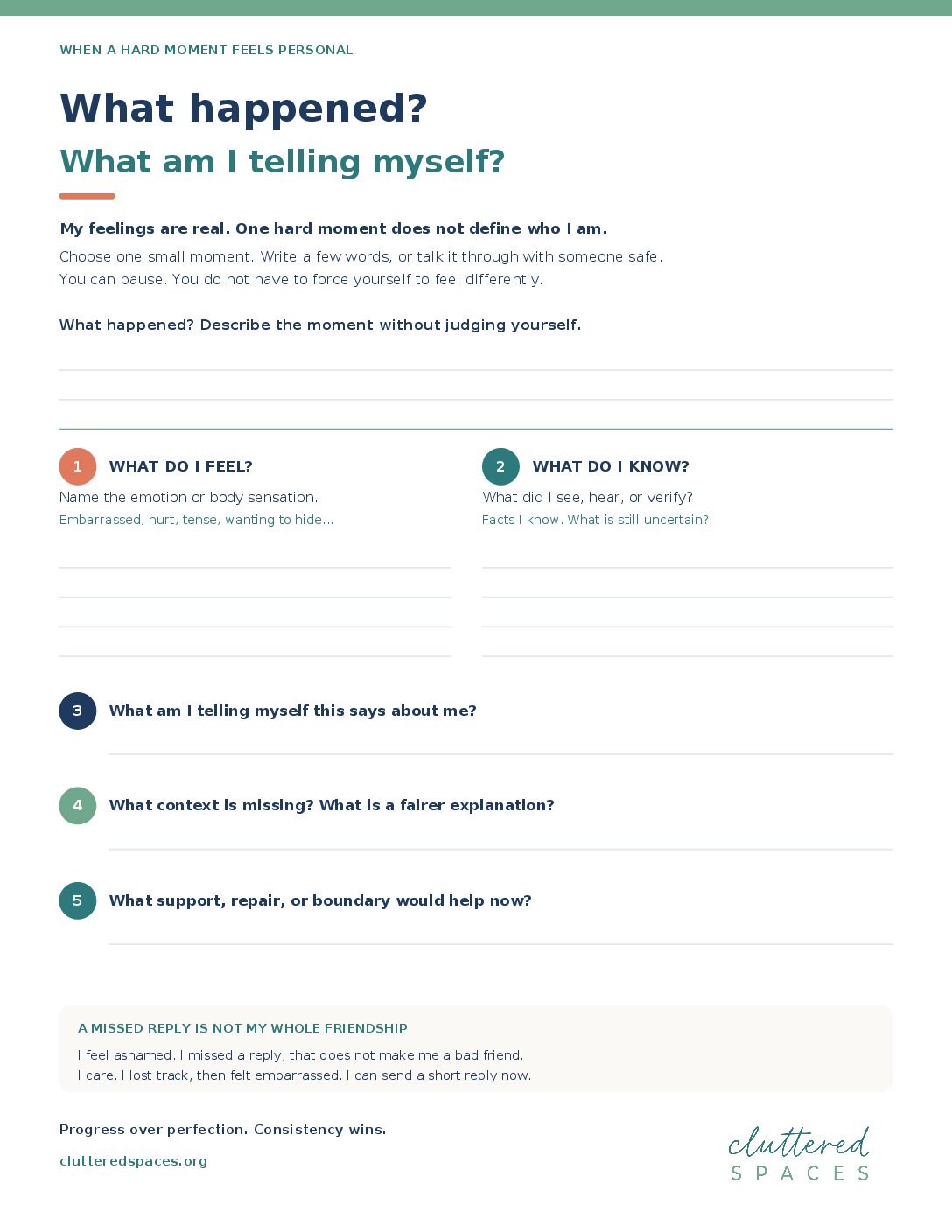
When one hard moment starts to feel like a statement about who you are, it can help to put the pieces on paper. What happened? What am I telling myself? is a one-page guided journal page for separating the feeling, the facts, and the meaning you have attached to them.
A kinder place to begin.
What happened? What am I telling myself? — Guided Journal Page
Start with one small moment. Name what happened, notice the meaning you attached to it, and make room for context and one useful next step.
Use the printable PDF to write by hand or the digital PDF to type and save your answers. A few words are enough.
Enter your email to get the free guided journal page.
Requesting the free guided journal page also subscribes you to Cluttered Spaces emails. Unsubscribe anytime. Open the signup page · Privacy policy
Choose one small, recent experience. Write a few words or talk it through with someone safe. Start with what happened and what you feel, then consider what you know, what context is missing, and what support, repair, or boundary would help. You can pause whenever you need to.
For example: “I missed a reply” is what happened. “I am a bad friend” is the story that followed. A fairer explanation might be, “I care. I lost track, then felt embarrassed. I can send a short reply now.”
What happened—and what did you make it mean?
Choose something small and recent. You do not need to begin with your most painful memory.
Start with what actually happened
“I didn’t answer my friend’s message for three days.”
Then notice what you added: “I’m selfish. I always let people down. They must be tired of me.”
That second part may feel very convincing. It is still more than the information you have.
You missed a reply. You do not yet know what your friend thinks, and this one moment cannot tell the whole story of how you show up in a friendship.
Ask what made it hard
Perhaps you opened the message while making dinner, then lost track of it. Perhaps it needed a decision you did not have the energy to make. Perhaps you kept waiting until you had time to write a thoughtful reply, and now the thoughtful reply apparently requires a quiet cabin and a three-day weekend.
The useful question is, “Where did I get stuck?”
You might discover a missing reminder, too many decisions, an unclear next step, or fear of disappointing someone. You might discover that you needed rest or help.
You may also realize that an expectation was unreasonable. Needing more time, clearer instructions, or a quieter space does not mean you failed.
Give yourself a more complete explanation
You do not have to replace “I’m a bad friend” with an affirmation you do not believe.
Try something more accurate: “I care about my friend. I lost track of the message, and then embarrassment made it harder to return. I can respond now.”
That explanation includes the difficulty, the feeling, and something you can do.
Looking back at older experiences may bring sadness, too. You may wish someone had understood how hard you were trying. You may feel angry about being punished or judged when you needed support.
There is room for that grief. You do not have to find a bright side or excuse how someone treated you in order to understand yourself differently.
Choose what would help now
Sometimes there is a repair to make: “I’m sorry I left you hanging. I saw this while I was busy and lost track of it. Are you still free Saturday?”
Sometimes you need to ask for something: “Could you send those steps in writing?”
Sometimes you need a boundary: “I’m willing to talk about what happened. I need us to do that without calling me names.”
You can take responsibility for your part without accepting responsibility for someone else’s behavior. When Trust Gets Broken looks more closely at repair and boundaries.
Give the next attempt a little more support
Once you can see where something became difficult, executive function practice has a useful place to begin.
“Be more responsible” is a very large assignment with remarkably poor instructions. “Leave yourself a cue to answer the message after dinner” gives you something you can actually try.
Three executive skills can help us think about that support: working memory, cognitive flexibility, and inhibitory control. These help us keep information in mind, consider another approach, and pause before responding. In everyday life, practice might look like this:
Help yourself remember what comes next
You notice that opening a message is easy; remembering to return is the difficult part. So you try marking it unread or setting a reminder before leaving it.
This supports working memory. The practice is noticing “I can’t do this now” and leaving yourself a usable cue. You are allowed to let a tool carry some of the remembering.
Practice one other way of looking at it
Your first thought is “I’ve left it too long. Now I can’t reply.” You try a second possibility: “A short, late reply may still be welcome.”
That is an everyday opportunity to use cognitive flexibility. You do not need to come up with ten positive explanations. One reasonable alternative gives you another option.
Make a little room before you respond
A reminder from someone else lands badly, and you want to send a sharp reply. You put the phone down and say, “I’m feeling defensive. Give me a minute.”
This creates space to use inhibitory control: pausing before acting on the first impulse. Your feelings can be there while you decide what you want to do with them.
Pick one situation and one support. Try it, notice what happens, and adjust. The aim is to make that part of life more workable. A successful reminder does not mean every memory difficulty has disappeared, and a missed reminder does not mean you are back at the beginning.
Our article on how executive function skills grow through practice offers more ways to make practice specific and manageable.
And you do not have to earn kindness by getting better at this. You deserve respect while you are learning, while you are struggling, and while you still need help.
“But if I stop being hard on myself, won’t I stop trying?”
If self-criticism has been your usual way of getting yourself moving, letting go of it can feel risky.
You may worry that kindness means making excuses or deciding the consequences do not matter. But you can care deeply about your impact and still speak to yourself with respect.
Research on self-compassion suggests that responding kindly to a setback can support motivation to improve. Those experiments were not specific to neurodivergent people, but they offer a useful challenge to the idea that we need to shame ourselves into doing better.
You can apologize. You can change the plan. You can ask for help. None of those actions requires calling yourself a failure first.
You are allowed to have someone beside you
Some shame runs much deeper than an unanswered text. If it keeps pulling you into old pain or making it hard to participate in your life, a therapist who understands neurodivergent experiences can help you work through it at a pace that feels manageable.
Coaching can help with the practical pieces alongside that work: figuring out where a routine gets stuck, trying a different support, and practicing without every attempt becoming a judgment.
For today, you might come back to just three questions:
-
What happened?
-
What made it hard?
-
What would help me now?
You do not need a perfect answer. You need somewhere kinder to begin.
Progress over perfection. Consistency wins.
Get the free What happened? What am I telling myself? reflection guided journal page by email.
For educational purposes only. Not a substitute for professional medical or mental health advice.
References
- Beaton, D. M., Sirois, F., & Milne, E. (2020). Self-compassion and perceived criticism in adults with attention deficit hyperactivity disorder (ADHD). Mindfulness, 11, 2506–2518.
- Hull, L., et al. (2017). “Putting on My Best Normal”: Social camouflaging in adults with autism spectrum conditions. Journal of Autism and Developmental Disorders, 47, 2519–2534.
- Diamond, A. (2013). Executive functions. Annual Review of Psychology, 64, 135–168.
- Breines, J. G., & Chen, S. (2012). Self-compassion increases self-improvement motivation. Personality and Social Psychology Bulletin, 38(9), 1133–1143.