
ADHD and Anxiety in Adults: When Everyday Life Feels Like Too Much
For the person keeping a lot going and wondering why it takes so much
There is an email you need to answer. You’ve opened it several times. You know roughly what to say. But you also need to find a date, check a detail, and explain why you haven’t replied already.
For a broader look at planning, starting, and following through in daily life, explore executive function at home.

The email is now old enough to require its own explanation.
Meanwhile, the laundry is waiting, an appointment needs booking, and you’re fairly sure there was something else. You can feel the weight of it without being able to name it. Very helpful, brain.
When ADHD and anxiety are both part of your life, the unfinished tasks may be only part of what wears you out. There can also be the constant effort of remembering, worrying, recovering, and trying to look as though you have it handled.
You may find yourself thinking, “I’m an adult. Why does this still take so much?” That question deserves a kinder and more useful answer than another lecture about getting organized.
There may be two kinds of difficulty in the same task
ADHD can make planning, organization, and remembering daily tasks difficult. Anxiety can add worry about what might go wrong, and that worry can interfere with concentration too. A person can have both ADHD and an anxiety disorder, and similar-looking difficulties can have different causes.
Consider that email. You might lose track of it because it disappears beneath newer messages. You might avoid it because you fear disappointing the person who sent it. You might find the missing information and still feel too worried to reply.
A reminder may help you remember the email. It may do very little for the fear that comes with answering it. Understanding both parts gives you more useful choices about support.
Occasional anxiety is part of life; anxiety disorders involve more than occasional worry. These examples cannot tell you which condition explains your experience. You also do not need to work that out alone before asking for help.
Being capable does not make the effort disappear
Perhaps you’re the person people rely on at work. You solve complicated problems, meet deadlines, or help everyone else get unstuck. Then you come home and cannot face opening the mail.
It is easy to use the first part as evidence against yourself: “If I can do that, I should be able to do this.” But look at the conditions. At work, you may have a clear deadline, a colleague nearby, and a next step someone has already defined. At home, you’re the person who has to invent that structure after a long day.
That is one possible explanation, not a rule about how ADHD works for everyone. The useful question is what makes a task more manageable in one setting, and whether some of that support could come home with you.
Sometimes the backlog comes with a story about you
An unopened envelope can be more than an envelope. It may carry memories of a late fee, an awkward call, or a partner asking why it wasn’t handled. Before you know what is inside, you’re already bracing for what it might say about you.
Putting it aside may bring a little relief. It can also leave the practical problem unresolved, so there is more uncertainty the next time you see it. This is a possible pattern to notice, not the explanation for everyone’s anxiety.
We explore the pull to step back when trying feels risky in When Not Trying Feels Safer. Here, it may help to notice the moment a specific task becomes a much bigger judgment: “I forgot to make a call” turns into “I cannot manage my life.”
The call may still need making. You can address that specific responsibility without turning it into a verdict on your adulthood.
How to use the Five Whys
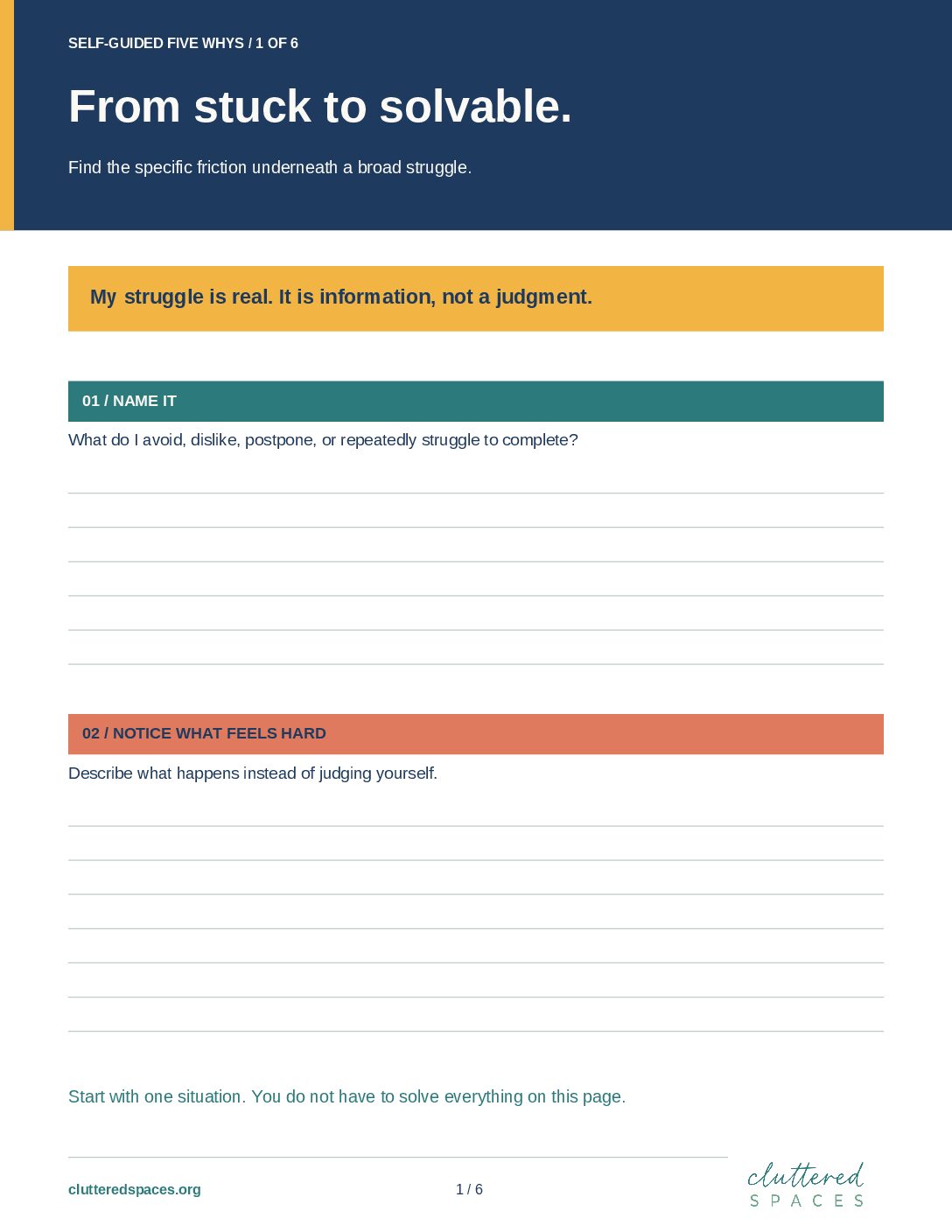
When you know you are stuck but cannot see where to begin, the Self-Guided Five Whys guided journal pages give you a place to work it out. Use them for one recurring task, on your own or with someone you trust. The aim is to find a specific obstacle and one support to test.
The free six guided journal pages comes in two versions: a printable PDF for writing by hand and a digital PDF for typing. You can use a few prompts at a time; finishing every box is not the assignment.
1. Name one stuck moment
Write what happens and what feels hard. Keep it specific: a message you avoid, an appointment you postpone, or an assignment you cannot start. Describe the moment without turning it into a judgment about yourself.
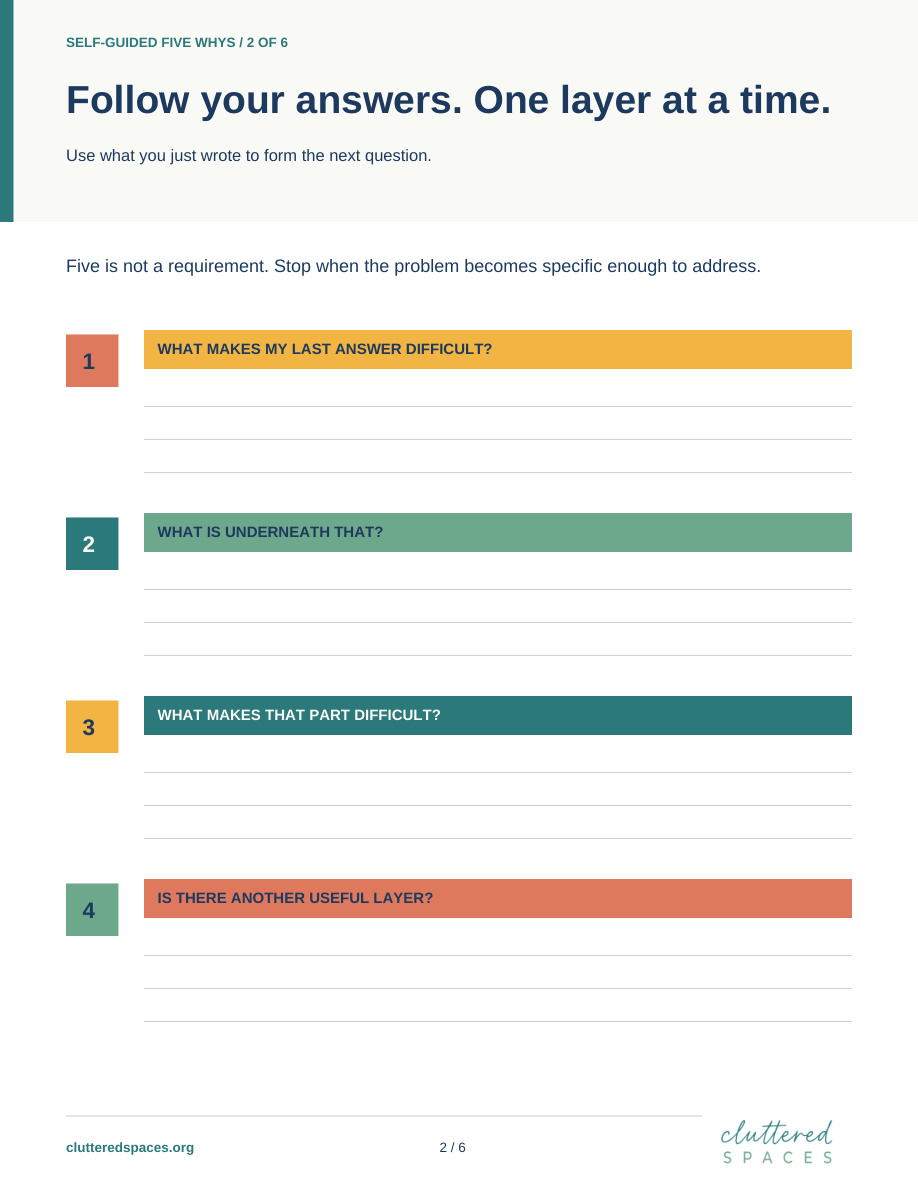
2. Let each answer guide the next question
Ask, “What makes that part difficult?” Then use your answer to form the next question. Notice missing information, decisions, effort, worries, or support you need. You do not have to force exactly five questions. Stop when you have something specific enough to change or test.
An adult example
“I keep putting off booking the appointment.” What makes that hard? “I am worried I will choose a time I cannot manage.” What makes choosing difficult? “The available times and my work calendar are in different places.” A useful test is to open both together and identify two possible times. If the worry is still strong afterward, that is useful information too.
3. Try one change and notice what happens
Use the guided journal pages to name the obstacle you suspect, choose one small change, and record what became easier or stayed difficult. Include a smaller version for a tired day and a clear way to return if you stop. Your first explanation is something to test; more than one difficulty may be involved.
If you keep circling the same question or feel more distressed, pause. You do not need a perfect explanation before you can ask for help. Use this activity to explore a practical task, not to diagnose anxiety or decide whether a feeling is justified.
Find a little more room around the problem.
Self-Guided Five Whys — Guided Journal Pages
Choose one situation that keeps feeling hard. Follow your answers, name the friction, and try one support that fits your day.
Use the printable PDF to write by hand or the digital PDF to type and save your answers. A few words are enough.
Enter your email to get the free guided journal pages.
Requesting the free guided journal pages also subscribes you to Cluttered Spaces emails. Unsubscribe anytime. Privacy policy
Want the prompts in front of you? Get the free Five Whys guided journal pages. Sign up with your email to receive the printable and digital PDFs.
For more examples and the thinking behind the questions, read use the Five Whys to find recurring friction.
Support can be something you choose
If someone else shares these responsibilities, they may be tired too. Perhaps they have become the reminder system, while you have become increasingly tense whenever they ask. Both experiences deserve room in the conversation.
At a calmer moment, try making the agreement more specific: “I’ll handle the appointment. Can we spend ten minutes together finding the information tonight? I’ll put the next action and date in my calendar.” Decide what a useful check-in looks like, including who initiates it.
If you live alone, you might choose a regular time with a friend or coach to work on separate tasks alongside each other. You can ask for company or help with one step without handing someone control of the whole task.
Try making one responsibility easier to return to
Choose one ordinary task. For this example, it is an unopened letter about an appointment. The aim is to understand the sticking point and leave yourself a usable next step.
1. Name the practical obstacle and the worry
Try: “I do not know whether I need to call or fill something out. I am worried I have missed a deadline.” You do not need to argue yourself out of the feeling. You are identifying what needs attention.
2. Get the information for one next action
Open the letter, perhaps with someone beside you if that helps. Find what it asks you to do and when. If something is unclear, the next action might be to ask the sender. You do not have to resolve every piece of mail while you are there.
If you keep getting stuck before this point, return to the Five Whys activity above to explore what would make the next action more manageable.
3. Leave a clear way back
Write down the action, the information you need, and when you will return to it: “Call the office during my lunch break; the number and letter are in this folder.” Put the reminder somewhere you already check. If you finish the call now, record any follow-up before moving on.
Afterward, ask what became easier and what still felt hard. Finding the number may solve a practical obstacle while leaving the worry needing more support. A useful experiment gives you information even when it does not make the whole task easy.
You can get help with both parts
Practical support and care for anxiety can work alongside each other. You might feel less anxious and still need a way to remember appointments. You might have a useful routine and still experience anxiety that deserves professional attention. One kind of progress does not make the other need less real.
When worry regularly interferes with sleep, work, relationships, or daily life, a qualified health professional can help assess what is happening and discuss care. Medication decisions belong with you and your prescribing clinician.
How Cluttered Spaces can help
At Cluttered Spaces, we work alongside adults on the practical demands of everyday life: sorting the steps of a task, making information easier to find, practicing routines, and adjusting supports when they stop being useful. Coaching does not diagnose or treat anxiety; it can complement the care you are already receiving.
You do not need to tidy everything or finish the overdue tasks before reaching out. “This part of my week keeps unraveling” is enough to give us somewhere to begin.
If school demands and parent–teen conversations are the more immediate concern in your family, read ADHD and Anxiety in Teens: When Everyday Things Feel Big.
Prefer a place to write this out? Get the free Five Whys guided journal pages by email, with printable and digital versions so you can choose what works for you.
For educational purposes only. Not a substitute for professional medical or mental health advice.
Sources and further reading
These sources support the discussion of ADHD, anxiety, and their overlap. The everyday examples and activities illustrate practical coaching possibilities; they are not diagnostic tests or treatments for anxiety.
National Institute of Mental Health. ADHD in Adults: 4 Things to Know. Adult symptoms, everyday functioning, and options for support.
National Institute of Mental Health. Attention-Deficit/Hyperactivity Disorder: What You Need to Know. Symptom overlap, assessment, and co-occurring conditions.
National Institute of Mental Health. Anxiety Disorders. The distinction between occasional anxiety and anxiety disorders.
National Institute of Mental Health. Generalized Anxiety Disorder: What You Need to Know. One type of anxiety disorder, including concentration difficulties and worry about everyday responsibilities.