
Your Teen Says They’re Tired. But They’re Up Late Again.
ADHD, winding down, and helping sleep feel a little less like a nightly battle
You know your teen is tired. They were barely upright at breakfast. Homework took forever. Tomorrow starts early.

And yet, somehow, at 10:45 p.m., they have found the energy to reorganize a playlist, explain something very important about a video game, and remember an assignment nobody has mentioned all evening.
You are ready for bed. They appear to be opening a second business day.
If this happens in your house, you may be worried, frustrated, and a little tired of hearing “I’m not sleepy” from someone who could barely keep their eyes open that morning. Your teen may be frustrated too. Knowing they need sleep does not necessarily make sleep arrive.
For families navigating ADHD, it helps to get curious about where the night is getting stuck. Stopping an activity, settling into bed, falling asleep, and staying asleep are different jobs. Ask during the day: “Is it hardest to stop, get comfortable, or actually sleep?” If stopping is the difficulty, start with “Make the landing easier.” If your teen is trying to sleep but cannot, read the sections on sleep timing and getting more help. Let their answer guide where you begin.
Bedtime asks more of a brain than we give it credit for
“Get ready for bed” sounds like one instruction. Inside that instruction are several transitions: stop what you are doing, notice the time, remember the next steps, put things down, get to the bathroom, and settle into something quieter.
Those are some of the same skills that can make schoolwork and everyday responsibilities difficult with ADHD. If you want a little more background, our article on understanding executive function explains why knowing the plan and carrying it out can be very different experiences.
Your teen may genuinely intend to stop after one more round. Then the round ends, a friend sends a message, and the intention disappears behind the next interesting thing.
For some teens, evening is also the first time all day that nobody is asking them to perform, hurry, or remember something. Giving up that time can feel expensive, especially when the next thing waiting is another school day.
That is worth asking about. “What do you like about being awake at night?” may tell you more than another reminder about tomorrow morning.
Tired and ready to sleep are not always the same thing
Two systems help decide when sleep happens. One builds the need for sleep as we spend time awake. The other is our body’s daily timing system: the circadian rhythm. It helps coordinate when we feel alert and when we become sleepy.
Think of one as the need to recharge and the other as the schedule for when the charging station opens. They do not always line up neatly.
During adolescence, the body’s preferred sleep timing commonly shifts later. Some people with ADHD also have delayed sleep timing, though that is not true of everyone. A teen can be exhausted from too little sleep and still struggle to fall asleep at the hour the family needs.
Light helps set that daily clock. Late bright light can keep the body receiving a daytime message, while daylight after waking helps reinforce that the day has begun.
This is why “go to bed earlier” can be a frustratingly incomplete answer. Getting into bed changes location. It does not instantly change the body’s timing.
If your teen regularly cannot fall asleep until very late but sleeps more comfortably on a later schedule when allowed, mention that pattern to their pediatrician. A later preference alone is not a diagnosis, but a persistent mismatch that disrupts school and daily life deserves attention.
First, find the part that is hard
Have this conversation during the day, when nobody is holding a toothbrush and defending their right to one more video.
You might ask: “I can see mornings are rough. At night, is the hardest part stopping what you’re doing, getting comfortable, or actually falling asleep?”
Listen for the distinction. A teen who loses track of time needs different help from a teen who is in bed on time but lies awake worrying. Someone who wakes repeatedly needs more than an earlier reminder to put on pajamas.
For a week or two, keep a few simple notes together: when they got into bed, roughly when they think they fell asleep, any long awakenings, when they woke, and how the next day felt. Note caffeine, naps, and medication timing if relevant. Estimates are fine. This is information to help you and their clinician, not a sleep report card.
Make the landing easier
The practical suggestions below are options to try, not a requirement to redesign your entire evening. Choose the one that matches the difficulty you identified.
Give the activity an ending
A reminder works better when it includes something your teen can actually do. “Bed soon” leaves a lot to figure out. “Finish this round, tell your friends you’re signing off, then plug in your phone” gives the transition a shape.
Agree on the stopping point beforehand. Consider an earlier cue that means “don’t start another round” rather than relying only on an alarm that means “stop immediately.” Our article When Your Brain Isn’t Ready to Switch Gears explores why those handoffs can be hard.
You can keep a limit while helping with the transition. With a younger child, that may mean doing the first step together. With a teen, ask whether a spoken reminder, an alarm, or a visible cue would feel most useful.
Move the little jobs out of the last ten minutes
If bedtime requires finding clean clothes, packing a bag, locating a charger, and resolving tomorrow’s transportation, the evening has acquired a surprise administrative department.
Try moving one of those jobs earlier. Put tomorrow’s bag by the door after dinner. Keep the charger in its usual place. Let a short written sequence carry the remembering: bathroom, phone charging, quiet activity.
The best routine is one your teen can use when they are tired. It does not need twelve steps and a laminated certificate. Agree together on a shorter version for lower-capacity evenings, while keeping enough time available for sleep.
Give winding down something to be
Removing an engaging activity leaves a gap. Help your teen choose what fills it: a familiar book, quiet music, drawing, or an audio story with the screen off. The test is whether it helps them settle. Even a “relaxing” activity can become one more thing they want to finish.
Consider comfort too. Is the room too warm? Is the bedding irritating? Is silence uncomfortable, or does household noise keep pulling their attention back? A dim light may be more workable than darkness for a child who feels anxious.
The American Academy of Pediatrics recommends avoiding screens for the hour before bed. If your family is far from that, choose a realistic first change, such as ending gaming earlier and charging the phone away from the bed. Keep working toward a quieter evening rather than treating an imperfect start as failure. A screen filter does not create a stopping point or end the conversation with friends.
Look at the whole day, gently
Sleep needs room in the schedule. Children ages 6–12 generally need 9–12 hours in 24 hours; teens ages 13–18 generally need 8–10. Time spent in bed is not necessarily time asleep.
If school, travel, activities, and homework leave only six hours available, there is a scheduling problem to solve alongside the bedtime routine. Your teen cannot make enough sleep fit into a gap that is too small.
A fairly steady sleep and wake schedule, daylight after waking, and movement during the day can support sleep. Large swings between school days and weekends can make timing harder to maintain. Work toward a manageable pattern that allows enough rest; do not use consistency as a reason to keep an already exhausted teen short on sleep.
Check caffeine too, including energy drinks, coffee, and caffeinated soda. Its effects can last for hours. Long or late naps can also make falling asleep harder. If your teen repeatedly needs substantial after-school sleep just to function, bring that to their clinician rather than simply banning naps.
What if they fall asleep, then keep waking up?
Sleep is not one uninterrupted block of identical sleep. Through the night, we move through lighter sleep, deeper sleep, and REM sleep. Brief awakenings can happen between cycles and may go unnoticed.
A quick wake-up is different from being awake for long stretches or waking repeatedly and feeling exhausted the next day. The aim is enough restorative sleep, not a perfect-looking night with zero movement or awakening.
If your teen wakes, keep the response quiet and reassuring. Avoid turning the moment into a phone session, a clock-watching exercise, or a discussion about why they should be asleep. Talk during the day about what they notice: noise, nightmares, discomfort, worry, or an uncomfortable need to move their legs.
Repeated waking deserves its own investigation. It should not automatically get filed under ADHD, and a bedtime routine cannot address every possible cause.
When it is time for more help
You do not have to spend months proving that you tried hard enough before calling the pediatrician. Reach out when sleep difficulty keeps interfering with school, mood, family life, or daytime functioning, or when reasonable changes are not helping.
Mention frequent loud snoring, gasping, pauses in breathing, persistent nighttime leg discomfort, or marked daytime sleepiness. Those details can point toward sleep problems that need assessment. Trouble paying attention does not rule out a sleep disorder; in children, disrupted sleep can also show up as increased activity or irritability.
If difficulties began or changed after an ADHD medication change, tell the prescriber. Medication can affect sleep, and the response varies by person. Keep changes to dose, timing, or medication with the prescribing clinician.
Melatonin is also a conversation to have with the pediatrician. It may help some children with sleep timing or falling asleep, but it is not a universal answer to nighttime waking. Timing matters, supplement contents can vary, and long-term safety in children is not fully established. Keep it safely stored away from children.
Persistent insomnia may need treatment specifically designed for sleep. Ask about an age-appropriate behavioral sleep intervention or a sleep specialist. There are more options than being handed the same bedtime advice again.
Start with one change you can both live with
You could begin with: “We both want mornings to feel less awful. What is one thing we could try this week?”
Maybe it is moving bag-packing earlier. Maybe it is agreeing on the last gaming round. Maybe it is getting outside together after waking, or making an appointment because your teen is already trying to sleep and cannot.
Check back after a week: Did stopping feel easier? Was there less arguing? Did they settle sooner, or feel any better the next day? A week can help you assess whether a routine is usable; it may not be enough to resolve a sleep timing problem. Adjust together, and seek medical help when the pattern calls for it.
Your teen is learning how to notice what their body and brain need. You are allowed to need rest too. A useful plan makes room for both of you.
The place to begin is understanding what keeps getting in the way, then making the next step a little easier to take.
Try a 10-minute family evening reset
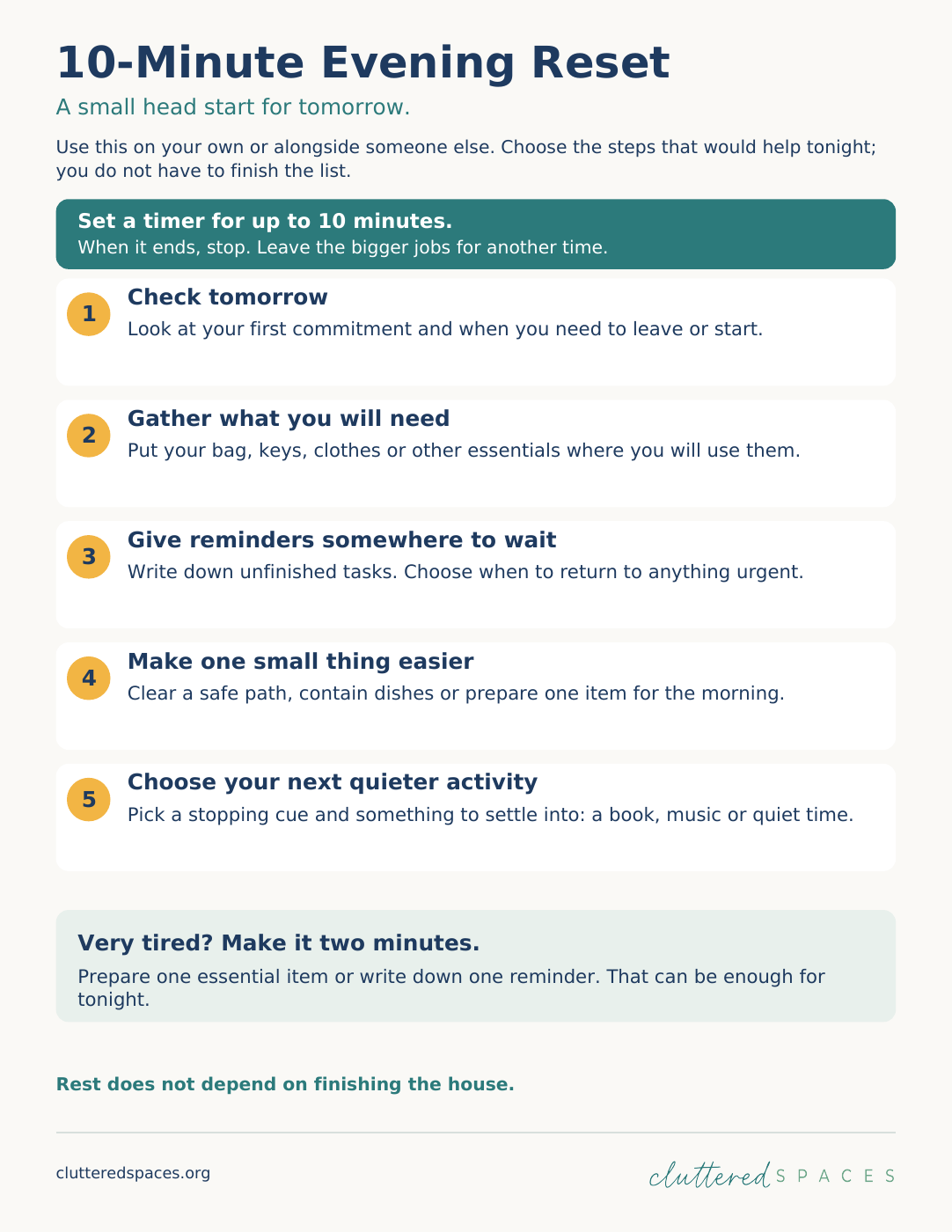
When everyone is tired, tomorrow’s missing shoes and unfinished reminders can become one more bedtime discussion. A family evening reset gives you a small window to get a few essentials ready together, then stop.
Choose a familiar moment before winding down, such as after dinner, and set a timer for up to 10 minutes. Let your teen choose a step from the chart while you take another. They might put their backpack by the door while you check tomorrow’s first commitment. You can also write down something that needs attention later so it doesn’t have to become tonight’s conversation.
When the timer ends, leave the bigger jobs and move to a quieter activity. On an especially tired evening, one prepared item or one written reminder is enough. The reset is optional support for the transition toward rest—not something your teen has to finish to earn it.
Open the full size to read on mobile
Open the chart to zoom in, or download the one-page PDF to print. No signup needed.
References
National Heart, Lung, and Blood Institute. Your Sleep/Wake Cycle; Sleep Phases and Stages; Healthy Sleep Habits. Sleep timing, sleep stages, and sleep habits.
Paruthi, S., et al. (2016). Recommended amount of sleep for pediatric populations: A consensus statement of the American Academy of Sleep Medicine. Journal of Clinical Sleep Medicine, 12(6), 785–786. Read the statement.
Van der Heijden, K. B., et al. (2005). Idiopathic chronic sleep onset insomnia in attention-deficit/hyperactivity disorder: A circadian rhythm sleep disorder. Chronobiology International, 22(3), 559–570. Study record.
Hiscock, H., et al. (2015). Impact of a behavioural sleep intervention on symptoms and sleep in children with ADHD, and parental mental health: Randomised controlled trial. BMJ, 350, h68. Read the study. This trial involved children ages 5–12; it does not establish the same effects for teens.
American Academy of Pediatrics. Melatonin for Kids: What Parents Should Know About This Sleep Aid. Parent guidance.
Kidwell, K. M., et al. (2015). Stimulant medications and sleep for youth with ADHD: A meta-analysis. Pediatrics, 136(6), 1144–1153. Read the analysis.
National Heart, Lung, and Blood Institute. Sleep Apnea: Symptoms; Insomnia: Treatment. Sleep apnea symptoms and insomnia treatment.
National Institute of Neurological Disorders and Stroke. Restless Legs Syndrome. Symptoms and assessment.
This article is for educational purposes only and is not medical advice. It is not a substitute for professional medical or mental health advice, diagnosis, or treatment. Talk with a qualified healthcare professional about sleep concerns, medication, or supplements.