
Your Teen Is Taking More Responsibility. Why Aren’t Their Grades Improving?
Your teenager checked the homework portal without being reminded. They wrote down what was due and started an assignment on their own. You noticed. Maybe you even let yourself relax a little. Then the grade report arrives: still missing work, grades that haven’t changed. It’s hard to know whether to celebrate the progress or start checking everything again.

Your teen may be taking more responsibility: checking assignments, trying the plan you made together, or asking for help when they get stuck. That ownership can grow while they still need a checklist, company to get started, or an agreed check-in. Responsibility is about taking ownership; independence is about how much they can manage without another person’s help. They can make progress in one without being ready for the other.
Managing schoolwork and understanding the material also involve different skills. A student can improve their follow-through while still needing help with a subject. Understanding executive function can help you see the planning, starting, and follow-through involved. The aim is to help your teen take part in managing the work with support they can use.
The Homework Process Map makes those steps visible and is free to read without signing up. Look at it with your teen: if assignments are finished but not received, you might practice checking the submission confirmation together. When you want help choosing and trying supports, the Parent’s Guide to the Executive Skill Practice Map below offers a worked example and planning pages; that separate resource is delivered by email.
Find the step that still needs help
A planner can tell your teen that an essay is due Friday. It cannot explain the prompt, turn “write an essay” into a first action, or remember to upload the finished file. Those are different parts of the job. Your teen may be getting better at finding assignments while still needing help with what happens next.
Homework is more than one task.
Homework uses a chain of executive skills from finding the assignment through confirming it was turned in. Use this map with your teen to find the step that needs support. You do not have to practice all sixteen steps at once.
Get Clear
- 1Find the assignmentCheck every place work may be posted.
- 2Read the directionsNotice what the teacher is asking for.
- 3Gather what is neededOpen files, notes, books, or supplies.
- 4Define “done”Know what must be completed and submitted.
Make a Plan
- 5Check the due dateInclude interim deadlines for longer work.
- 6Estimate the effortConsider time, energy, and difficulty.
- 7Break it into stepsMake large assignments easier to enter.
- 8Choose what comes firstSelect one clear starting point.
Do the Work
- 9BeginTake the first visible action.
- 10Stay with the taskUse time cues and a workable pace.
- 11Return after distractionFind the next step and re-enter the work.
- 12Ask for help when stuckClarify the question without giving away the work.
Turn It In
- 13Review the requirementsCheck the work against the directions.
- 14Finish and saveName the file or prepare the paper copy.
- 15Submit in the right placeUpload, send, or place it where it belongs.
- 16Confirm it went throughLook for the receipt, status, or teacher confirmation.
The student still owns the learning. The scaffold carries more of the process while practice helps the skills develop.
Open full size for easy reading and download
Opens a one-page PDF in a new tab. Use the PDF viewer to download or print it. No signup required.
Use the map as a conversation aid, not a scorecard. Trace a recent assignment together and notice where it stopped moving. That gives you a place to practice.
Support the part they are learning to do
That is where scaffolding comes in: giving enough structure for your teen to practice a step they cannot yet manage reliably alone. You might think aloud as you turn directions into a short checklist, sit beside them while they try it, or help set a reminder where they will actually see it. The support makes the process easier to follow while your teen learns how to use it.
The useful question is how much of the process your teen can manage with the supports available. A written cue, a shared work session and a teacher’s clarification can each help with a different part. Your teen can help choose the support and still be responsible for doing the work. Supporting someone without taking over means keeping them involved in the decisions and the practice.
Show it, practice together, then let your teen lead
Imagine your teen finishes assignments but forgets to submit them. You are both worn out by the nightly “Did you turn it in?” conversation. Instead of adding more reminders, agree to practice the last part of the process together.
First, make the finish visible. With your teen, write the actual sequence for that class: save the file, upload it, click Submit, then look for the confirmation. Put it beside the screen or on the checklist they already use. “Finish your homework” now has an ending they can check.
Show the unfamiliar part, then let them try. If your teen does not know where the confirmation appears, walk through an example together. Let them handle the next submission while you sit nearby. Name the step only if they get stuck; leave room for them to notice and correct an error.
Let your teen run the sequence. Once they can use it, move from talking through each action to an agreed check at the end. A parent might say, “You handle submitting tonight, and we’ll look at the status together at seven.” This gives the teen a chance to lead and the parent a clear time to stop wondering.
Review what happened together. If the file did not reach the teacher, find the missed step and adjust the help there. If it did, notice what worked: “You checked the confirmation and caught the wrong attachment.” That tells your teen which action helped, instead of leaving progress at “Good job.”
This is an example, not a schedule your teen has to follow. They may need several supported tries, a different cue, or help in more than one part of the process. Start from what they can do now, and agree on the plan together.
Step back when the step is working
When a step is working across several real assignments, try reducing one part of your involvement. You might stop sitting beside your teen but keep the agreed evening check. Later, you might check together less often while your teen continues using the checklist. Keep the next review on the calendar so neither of you has to guess what “I’ll handle it” means.
If submissions start slipping again, look at what changed before removing more help. A new teacher, a different online platform or an exhausting week may call for another demonstration or more company. Returning to support gives you another chance to practice.
Useful tools can stay. Adults use calendars, checklists and reminders too. Taking more responsibility can mean choosing and using those supports, noticing a problem and asking for help. It does not require doing everything from memory or never needing another person.
If staying close is wearing you out, name what you can realistically offer. A short planned check-in, help from school, or another trusted adult may be more workable than being on call throughout homework time.
Match the help to what is getting in the way
If your teen keeps putting off an assignment, look at an actual example together. The point is to find something you can change, rather than having another conversation about trying harder.
Unclear directions: help your teen identify the confusing part and draft a specific question for the teacher. They can send it and use the reply to choose their next action.
A task that is too broad: turn “work on the history project” into visible actions such as opening the instructions, choosing a topic and finding the first source. Plan those steps around the time actually available.
A difficult transition: agree on a stopping cue and a first homework action before the preferred activity begins. If this is where the evening repeatedly unravels, Make the Shift Easier offers more support for changing activities.
A subject they do not understand: help arrange clarification, a teacher check-in or appropriate tutoring. Sitting beside a confusing worksheet for longer may not resolve the confusion.
When there is a backlog, work with your teen and the teacher to identify what is still accepted and what matters most now. A realistic recovery plan needs priorities and available time, not every overdue assignment squeezed into one evening.
Notice progress and keep addressing the grades
It is reasonable to care about the report card. It is also useful to notice the actions that a report card cannot show: your teen found the assignment, used the checklist, caught an upload error, or asked for clarification. Those are specific skills you can build on. They do not guarantee that grades will improve later, and you do not have to wait for another report card to address missing work or low scores.
At an agreed review time, look at a few recent assignments together. Notice whether they reached the teacher, where help was needed, and whether the work showed understanding. Keep this small enough to use; it does not need to become another spreadsheet for you to maintain.
You might discover that your teen now finds the work independently but still needs company to begin it. That is a clearer picture than “nothing is improving,” and it points to what to practice next.
If assignments are reaching the teacher but scores remain low, bring a recent example to the teacher and ask what the work shows: misunderstood directions, missing knowledge, difficulty explaining an answer, or another barrier. The next step may be teaching, tutoring or school-based support. More planner practice will not teach a concept your teen has not understood.
For your next check-in, look at a recent assignment together and find where progress stopped. Agree on what your teen will try, what help you will provide, and when you will look at the result. On a hard week, help can increase again. The aim is for your teen to learn how to move the work forward and get help when they need it, with fewer surprises for both of you.
For more help choosing supports together, the free Parent’s Guide to the Executive Skill Practice Map includes a worked example and planning pages. Use it to identify the sticking point and agree on help your teen is willing to try. If changing activities is the difficult part, explore Make the Shift Easier.
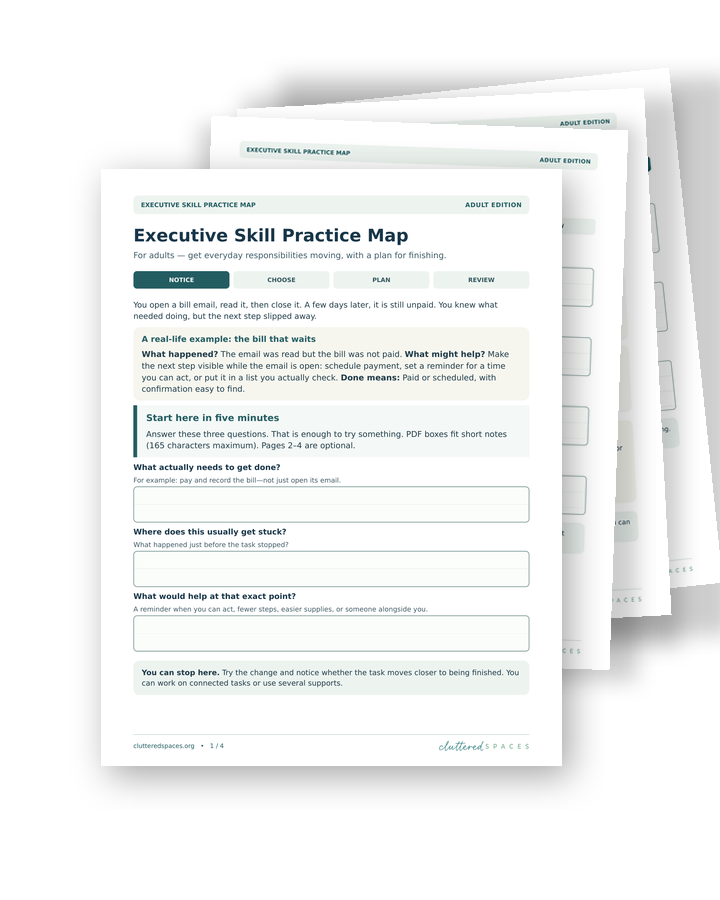
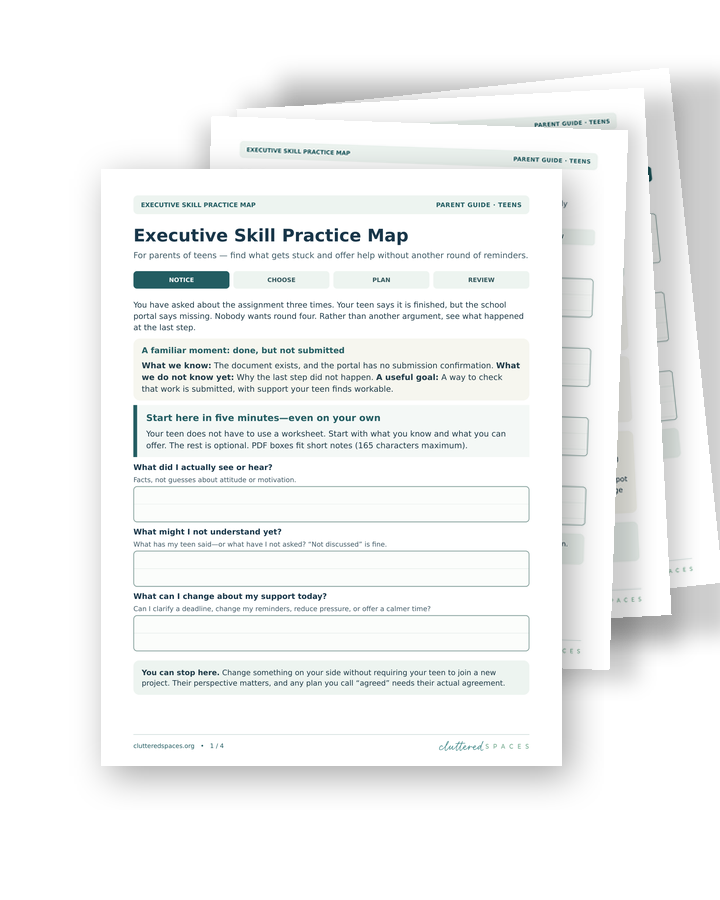
Find support your teen can actually use
The unfinished tasks. The reminders that aren’t working. The plans that fall apart despite real effort.
The free Parent’s Guide includes a worked example and planning pages for choosing supports with your teen. Select “For a teen I support” below. The Adult Practice Map is also available if you want help with your own tasks.
References
Sibley, M. H., et al. (2026). Randomized controlled trial of a peer-delivered high school preparatory intervention for ADHD. Journal of Attention Disorders. Read the study.
Sibley, M. H., et al. (2016). Parent-teen behavior therapy + motivational interviewing for adolescents with ADHD. Journal of Consulting and Clinical Psychology, 84(8), 699–712. Read the parent–teen skills study.
These studies examined specific interventions. The homework examples here are practical suggestions, not a tested treatment program or a promise of improved grades.
Research background: Sibley and colleagues (2026) studied a peer-supported high-school transition intervention for 72 ninth graders with ADHD. Several organization and autonomy measures improved, but primary academic outcomes did not significantly improve. The findings do not prove that the same pattern will occur for every student.