You’re Home but You’re Still Carrying the Day
Heavy work, ADHD, and making room for the people you love
You have closed the laptop. You have made it through traffic. You are standing in your own kitchen, and someone you love asks a perfectly reasonable question.
It lands like one more demand.
You want to hear about their day. You also want everyone to stop talking for approximately seven business days. Your shoulders are up, your thoughts are still arguing with an email, and the smallest decision feels like it requires a committee.
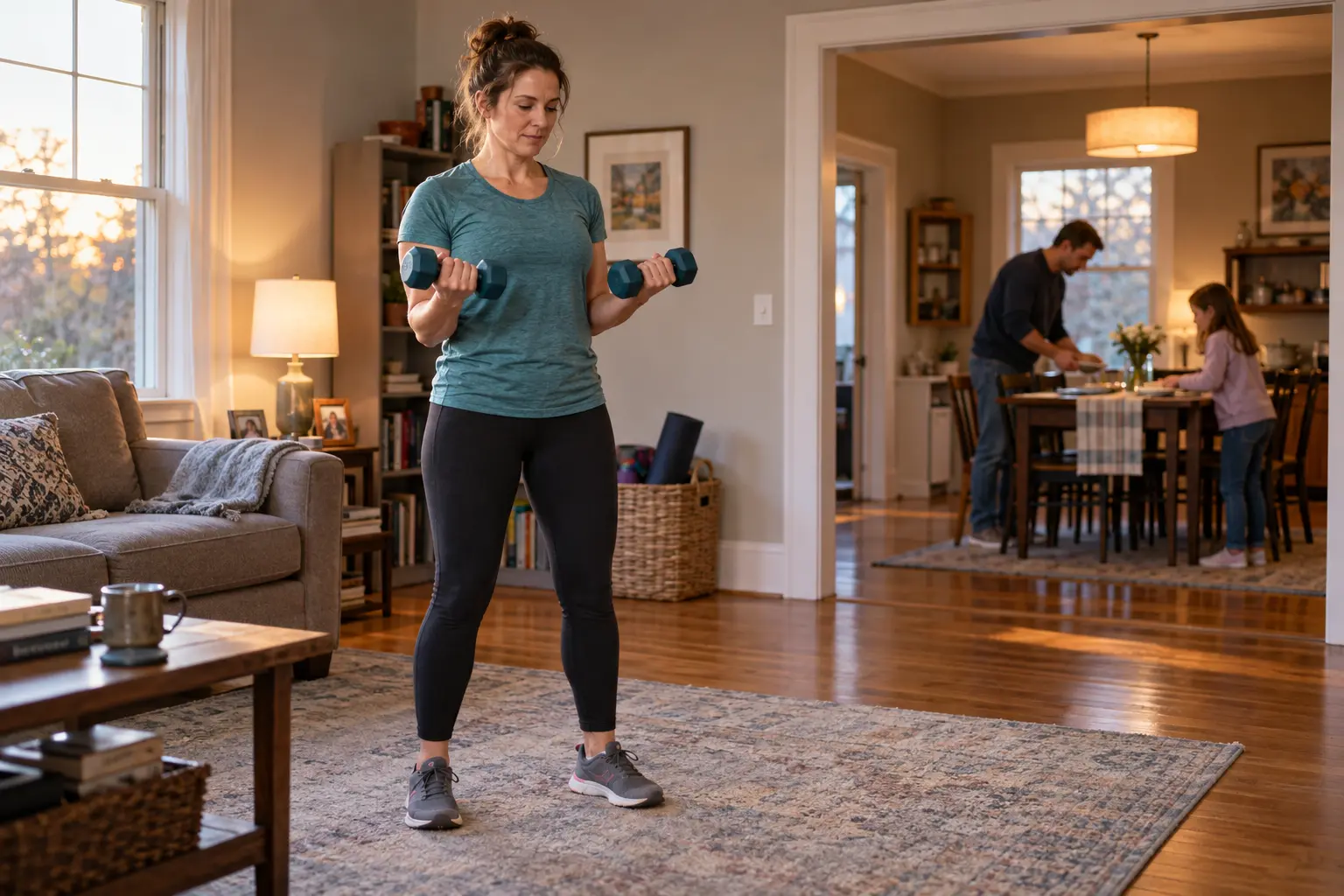
If you have ADHD, that move from one part of the day to another may need more support than closing a door. Sometimes it helps to give yourself a small space between what you have been carrying and what comes next. Movement—including pushing, pulling, or carrying against comfortable resistance—can be one thing to try in that space.
The hope is an evening with a little more room in it: enough to hear the story, enjoy the joke, or sit beside someone without feeling as though every bit of you is already spoken for.
You do not have to arrive ready for everything
Work can mean a paid job, caregiving, appointments, household decisions, or holding things together for other people. A day can ask a lot of you even if you never leave home.
By evening, you may need food, quiet, a change of clothes, movement, or help sharing the load. It is worth noticing which. Exercise will not fix a missing meal or make an unreasonable workload reasonable.
For some people, sitting down immediately feels restful. For others, it leaves them replaying the day with their jaw clenched. If that sounds familiar, a little movement might be a more comfortable way into the evening. You can try it without committing to a whole new fitness personality.
What heavy work might look like for you
“Heavy work” is a term often used in occupational therapy for activities that ask muscles and joints to work against resistance. Think pushing, pulling, carrying, or supporting your body’s weight. These movements give you information about where your body is and how much force it is using.
At home, that might be a few comfortable wall push-ups, a resistance-band exercise you already know how to do safely, kneading dough, or carrying a manageable basket. A brief, chosen household task can work too—provided it does not turn your breathing room into another hour of chores.
You do not need the heaviest weight you can tolerate. You are looking for an activity that feels comfortable and useful to you, with an ending you can recognize. If resistance feels irritating or exhausting, walking, dancing, gentle mobility, or quiet may suit you better.
Movement is a support you can test
Exercise has a place in an overall ADHD management plan. A recent review of adult studies found that a single exercise session could improve performance on tests of inhibitory control—the ability to hold back an automatic response. Results for longer-term exercise were mixed. A small trial of a supported exercise program added to usual ADHD care was encouraging, although dropout and additional skills training limit the conclusions.
Those findings do not establish that a few wall pushes will release the day’s stress or make family conversations easier. Resistance-exercise studies also do not show the same mood benefit every time. The practical question is narrower: after this activity, do I feel a little less wound up, and is it easier to join the evening?
You might describe that feeling as “letting off pressure.” That is a useful description of your experience, rather than proof that stress has been physically emptied out of your body. You do not have to push harder, get exhausted, or feel perfectly calm for the break to be worthwhile.
Make the transition small enough to happen
Start with one existing moment: after you close the laptop, change out of work clothes, or finish an agreed handoff at home. Choose the activity beforehand so your tired self does not have to invent the plan.
If the decision to move is itself too much, begin with a drink of water and a few quiet minutes. Work-recovery research suggests that mentally stepping away from work can sometimes help people get to exercise in the first place. The pause is allowed to come first.
Try an arrival routine you can return to
Here is one example to adapt. The timing is a practical starting point, not a prescribed ADHD dose.
Anchor: After I change out of my work clothes, I take a short transition break.
Start: I put my phone aside and begin one familiar, comfortable movement. I have already chosen what I need.
Usual version: I spend about 10–20 minutes on movement I enjoy. If I choose resistance exercises, I use a routine and technique appropriate for me.
Minimum: On a crowded day, I choose a couple of comfortable minutes, a short walk, or the rest my body needs.
Stop: I finish at the agreed time, or sooner if I feel unwell. I leave enough time to cool down and rejoin the household.
Return: If today falls apart, I try again at the next workable anchor. I do not make up missed minutes.
This can be a brief transition, a place for regular exercise, or both. A short heavy-work activity is not equivalent to a full exercise session. General adult activity guidance includes at least 150 minutes of moderate activity a week, or an equivalent vigorous mix, plus muscle strengthening on two days. Your own starting point and adaptations may differ.
Make room for your evening
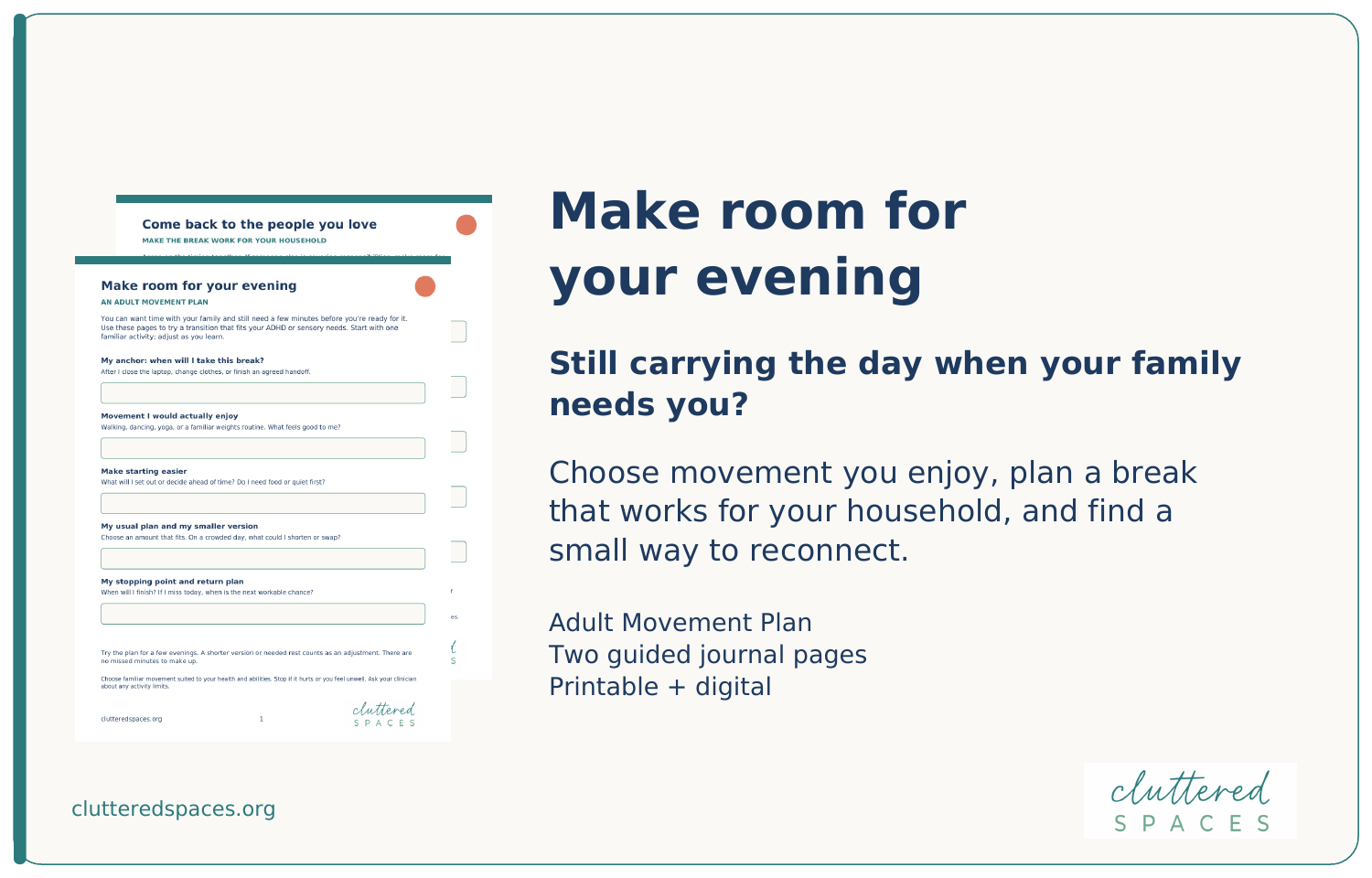
Choose movement you enjoy, plan a break that works for your household, and find a small way to reconnect. The Adult Movement Plan includes two guided journal pages in printable and digital versions.
Let your family know what the break means
A break is easier to understand when the people around you know what is happening and when you will be back. You might say: “I want to hear about your day. I’m still wound up from mine. Can I take ten minutes to move and change, then sit with you?”
Agree on the timing together. If someone else has been handling the children or other responsibilities, make room for their break too. If you are the only adult available, a separate break may not fit; a shared walk, a safe movement activity nearby, or a quieter pause may be more realistic.
If ten minutes becomes half an hour, say so and renegotiate. Returning when you said you would is part of making this feel like support for the household.
Make a little room for connection
Before the break ends, choose one small way to come back. Put the phone down and ask about the funny thing that happened. Sit beside your partner while they finish a task. Listen to the story without also sorting the mail.
You do not need to become the evening’s entertainment director. A few minutes of attention may be the connection you were hoping to make space for.
Sometimes you can move together. Walk around the block, garden alongside each other, or put on music while you get dinner started. Company may feel good; conversation can be optional. If you prefer a few minutes alone, you can say that too.
Movement does not erase an argument or replace an apology. If you snapped earlier, returning might include, “I was overloaded, and I spoke sharply. I’m sorry. I’d like to hear what you were saying.” You can recognize your limits and still take care with the people beside you.
Notice what actually makes the evening easier
After a few tries, ask yourself: Do I enjoy this? Do I feel less wound up or more exhausted? Is joining the family any easier? Does the timing work for everyone? You are looking for something useful, not evidence that you did the routine correctly.
Change one part if needed. A quieter activity, less resistance, a different time, or a smaller plan may fit better. You may discover that food, sleep, fewer evening decisions, or more practical help makes a bigger difference.
If evenings repeatedly feel unmanageable, bring that pattern to your clinician. Sleep difficulties, anxiety, pain, medication timing, and other needs may deserve attention. Movement can sit alongside care; you do not have to solve the whole evening through exercise.
Choose activities suited to your health and abilities. Stop for pain, dizziness, numbness, unusual breathlessness, or unstable joints, and ask a healthcare professional about individual limits. An occupational therapist can help you explore sensory needs when those are disrupting daily life.
Start with the evening you actually have
Choose one transition, one activity you are willing to try, and one small way to reconnect afterward. Tell the people around you what the plan is, and leave room to adjust it.
The people you love do not need a perfectly calm version of you. You deserve a way to come home to your own evening, too.
Related reading: Your Teen, Exercise & ADHD.
References
NICE. Attention deficit hyperactivity disorder: diagnosis and management (NG87). Recommendation 1.6.1 supports regular exercise within ADHD care. Read source
Xu S, Zhao C, Hu L. (2026). The effects of acute and chronic exercise on executive functions and core symptoms in adults with ADHD: A systematic review and meta-analysis. Psychology of Sport and Exercise, 84, 103088. Read source
Svedell LA, Lindvall MA, Holmqvist KL, Cao Y, Msghina M. (2025). Physical exercise as add-on treatment in adults with ADHD: the START study. Frontiers in Psychiatry, 16, 1690216. Read source
O’Sullivan D, et al. (2025). Effects of Resistance Exercise on Depressed Mood State: A Randomized Controlled Trial. PMID 40440519. The acute comparison found no significant group-by-time effect on depressed mood; this was not an ADHD or family-connection trial. Read source
Koch TJS, Nesher Shoshan H, Völker J, Sonnentag S. (2024). Psychological detachment matters right after work: Engaging in physical exercise after stressful workdays. International Journal of Stress Management. An observational diary study, not proof that exercise causes recovery. Read source
CDC. Adult Activity: An Overview. General aerobic and muscle-strengthening guidance. Read source