Your Teen, Exercise & ADHD
Making time for physical activity before expecting your teen to focus again.
By the time everyone gets home, there may be very little patience left in the house—and somehow homework still expects everyone to have some. Your teen is restless, the first assignment feels enormous, and you are trying to decide whether to help, back off, or find everyone a snack.

Movement deserves a place in that picture before the evening reaches its breaking point. A walk, bike ride, dance break, swim, or activity your teen enjoys can become a regular part of the day. Some people also like movement with resistance: pushing, pulling, carrying, or climbing. In occupational therapy, you will often hear that called heavy work.
The useful question is how to make movement a welcome, repeatable part of your family’s ADHD support plan. That includes choosing activities together, making them easier to start, and leaving room for days when everyone has less to give.
A place for exercise in the bigger plan
Regular exercise belongs in the ADHD management conversation. NICE’s clinical guidance recommends emphasizing it for children, teenagers, and adults with ADHD. Studies in children and teens suggest physical activity can help some executive skills, including holding information in mind, resisting an automatic response, and switching mental gears. Other research points to possible benefits for mood and emotional regulation.
Better performance in a study does not guarantee an easier homework session at home. The activity, the support around it, and what else is happening that day all matter. Movement can be worth trying without expecting it to solve every part of the evening.
Exercise can be one useful support alongside treatment, sleep care, school accommodations, and help with everyday tasks. It is not a cure or a reason to change medication on your own. If medication is unavailable, difficult to tolerate, or leaving important needs unmet, a clinician can help you build a fuller plan.
Give movement a place in the day
You do not need a family fitness transformation. You need something that has a reasonable chance of happening again. Start with a moment that already exists: after the afternoon snack, after school pickup, or after dinner.
For example: “After our snack, we move for about 20 minutes.” Let your teen help choose what that looks like. Walking with a playlist, shooting baskets, cycling, dancing, or an adapted seated activity may fit better than a workout someone else picked. The predictable part can be the moment; the activity can change.
Twenty minutes is an example starting point, not a proven ADHD dose or a complete activity recommendation. General guidance for ages 6–17 is at least 60 minutes of moderate-to-vigorous activity daily, with vigorous, muscle-strengthening, and bone-strengthening activity on at least three days a week. A daily anchor can contribute toward those goals.
Start with what fits the person’s health, abilities, and current activity level. If 20 minutes makes the plan feel impossible, choose a smaller beginning. If sports practice already provides regular movement, you may need a cue for getting there rather than another activity.
Make room for movement in your day
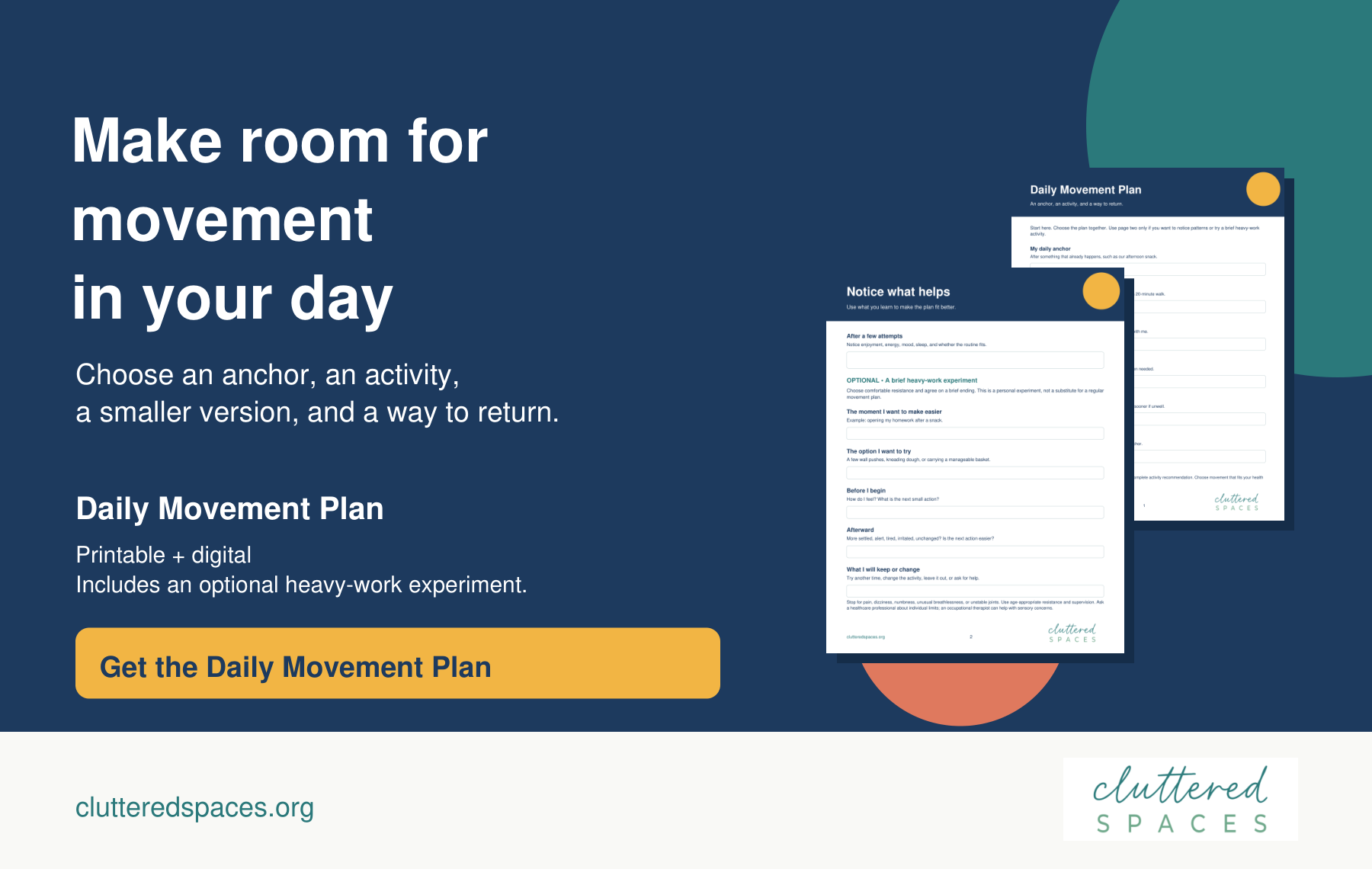
The Daily Movement Plan helps you choose an anchor, a first step, a usual activity, a smaller version, and a way to return. Use page one together; page two offers an optional heavy-work experiment. The printable version has writing space, and the digital version lets you type your plan.
Make the first step almost boring
“Exercise” is a surprisingly large instruction. It can mean finding shoes, choosing an activity, negotiating who is coming, and locating the water bottle that was definitely here yesterday.
Choose the first action ahead of time: put on the shoes by the door, start the saved playlist, or take the ball outside. Ask what kind of company helps. Your teen may want you beside them, a friend to meet, or enough space to do it independently.
Keep a smaller version and a way back
A workable plan includes tired afternoons, late appointments, bad weather, and days when the usual activity is simply too much. Decide on a smaller version while you have the energy to think: five comfortable minutes, one song, or a short trip outside.
Agree on an ending too. “We finish after one loop” is clearer than “Keep going until you have done enough.” Stop earlier if the activity becomes painful or feels wrong. Rest may be the right choice when someone is ill or recovering.
When the routine gets interrupted, return at the next workable anchor. There is no exercise debt to repay. If it keeps falling apart at the same point, change that part of the plan: the timing, the activity, the setup, or the support.
Where heavy work fits
Heavy work asks muscles and joints to work against resistance. It provides information about where the body is and how much force it is using—often called proprioceptive input. “Heavy” does not mean you should strain or add weight until an activity becomes difficult.
Some people enjoy the feeling of pushing, pulling, or carrying. A few wall pushes, kneading dough, carrying a manageable laundry basket, or a safely taught resistance exercise may feel good during a transition. Other people prefer walking, stretching, or quiet. A restless body does not tell us which option will help.
Heavy work can sit within a daily movement routine, or be a brief, optional activity before a particular task. Those are different uses. A few wall pushes are not the same as the exercise programs studied over several weeks. Research on sensory strategies also varies by technique and outcome; it does not establish a universal heavy-work routine for ADHD.
Try it with curiosity
Choose one moment, such as getting ready to start homework. Ask, “Would a short walk, a few wall pushes, or sitting with a snack feel better first?” If your teen wants to try resistance, choose a comfortable activity and a brief ending together.
Afterward, ask how it felt and whether the next step seems any easier. More settled? More awake? Tired or irritated? No noticeable difference? All of those answers help you decide whether to keep it, change it, or leave it out. Looking quieter is not the goal if the person feels worse.
A chance to practice a manageable challenge
There is something useful about meeting a small challenge in an activity you chose. On a walk, you can slow down on the hill. In the pool, you can rest and try again. Learning a dance gives you plenty of chances to get a step wrong without the world ending.
From a coaching perspective, these can be opportunities to practice adjusting, asking for help, resting, and returning. You might notice together, “That part got easier when we slowed down.” You do not need to turn every walk into a lesson about character.
That is different from promising that exercise rewires the brain to handle any difficult situation. Research does not establish that finishing a workout automatically makes homework, disappointment, or planning easier. Those situations still need their own practice and support.
Keep it on their side
Movement should not become the price of being restless, emotional, or behind on work. “You need to do push-ups because you cannot behave” makes support feel like punishment. An invitation leaves room for the young person’s experience: “Would moving help, or is something else getting in the way?”
If the answer is hunger, exhaustion, pain, confusing instructions, or needing company, attend to that. Even after a lovely walk, the assignment may still need to be broken into smaller steps. Exercise does not make every other need disappear.
Notice whether the plan is helping
Look beyond whether homework went well on one afternoon. Is the activity enjoyable enough to repeat? How are energy and mood afterward? Is sleep changing? Does the routine fit family life? You can make a brief note after a few attempts without turning movement into another grading system.
Choose safe activities and age-appropriate resistance. Stop for pain, dizziness, numbness, unusual breathlessness, or joints that feel unstable. Ask a healthcare professional about individual limits or adaptations. An occupational therapist can help when sensory needs are hard to understand or regularly disrupt daily life.
For today, choose one place for movement to land. Ask your teen what they would like to do, make the first step visible, and agree on a smaller option. You are building a routine you can return to, with room to learn what helps.
Make room for movement in your day
Use the Daily Movement Plan to choose your anchor, activity, smaller version, and return plan. Start with page one; add the heavy-work experiment only if it is useful. Available as printable + digital PDFs.
Print and write: Download the printable Daily Movement Plan.
Complete digitally: Download the digital Daily Movement Plan.
Related reading: You’re Home but You’re Still Carrying the Day.
References
NICE. Attention deficit hyperactivity disorder: diagnosis and management (NG87), recommendation 1.6.1. Regular exercise within ADHD care. Read source
Song Y, Fan B, Wang C, Yu H. (2023). Meta-analysis of the effects of physical activity on executive function in children and adolescents with ADHD. PLOS ONE, 18, e0289732. Read source
Song Y, Jia S, Wang X, et al. (2025). Effects of physical exercise on anxiety, depression and emotion regulation in children with ADHD. Frontiers in Pediatrics, 12, 1479615. Read source
Piller A, McHugh Conlin J, Glennon TJ, et al. (2025). Systematic review of sensory-based interventions for children and youth (2015–2024). Frontiers in Pediatrics, 13, 1720179. Read source
CDC. Child Activity: An Overview. General activity recommendations for children and teens. Read source
CDC. Adult Activity: An Overview. General aerobic and strengthening recommendations. Read source