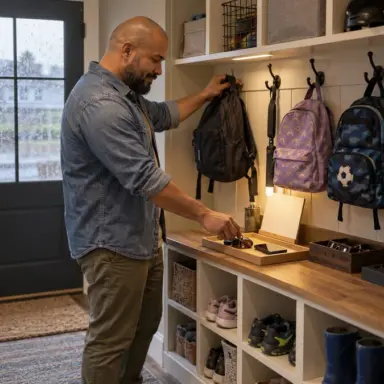
It Was an Easy Request. Now It’s a Tense Standoff: Demand Avoidance and Your Teen
A calmer way to look at pressure, executive functioning, and what happens next.
You are standing in the kitchen, trying to get dinner started, and you ask whether the assignment is done. Your teen says, “I know.” Ten minutes later, you ask again. They argue about how you asked, disappear into their room, or stare at a screen. By bedtime, the work is still there, and neither of you feels good about how the evening went.

Of course you are concerned. You can see the deadline coming, and you may be the person who gets the school email tomorrow. Your teen may be concerned too, even if they are doing an excellent impression of someone who could not care less. Sometimes they were close to starting, but once it became a requirement, it could suddenly feel impossible. When a request turns into a standoff, it is worth asking what happened before you add another reminder. Our guide to supporting a teen when the work still is not getting done offers ways to identify the difficult step together and agree on help your teen can use.
The “no” does not tell the whole story
Demand avoidance simply describes what you can see: a person pulling away from a request or expectation. It does not tell you why. A teen with ADHD may want to do the assignment but struggle to start, shift attention, or keep track of its steps. Another teen may dread getting it wrong, be overwhelmed after school, or need more say in how and when it happens. Several of those things can show up together.
You may also hear the term PDA, short for pathological demand avoidance. Some people prefer “persistent drive for autonomy.” It describes a proposed, more persistent and intense profile, usually discussed in relation to autism, where many ordinary demands can feel hard to meet, including wanted activities. PDA is not a standalone diagnosis in the DSM or ICD, and the research has not established one agreed cause or support plan. A hard week of homework does not, by itself, tell you that your teen has PDA.
When you need help tonight, the useful question is what happened just before the visible no. Did your teen understand the assignment? Were they already overloaded? Did the reminder arrive just as they finally felt settled? Did being watched turn a manageable task into a performance? Their answer matters, even when you still need to hold a boundary.
If this keeps happening, you can come back to one moment later rather than solving it in the kitchen. The guided pages below give your teen a way to write, talk, point, or skip; a separate caregiver page helps you plan one calmer return.
What homework can ask of a tired brain
“Start your homework” sounds like one instruction. Your teen may need to stop a game or conversation, locate the assignment, decide which part to do first, remember directions, tolerate uncertainty, and shift into a different kind of attention. Those are executive function demands. If the work is confusing or feels high stakes, the emotional load arrives too. Then a repeated prompt may make your teen feel that even the timing is no longer theirs.
Executive function difficulty can contribute to a stuck moment, especially for a teen with ADHD; it does not prove PDA. Anxiety, learning differences, sensory overload, poor sleep, and school stress can also matter. Our article on executive function at home explains the skills hidden in daily tasks, and our guide to task transitions looks at the difficult handoff between activities.
You do not have to figure out the whole cause in the middle of an argument. First, give both of you enough room to think.
What to do when the conversation is heating up
Try saying the necessary information once: “This assignment is due tomorrow.” Then pause. More reminders may communicate urgency to you, but feel like more pressure to your teen. If you can, step away and agree on a time to return. A calm written note may work better than calling through a bedroom door. Some teens will want company for the first step; others need privacy. Ask rather than assume.
Offer choices you can actually honor. “Would you rather look at the instructions alone first, or read the first question with me?” gives your teen a say in how to begin. “Do it now or lose your phone” gives them a consequence, but little room to participate in solving the problem. Choices do not make necessary things optional. If safety or a medical need sets a firm boundary, explain it plainly and share control over the parts that can be flexible.
Come back to the stuck point, together
Later, when no one is trying to win the moment, you might ask: “What made starting hard after I brought it up?” It is possible you will hear “I don’t know.” Try a smaller question: “Was it the assignment itself, changing activities, or me checking?” Your teen might identify something you did not see. They might also need time to notice it.
Work with that answer on one experiment. If switching is hard, perhaps your teen chooses 30 minutes of quiet after school and one written check-in at 5:00. If starting is the snag, perhaps the first step is opening Canvas and identifying what is due. If a request feels controlling, ask which parts of the plan they want to choose. Agree on what you will each do, then revisit it together.
If the experiment fails, it is information, not a verdict on your teen. The break may make reentry harder, the directions may still be unclear, or the check-in may feel intrusive. Our Five Whys guide can help you trace where a task gets stuck, as long as the questions remain curious rather than turning into cross-examination.
A page for after the standoff
The teen-led page asks what happened, when it got harder, and what might help next time. The caregiver page asks what you actually observed and which choice you can offer. These are guided journal pages inspired by the Five Whys, but no one needs to answer five questions or defend themselves. Use them after the pressure has eased, with your teen choosing what to share. The printable and digital versions are delivered by email.
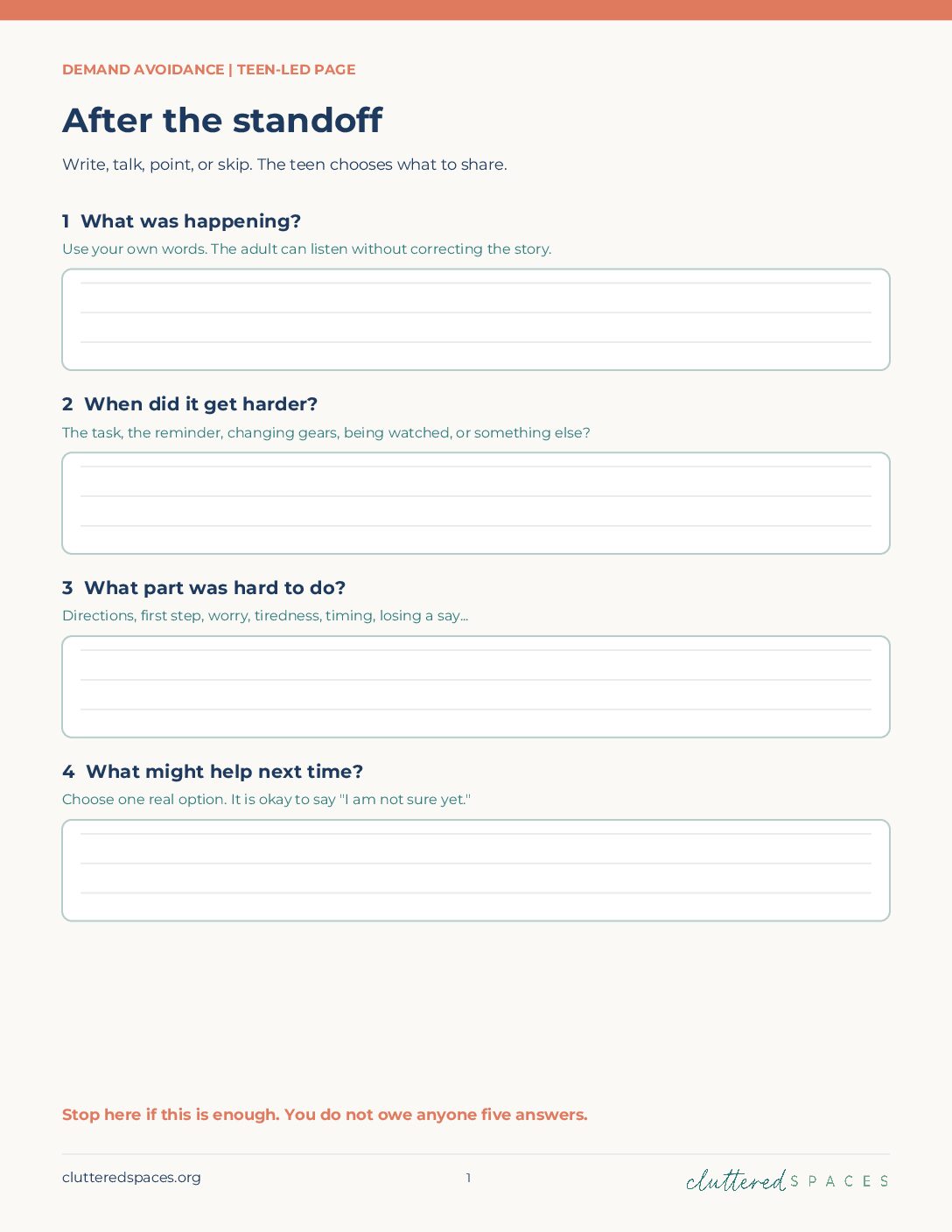
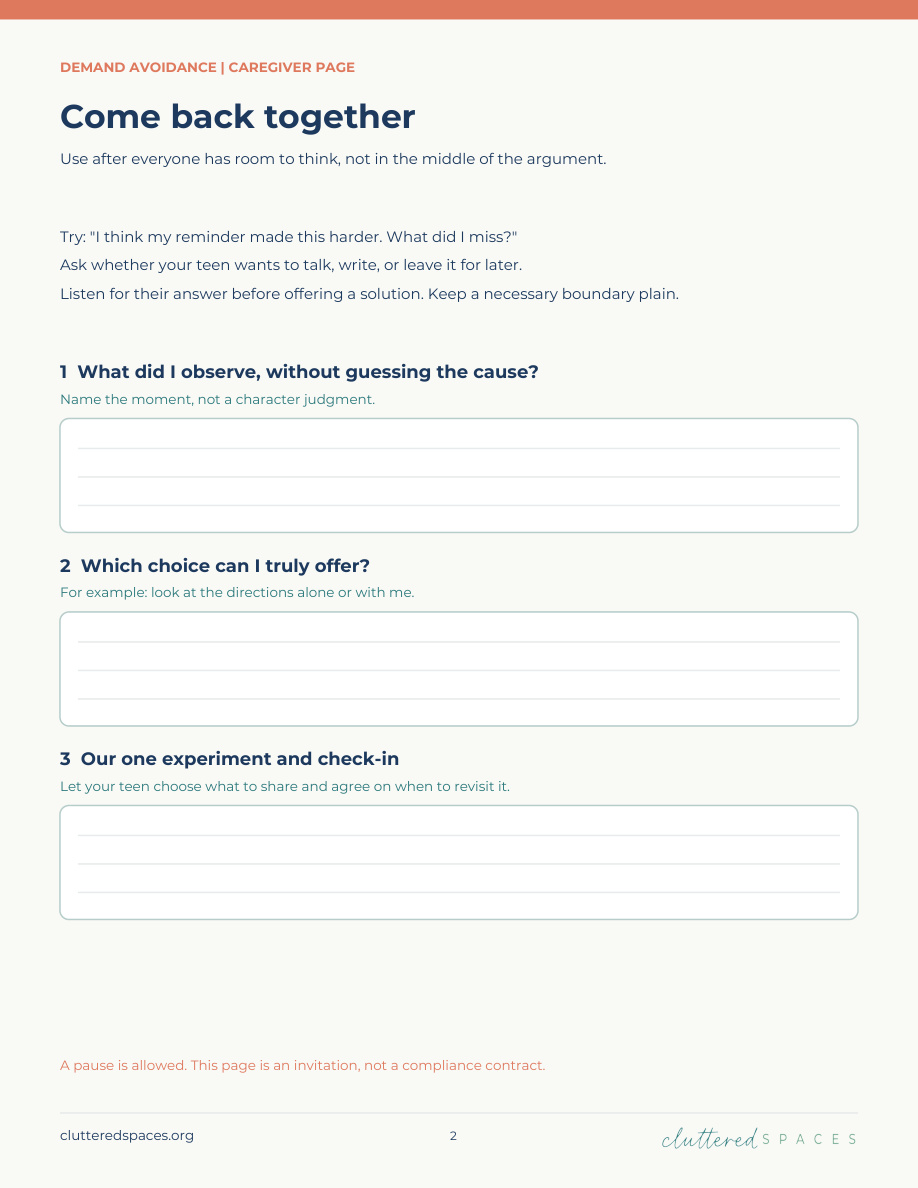
Come back to the moment with less pressure. The teen-led page makes room for their account; the caregiver page helps you look at your own observations and the choices you can offer. Use them after things have settled. Your teen can skip the page or keep answers private. Enter your email for the free printable and digital versions.
You’ll also receive Cluttered Spaces emails. Unsubscribe anytime.
When the whole family needs more support
If your teen repeatedly cannot attend school, sleep, eat, manage hygiene, or take part in ordinary life, seek an individualized assessment from a qualified professional. Bring specific examples and the teen’s own description. Ask the school which expectations can be clarified or adapted. A clinician can assess health and mental health concerns; a coach can help practice planning, transitions, and routines in daily life.
You can care about the assignment and the relationship. Over time, the goal is a teen who can notice what gets in the way, ask for useful support, and take more ownership of what happens next. That work takes more than one Tuesday night.
If another evening goes sideways, the pages can help you return to one moment together. Your teen can decline the page and still have a say in the next experiment. Get the free teen and caregiver pages by email.
Suggested next step: Explore Executive Function Coaching to help your teen practice planning, transitions, and workable routines while keeping their ownership in view.
References
Haire, L., et al. (2024). Methods of studying PDA in children and adolescents: A scoping review.
Company, D., & Rotella, J. A. (2026). A systematic review of pathological demand avoidance.
Suriano, R. (2026). ADHD and procrastination: A systematic review.