
When Rejection Feels Certain
Your feeling is real. The meaning may still need checking.
The text says, “Okay.”
That is all it says. One word. A perfectly ordinary word that, today, feels like it has personally asked you to leave the friendship.
You read the messages above it. Were you too much? Did that joke land badly? Should you explain what you meant? You start typing an apology, then delete it because you are not entirely sure what you are apologizing for.
Meanwhile, the coffee is getting cold, and the thing you sat down to do has disappeared behind this much more urgent question: Are we okay?
If you recognize that moment, you probably do not need anyone to explain that a text can be hard to read. You know that. Knowing it may do very little for the feeling in your chest.
What can help is having somewhere to put both things: the hurt you feel and the information you actually have. Neither needs to be pushed aside.

The hurt can arrive before the explanation
Rejection sensitivity is a name for a pattern of expecting rejection, noticing possible signs of it, and feeling its impact strongly. It might show up when someone seems disappointed, a friend does not invite you, or feedback lands much harder than you expected.
You may want to explain yourself immediately. You may go quiet, cancel your own plans, or decide you will stop asking for things. From the outside, it might look as though you have moved on. Inside, you are still revisiting a conversation from Tuesday.
Sometimes the painful part is followed by another thought: Why am I like this? Other people would not care this much.
That is a lot to carry on top of already feeling hurt. You do not have to scold yourself into being easier to reassure.
Many people with ADHD have difficulty managing strong emotions, although experiences vary. You may hear especially intense rejection-related pain called rejection sensitive dysphoria, or RSD. It is not a standalone formal diagnosis, and it does not describe everyone with ADHD. The experience can still deserve support. Research and background sources are linked in the references below.
Sometimes this moment has company
Perhaps “Can you fix this?” arrives with memories of being called careless. Perhaps a friend’s frustration reminds you of all the times you were told you talked too much. A request for clarification can feel different when asking questions has previously earned you an eye roll.
If that is part of your history, it makes sense to include it when you are trying to understand why something hurt.
For autistic people and other neurodivergent people, the details may be different: being misunderstood, having a need dismissed, or working hard to navigate communication that never feels particularly clear. There is no single neurodivergent experience of rejection.
And sometimes someone really is unkind. We need room to notice that, too.
A useful question is: “What happened today, and what did it bring up for me?” You can be compassionate about both answers.
“I feel unwanted” and “I am unwanted” are different places to land
The first tells us something about your experience. The second reaches a conclusion about your place in someone else’s life.
When you are hurting, the distance between them can be very small.
You do not need to replace the conclusion with “Everyone loves me and everything is fine.” You might not believe that, and you do not have enough information to promise it anyway.
Try something you can stand behind:
That sentence leaves you with options. You can ask a question, give something time, name a need, or decide a boundary would help.
The What do I feel? What do I know? guided journal page gives those thoughts a little space on the page. It is a one-page reflection for moments when a feeling and a conclusion have become tangled. You can write a few words or talk it through with someone you trust. You do not have to make yourself feel differently to use it.
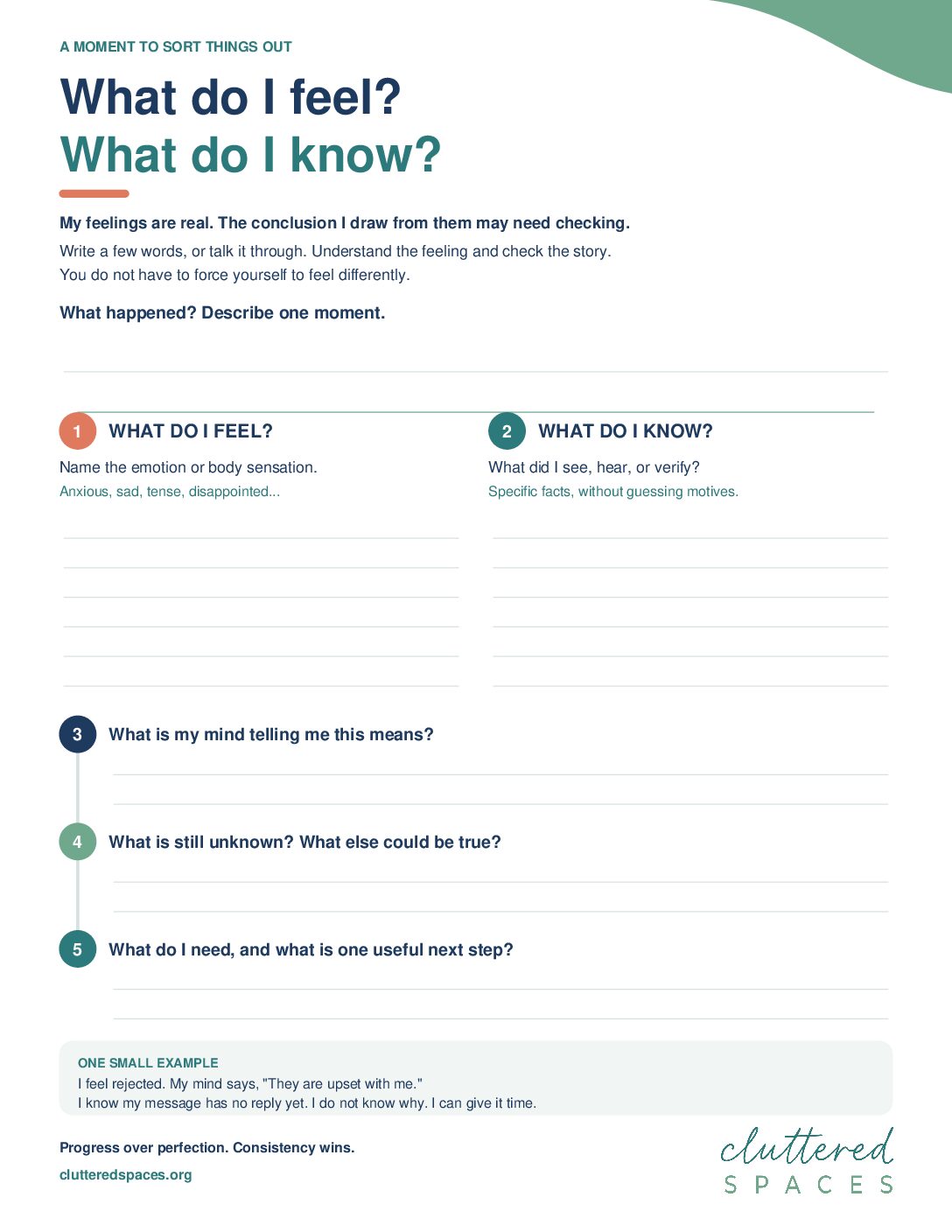
Give the feeling and the facts a little space.
What do I feel? What do I know? — Guided Journal Page
Your feeling is real. The meaning may still need checking. Use one moment to sort what you feel, what you know, and what would help next.
Use the printable PDF to write by hand or the digital PDF to type and save your answers. A few words are enough.
Enter your email to get the free guided journal page.
Requesting the free guided journal page also subscribes you to Cluttered Spaces emails. Unsubscribe anytime. Open the signup page · Privacy policy
Try it with one moment, not your entire relationship history
Before you begin, make yourself a little more comfortable if you can. Put the phone down. Move away from the noise. Take a moment before answering. “I need a little time to think” is a complete sentence; you can agree on when to return to the conversation.
For this example, imagine that a friend has canceled dinner and said they are exhausted. You were looking forward to seeing them. Now you are wondering whether they were looking forward to seeing you.
Start with the guided journal page’s opening question: “What happened? Describe one moment.” A sentence is enough: “My friend canceled tonight’s dinner and said they were exhausted.”
1. What do I feel?
“Disappointed. Lonely. Embarrassed that I was so excited. My stomach feels tight.”
Let the answer be honest. You can understand that people get tired and still be sad that your evening changed. You do not need to earn permission to be disappointed.
2. What do I know?
“They canceled dinner. They said they were exhausted. They have not suggested another day.”
Stay with what you saw, heard, or verified. “They are tired of me” may be what you fear, but it is not something they said.
Relevant history belongs here as well. If this is the fourth cancellation, write that down. The exercise works best when you let the facts be what they are.
3. What is my mind telling me this means?
“I matter less to them than they matter to me. I should stop trying.”
It can feel tender to write that. You are giving words to the part that hurts, so you can look at it with a little care.
4. What is still unknown? What else could be true?
“I do not know whether they want to reschedule. They may really need rest. There may also be something about our friendship that we need to talk about.”
You are allowed to finish with “I do not know yet.” There is no prize for producing the most optimistic explanation.
5. What do I need, and what is one useful next step?
“I need connection, and I need to know whether to make another plan with them.”
You might reply: “I’m disappointed we won’t see each other, but I understand needing rest. Would you like to choose another day?”
Then think about your own evening. Would calling someone else help? Would you still enjoy the meal you had planned? You can care about this friendship while also caring for the person sitting here feeling lonely: you.
Make one pass through the guided journal page. It is a place to organize your thoughts, not an assignment to repeat until you feel certain.
The executive skills are hiding in these small steps
Pausing a reply, remembering what was actually said, and making room for a different explanation all ask something of your executive skills. Here is what that can look like in an ordinary conversation.
Working memory: keeping the whole picture nearby
You want to remember the message, the context, and the question you meant to ask. That is a lot to hold while upset.
Write it down. A few words on the guided journal page can hold the information while you work out what you need. You can also bring one written question into a conversation so it does not vanish when you start talking.
Cognitive flexibility: leaving room for another possibility
“They are angry with me” may be the first explanation that appears. Flexibility helps you consider what else could fit and adjust when more information arrives.
You are practicing “There may be more to understand here.” You do not have to agree with someone else’s explanation or abandon your own experience.
Inhibition control: giving your response a little time
You may want to send the long explanation, apologize for everything, or announce that you will never bother them again.
Try drafting in a note instead of the message thread. Give yourself a return time. Ask, “Is this what I want to say, or do I need a little more time to find the words?”
These are skills you can practice with support. Needing a note, a pause, or someone beside you does not make the practice count less.
What if someone really did hurt you?
Then that matters.
You can feel things intensely and still recognize disrespect. You can misunderstand one detail and still need a boundary. You do not have to prove that your reaction was perfectly measured before asking someone to stop making jokes at your expense.
“I’m willing to talk about the mistake. I’m not willing to be called names” is a reasonable place to begin.
And if you responded in a way you regret, you can repair that part without taking responsibility for the whole interaction: “I’m sorry I raised my voice. I still want to talk about what happened.” We explore this further in When Trust Gets Broken: Repair, Boundaries, and ADHD.
When you are helping someone you care about
“You’re overthinking it” rarely gives a hurting person somewhere useful to go.
Try: “That sounds painful. Do you want me to listen, or would it help to sort through it together?”
If they want to use the guided journal page, let their words lead. You can write while they talk. The page should help them understand their experience; it should not become evidence that you were right about what happened.
For teens who find themselves predicting difficult conversations before they happen, When Your Brain Decides It Will Go Badly offers a related example.
You can start before you feel completely better
Some days, the whole guided journal page will feel manageable. Other days, your version might be: “This hurts. I do not have to answer immediately.”
If these experiences regularly take over your sleep, relationships, or daily life, you deserve more support than a page can offer. A mental-health professional can help you work through the distress. Coaching can support the everyday practice of pausing, preparing conversations, and following through. If checking the facts itself becomes something you cannot stop repeating, bring that up with a clinician too.
When you are ready, return to What do I feel? What do I know? with one moment in mind. Use short phrases. Leave a box unfinished if you need to. Look for one next step that takes both the situation and your needs seriously. If the conclusion has grown from “that interaction hurt” into “everything is hopeless,” When One Hard Moment Makes Everything Feel Impossible walks through separating the event from that larger conclusion.
You are allowed to want reassurance, connection, and a place to belong. You are also allowed a little time to understand what happened before deciding what it says about you.
Progress over perfection. Consistency wins.
For educational purposes only. Not a substitute for professional medical or mental health advice.
References
Cleveland Clinic. Rejection Sensitive Dysphoria (RSD). Background on the term and its diagnostic limitations.
Shaw, P., Stringaris, A., Nigg, J., & Leibenluft, E. (2014). Emotion dysregulation in attention deficit hyperactivity disorder. American Journal of Psychiatry, 171(3), 276–293.
Diamond, A. (2013). Executive functions. Annual Review of Psychology, 64, 135–168.
NHS Every Mind Matters. Reframing unhelpful thoughts. General guidance on examining evidence and alternative interpretations; not specific validation of this article’s exercise.