When Everyday Tasks Feel Harder Than They Should: Look at the Environment
You need to pay a bill. But the statement is in a stack of mail, the password is on another device, and you aren’t sure whether the payment is already scheduled. Twenty minutes later, you’ve opened six things and still haven’t paid it.
Before deciding you’re bad at ordinary tasks, ask another question: How much extra work is your environment adding?

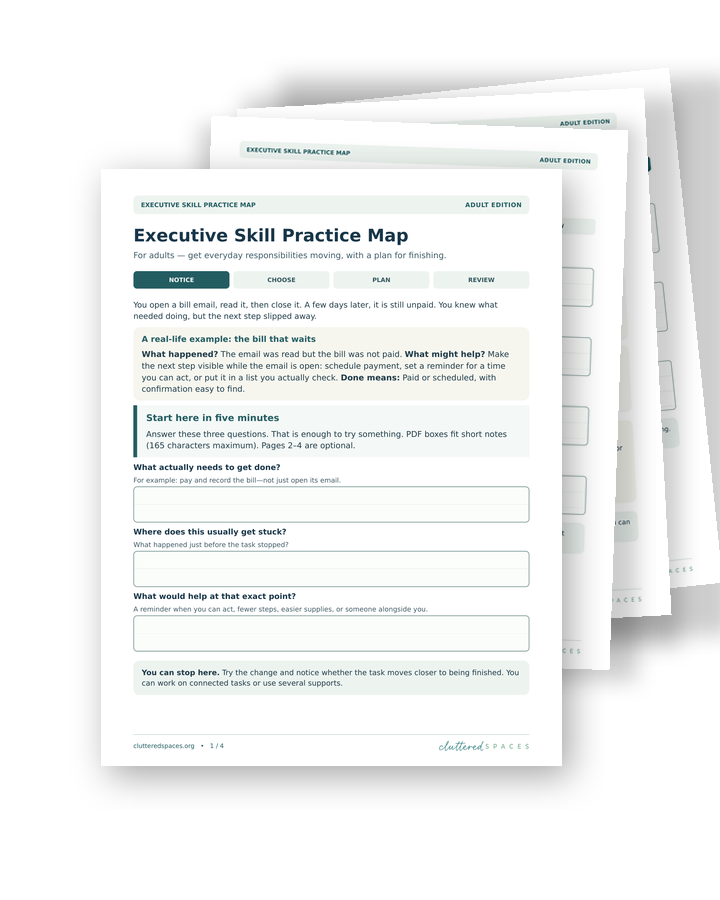
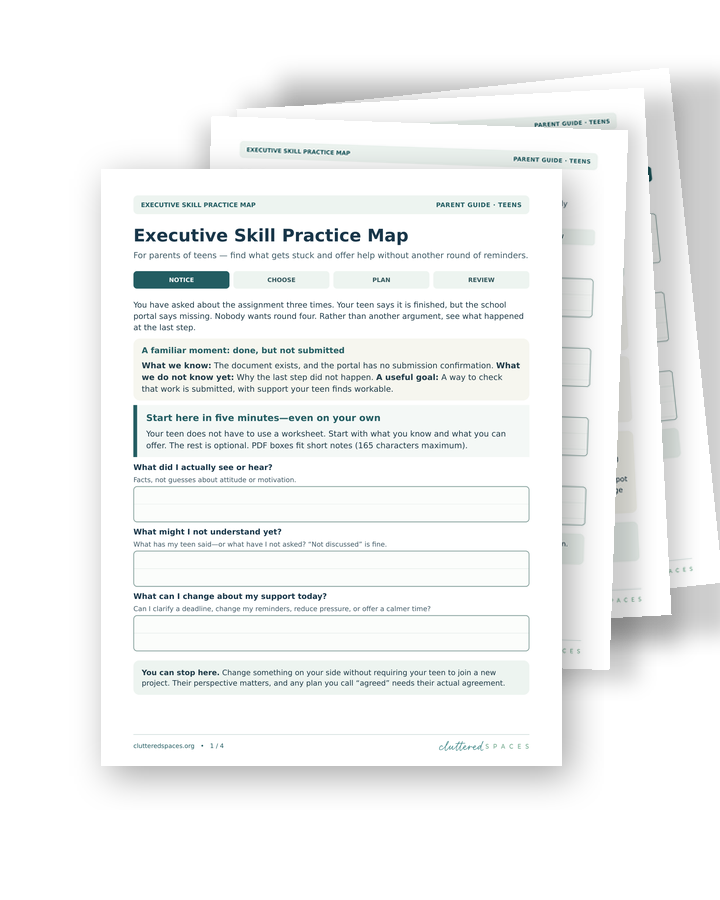
The Executive Skill Practice Map helps you turn an observation into an experiment. For a bill that keeps waiting, you might identify the missing statement and password as barriers, keep the statement where you can find it and use a secure way to retrieve your login, and notice whether starting becomes easier. Choose the adult version for yourself or the parent’s guide when supporting a teen.
Every extra step asks something of your brain
Planning, remembering, switching attention, and beginning draw on executive-function skills. Your surroundings can influence how much you need to rely on them. If a task requires searching, choosing, checking, and moving from place to place before you even begin, the environment may be increasing the load.
Take medication as prescribed, for example. A consistent location, an appropriate reminder, and a safe method for recording doses can reduce steps. Any setup still needs to follow medical instructions and safe storage requirements.
Look at the whole process, not just the visible task
Grocery shopping starts long before the store. There may be meal decisions, checking supplies, making a list, arranging transportation, budgeting, shopping, and unpacking. Someone can know how to shop and still get stuck before leaving home.
The helpful question isn’t simply ‘Can you grocery shop?’ It’s ‘Which parts are manageable, and where would support help?’
Reminders aren’t the only support
Moving reusable bags near the door, giving incoming mail a consistent location, storing breakfast supplies together, or keeping supplies near the work area can reduce friction. None of these changes has to be elaborate. The best changes address what actually stops the process.
There isn’t one correct setup for every brain
Open shelves help some people see what they own but distract others. Noise, harsh lighting, uncomfortable seating, or supplies that are painful to reach can also make a task harder. Ask about sensory comfort and physical access as well as remembering and organizing. Wall calendars work for some families; phone reminders suit others. Ask the person using the system what feels useful, sustainable, and acceptable rather than imposing a solution because it looks organized.
Supports and independence can coexist
A young adult who can wash and fold clothes but doesn’t notice when laundry needs starting may benefit from a recurring cue. Using a cue doesn’t erase independence. Adults use calendars, automatic payments, shopping lists, and reminders every day.
Change the environment, then observe
Choose a task that repeatedly stalls. Walk through it from the very beginning. Notice where you search, remember, decide, or move between rooms. Try changing the steps that add unnecessary work—and observe whether it actually helps.
Some difficulties require instruction, practice, physical assistance, or other supports rather than environmental changes alone. The point is to find the actual barrier, not assume every problem has the same answer.
You know what needs to happen. Why does it keep getting stuck?
The unfinished tasks. The reminders that aren’t working. The plans that fall apart despite real effort.
The free Practice Map helps you notice where things get stuck, choose practical supports, and try a different approach. Choose the version that fits you.
References
LaPoint, S., Kim, S.-Y., Ji, H., Lee, D., Ryu, I., & Kim, S. Y. (2026). A systematic review of environmental structuring interventions for autistic individuals. Education and Training in Autism and Developmental Disabilities. Read the study.
Research background: LaPoint and colleagues (2026) reviewed environmental supports for autistic individuals. Their review emphasizes user perspectives and accessibility, but it does not directly establish the effectiveness of any specific household or independent-living adjustment.