
When Fear Makes Everyday Tasks Feel Bigger
There is an envelope on the counter. You have moved it to wipe underneath it, stacked it neatly with other mail, and briefly considered buying a nicer basket for it. Opening it has somehow remained a separate project.
For the broader picture, explore executive function skills for independent living. For school and friendship situations, see When Your Brain Decides It Will Go Badly.

Maybe you are afraid it contains a bill you cannot manage. Maybe it will ask you to make a phone call, find paperwork, or explain something you wish you had handled earlier. Before you know what is inside, you are already carrying the weight of the possible next five steps.
Separating fear from fact can help you find a place to begin. For executive function and independent living, the useful part comes next: using that information to choose an action, identify the support it needs, and follow through.
The feeling belongs in the conversation
“I feel afraid to open this” describes your experience. “Whatever is inside will be impossible to handle” predicts an outcome. The feeling is real; the prediction still needs room for information.
Fear may point toward something that genuinely needs attention. Money may be tight. A deadline may have passed. Previous calls may have been frustrating or humiliating. Those facts belong on the page too.
The aim is a realistic response. You do not have to replace every worry with a cheerful thought. Sometimes the most useful conclusion is, “This might be difficult, and I need help with the next part.” The NHS guidance on examining unhelpful thoughts similarly encourages checking evidence and considering other perspectives.
Where executive function gets involved
Everyday tasks ask us to keep information in mind, decide what matters, adjust our plan, and get started. Those demands draw on executive function. Working memory, mental flexibility, and self-control are interconnected parts of that system, as described in Harvard’s executive function overview.
Consider making an appointment. You might need the phone number, your calendar, information the office will ask for, and words to start the conversation. If you are also predicting that you will sound foolish, it becomes harder to identify which part actually needs support.
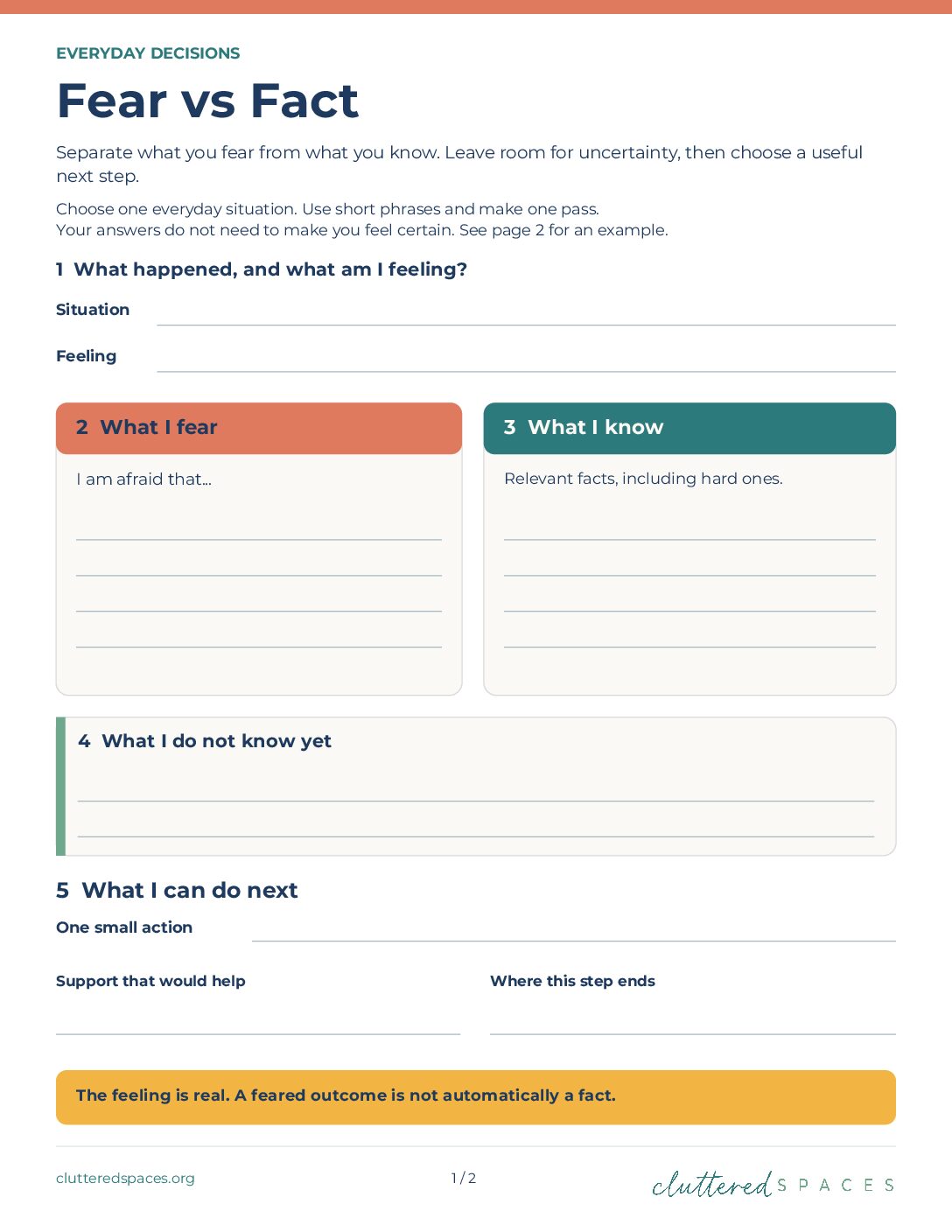
Our Fear vs Fact guided journal pages put those pieces somewhere you can see them. You record the information instead of trying to hold everything in mind. You leave space for another interpretation. Then you choose a step and a cue for returning to it. The useful question is whether the page helps you identify and attempt a manageable next step.
Get the free Fear vs Fact guided journal pages by email. Use the printable or digital version to name one worry, record what you know, leave room for uncertainty, and choose a supported next step. The example below shows how the shared guided journal pages apply to adult responsibilities.
Put the worry and the information side by side.
Fear vs Fact — Guided Journal Pages
Choose one everyday situation. Notice what you fear, what you know, and what is still uncertain. Then choose one step and the support it needs.
Use the printable PDF to write by hand or the digital PDF to type and save your answers. A few words are enough.
Enter your email to get the free guided journal pages.
Requesting the free guided journal pages also subscribes you to Cluttered Spaces emails. Unsubscribe anytime. Privacy policy
Try it with an appointment you have been putting off
Choose one ordinary situation. Brief notes are enough. You can talk through the prompts with someone you trust if writing adds another obstacle.
Name what happened and how you feel
“I received a reminder to schedule an appointment. I feel embarrassed because I have put it off.”
That is a specific starting point. “I am terrible at being an adult” is a much larger conclusion, and it gives you very little help finding the phone number.
Write the feared outcome
“I am afraid I will forget what to say and the person answering will judge me.”
You are naming the fear without having to prove or dismiss it.
Record what you actually know
“I have the office number. I need to schedule an appointment. I have lost my words on calls before. I can keep a note in front of me.”
Include the uncomfortable detail. Forgetting what to say has happened before, so a script is a reasonable support. It does not tell you how the person answering will respond this time.
Leave room for what you do not know
“I do not know which appointments are available or exactly what questions they will ask.”
You can prepare for likely questions without rehearsing every possible conversation. Guidance on worry and uncertainty distinguishes useful problem-solving from trying to eliminate uncertainty.
Choose an action and its support
“After lunch, I will write: ‘Hi, I received a reminder and would like to schedule an appointment.’ I will put my calendar and the office number beside it.”
That preparation step ends when the script and materials are ready. Choose a call time within office hours and set a reminder. If you book the appointment, enter it in your calendar before putting the phone away. If the office is closed or you need more information, record the actual next step.
The sequence gives you something to do with what you learned. You do not have to feel completely calm before proceeding.
When the facts reveal a real obstacle
Sometimes you open the envelope and discover that the bill really is overdue. Fear vs Fact has not failed. You now have information your plan needs to account for.
Record the requested action and date. Decide what help you need to understand your options. If you cannot pay, finding appropriate assistance is part of the next step; a more encouraging thought will not create the missing money.
The same distinction matters with household skills. “I will ruin the clothes” may include a prediction and a real knowledge gap. If you have never learned the settings or care labels, ask for a demonstration with one suitable load. A visible checklist can hold the sequence, and a timer can help you return for the next step.
When a task keeps getting stuck, the Five Whys can help you explore the practical barrier until there is something changeable: unclear instructions, missing supplies, a task that needs to be smaller, or assistance you have not had access to.
Independence can include a script and another person
Managing everyday life includes recognizing what you need and choosing how to get it. A reminder, written guide, accessible system, or trusted person can remain part of a workable routine.
Perhaps you want someone beside you while you open mail. Perhaps you want help drafting a work message after a missed deadline. You can decide what their participation looks like: “Help me identify the first action,” or “Stay with me while I make the call, and let me do the talking.”
Harvard’s guide to building adult life skills supports collaborative practice in real situations and practical aids such as reminders. In coaching, we can apply that approach by working alongside you on the actual responsibility and adjusting the support as you learn what works.
Past difficulty deserves attention too. If previous attempts ended in criticism or overwhelm, another attempt may feel loaded before it begins. When Not Trying Feels Safer explores that protective pull toward avoidance.
How to use the shared guided journal pages
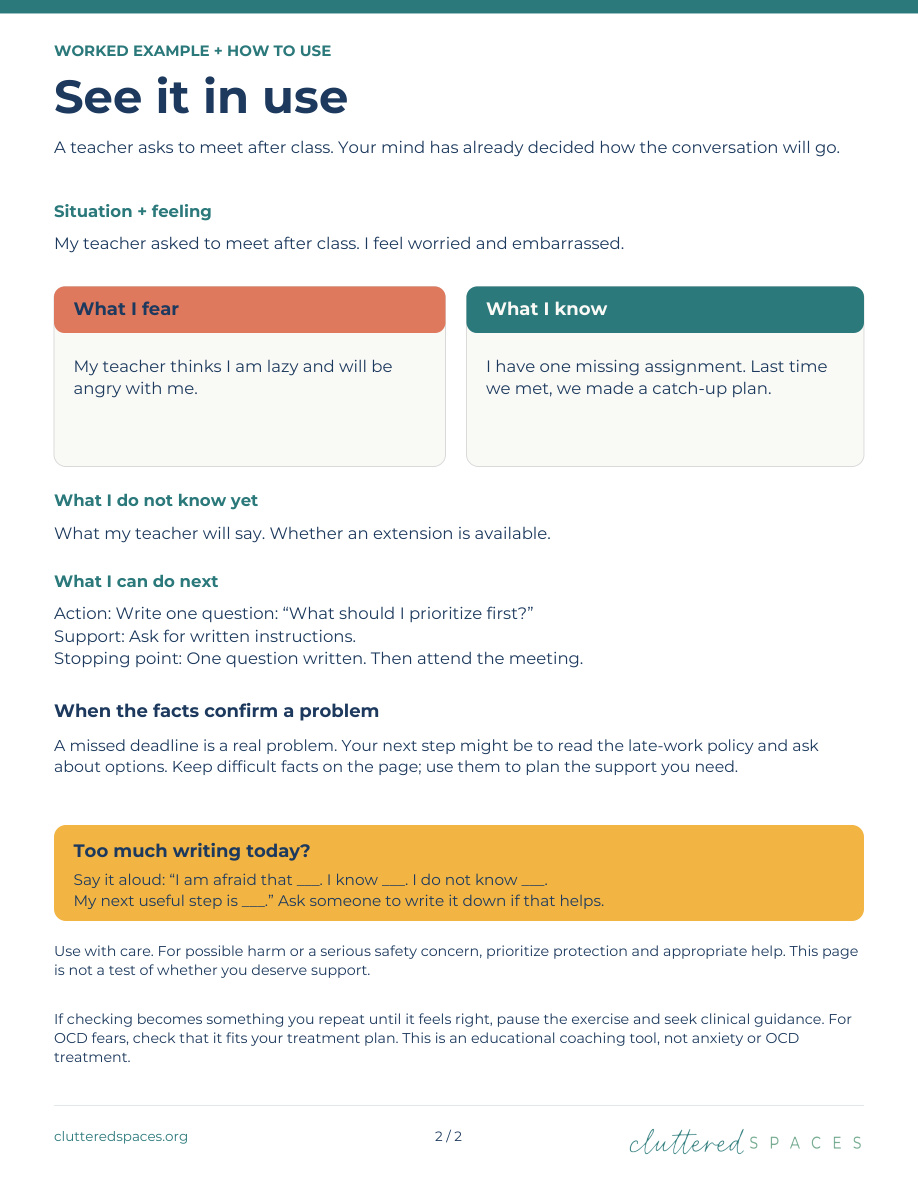
The Fear vs Fact guided journal pages is a two-page tool: a reusable page, followed by a completed teacher-meeting example and a shorter spoken version. Adults and teens use the same prompts. For an adult example, use the appointment walkthrough in this article.
Choose one situation and make one pass through the page. Write short phrases or type into the digital PDF. Download the digital file, open it in a PDF reader that supports forms, and save your answers.
In the next-step space, name an action you can begin. In the support space, include the cue, materials, instruction, or person that would help. Give the step a stopping point. Later, review what happened once: did the support help, and what needs adjusting?
If writing feels like too much, say: “I am afraid that ___. I know ___. I do not know ___. My next useful step is ___.” Someone else can write down the plan with your permission.
This expands the “Separate facts from predictions” step in the NEST Avoidance Reset. You can use the guided journal pages on its own; there is no requirement to complete a collection of tools before opening one envelope.
When the guided journal pages need backup
If you may be facing harm, coercion, discrimination, or a serious safety concern, prioritize protection and appropriate help. You do not have to disprove a fear before seeking support.
Repeatedly checking the evidence until you feel certain can become reassurance-seeking, particularly in OCD. The International OCD Foundation’s guidance on reassurance explains this concern. If you have OCD, check with your clinician before applying this exercise to obsessional fears. Stop repeating it for certainty if that becomes its purpose.
When worry regularly disrupts sleep, work, relationships, or basic care, a mental-health professional can help. This is an educational coaching resource, not an anxiety or OCD treatment.
One responsibility and one useful step
Choose something you want to approach: one envelope, one appointment, one message. Get the free Fear vs Fact guided journal pages by email and use it to separate the prediction from the available information, then name the action and support you need.
You may still feel worried. You can also have the phone number, a first sentence, and someone beside you. That is a more usable place to begin.
For educational purposes only. Not a substitute for professional medical or mental health advice.
References
Center on the Developing Child at Harvard University. InBrief Executive Function. Background on working memory, mental flexibility, and self-control.
Center on the Developing Child at Harvard University. Building the Skills Adults Need for Life A Guide for Practitioners. Guidance on collaborative practice and supports for everyday skills.
NHS Every Mind Matters. Reframing unhelpful thoughts. Guidance on examining evidence and considering other interpretations.
Centre for Clinical Interventions, Government of Western Australia. Worry and Rumination. Resources on problem-solving, worry, and uncertainty.
Claggett Woods, C., International OCD Foundation. For Faith Leaders. Sections on validation and reassurance-seeking support the OCD caution; faith-specific examples are not used here.