You’re Exhausted. So Why Are You Still Awake?
ADHD, winding down, and making room for sleep without giving up the only part of the day that feels like yours
All afternoon, you imagined going to bed early. You were tired during the meeting, tired while making dinner, and tired while looking for the thing you had in your hand thirty seconds ago.

Now the house is quieter. Nobody needs an answer. You finally have a little room to think.
Naturally, this is when you decide to research a new hobby, finish a project, or watch something that has absolutely nothing to do with being a responsible adult.
You look up. It is tomorrow.
Or maybe you do make it to bed, only to lie there while your brain reviews the day and schedules several imaginary meetings. You want to sleep. You are actively trying to sleep. Apparently, sleep has other plans.
Both experiences can happen with ADHD. They may look similar from the outside, but they need different kinds of attention. An evening that keeps getting away from you is different from giving yourself time to sleep and still being unable to.
Before buying another pillow or declaring that you need more discipline, it helps to find out which part is getting hard. If stopping an activity is the problem, begin with the practical ideas under “Build an ending you can actually use.” If you are making time for sleep but cannot settle or keep waking, the sections on waking and getting more help may be more useful. You do not need to work through every suggestion.
Sometimes the hardest part is letting the day end
If you spend much of your day responding to other people, nighttime may feel like your first chance to choose what happens next. Going to bed can feel like giving that time back before you have had enough of it.
That does not mean staying up is working well for you. It does mean that “stop scrolling” may leave an important need unanswered.
Ask yourself what the late hours are giving you. Quiet? Privacy? Something interesting? A chance to finish without interruption? You may discover that you are trying to fit an entire personal life into the hour before bed.
If so, protecting a small pocket of choice earlier in the evening might be a useful experiment. It will not solve a sleep disorder, but it may make ending the day feel less like losing something. A familiar show after dinner, time with a hobby, or ten minutes outside can count. It does not have to become another self-improvement assignment.
There is also the transition itself. Stopping, noticing the time, remembering the bedtime steps, and leaving an interesting activity all ask something of your executive function. Our article on understanding executive function explains why knowing what you intend to do does not automatically get you there.
A bedtime alarm can announce a decision. It cannot make all those steps happen for you.
Your body has a clock, even when you have lost track of yours
Sleep depends partly on the need for rest that builds while you are awake and partly on your circadian rhythm: your body’s roughly 24-hour timing system. That rhythm helps determine when you feel alert and when sleep comes more easily.
You can feel worn out without feeling ready to fall asleep. Some adults with ADHD and difficulty falling asleep have a delayed body clock, meaning their sleepy window arrives later. That is one possible pattern, not an explanation for everyone with ADHD.
Light is one of the signals that helps set that clock. Bright evening light can keep sending a daytime message. Daylight after waking can help reinforce the start of the day.
If you routinely cannot sleep until very late but sleep more comfortably when allowed to follow a later schedule, tell your healthcare provider. A late preference alone does not establish a disorder. A persistent mismatch with work, family, or daily life is worth investigating.
Moving your bedtime three hours earlier does not necessarily move your body clock with it. If timing is the problem, get help with timing rather than spending those hours trying harder to be unconscious.
Find the stuck point before you build the routine
For a week or two, notice where things go sideways. Are you delaying the start of bedtime? Are you in bed but unable to settle? Are you falling asleep and then spending long stretches awake? Or are you getting what seems like enough sleep and still feeling unrefreshed?
A few notes can help: roughly when you got into bed, when you think you fell asleep, any prolonged awakenings, when you woke, and how you felt the next day. Include caffeine, naps, and medication timing when relevant. Estimates are useful; you do not need to keep checking the clock to produce accurate data.
If tracking becomes one more thing you dread, use a morning note with just three observations: bedtime, wake time, and how rested you feel. Bring what you have to your clinician. The point is to make the pattern easier to see.
Build an ending you can actually use
If getting to bed is the part that keeps slipping, try making the transition more concrete. These are practical experiments, not a treatment plan for insomnia. Choose one that fits your evening.
Decide what stopping looks like
“I’ll stop soon” has a remarkable ability to survive several hours without becoming a plan.
For an evening plan you can return to after a late meeting or an exhausting day, build in a way to restart the routine. Choose an ending you can recognize: finish this episode without starting another, save the document and write the next step, or plug in the phone when the reminder sounds. If an activity makes it hard to notice reminders, put the cue somewhere you will encounter it, or ask a willing household member for one agreed check-in.
Leaving a short note about where to restart can make unfinished work easier to set down: “Tomorrow: open the invoice and check the total.” Our article When Your Brain Isn’t Ready to Switch Gears offers more ways to make those handoffs easier.
Give tomorrow somewhere to wait
Bedtime has a way of revealing every forgotten task. Suddenly you need to answer an email, find your keys, and solve a problem you have successfully avoided since Tuesday.
Keep a place to capture those reminders without doing them all. A small notebook can hold “call dentist” without opening the phone and accidentally discovering forty other things.
When possible, move one preparation task earlier: put the bag by the door after dinner, choose clothes before sitting down, or charge devices in their usual place. The aim is to reduce the work between you and rest, not to make the whole house perfect before you are allowed to stop.
Choose a quieter next activity
Winding down is easier to picture when it includes something specific. Try a familiar book, quiet music, or an audio story with the screen off. Choose something that tends to help you settle rather than something that reliably becomes a new project.
Consider comfort too: room temperature, bedding, noise, and light. A useful setup does not have to look like a luxury hotel. It needs to work for the person sleeping there.
If you want the phone farther away, decide what will replace the jobs it is doing. You may need a separate alarm, a notebook, or an audio option. Otherwise, you are likely to retrieve it for a perfectly reasonable reason and remain there for a less necessary one.
Give sleep enough room in the day
Adults generally need at least seven hours of sleep regularly, and many need more. That means sleep has to occupy actual time in the schedule. Five available hours cannot become eight because you have an excellent wind-down routine.
A reasonably steady sleep and wake schedule can help. So can daylight, daytime movement, and a quieter period before bed. Look for something repeatable within your circumstances; caregiving, shift work, pain, and housing conditions can create real limits.
Notice whether afternoon caffeine or long, late naps make nights harder. Alcohol may help you feel drowsy at first while making sleep more disrupted later. These are useful details to explore, not reasons to blame yourself for a bad night.
If your schedule regularly prevents enough rest, the work may include changing demands or asking for support. If you allow enough time and still cannot sleep, that points toward a different conversation with your healthcare provider.
Waking up is not automatically a failed night
We cycle through lighter sleep, deeper sleep, and REM sleep during the night. Brief awakenings can happen between cycles. They do not necessarily mean something is wrong.
Long stretches awake, repeated waking, or persistent daytime exhaustion deserve more attention. Do not assume that every sleep problem is another feature of ADHD.
If you wake, try to keep the moment quiet rather than launching into email, news, or calculations about how little time remains. If you are clearly awake and getting frustrated, a quiet activity outside the bed, in dim light, may help; return when sleepy. If getting up is difficult or unsafe, ask your clinician how to adapt that approach.
There is no need to turn the night into a stopwatch exercise. Persistent waking is a reason to seek help with sleep, not to invent increasingly complicated rules for yourself.
When routine advice has reached its limit
Talk with your healthcare provider when sleep problems keep affecting your functioning, even if you have not perfected every habit. Mention loud snoring, gasping, breathing pauses, uncomfortable urges to move your legs, or substantial daytime sleepiness. Sleep apnea and other sleep disorders need their own assessment. If you are too sleepy to drive safely, arrange another way to travel.
Bring your medication and supplement list too. ADHD medication can affect sleep differently for different people. If nights changed after a medication change, tell your prescriber rather than adjusting the medication on your own.
For persistent insomnia, ask specifically about cognitive behavioral therapy for insomnia, usually called CBT-I. It is a treatment designed for difficulties falling or staying asleep, including the patterns and worry that can build around them. It can be adapted to your needs. Basic sleep habits alone are not the recommended treatment for chronic insomnia.
For a delayed body clock, clinicians may use carefully timed light or melatonin. Timing matters, and this is different from taking a supplement whenever you want to feel sleepy. Ask about suitability, interactions, and a plan before starting. Keep any supplements safely stored away from children.
You do not need to turn yourself into a sleep researcher. You do need support that matches the problem you are having.
Make tonight a little easier to end
Choose one small experiment. Give yourself a clear stopping point. Put tomorrow’s reminders on paper. Move one preparation task earlier. Or make the appointment you have been postponing because you thought you should be able to fix this alone.
Notice whether the change makes the evening easier to use. Are you getting to bed with less friction? Is the quiet activity actually quiet for you? Does the plan still work when you are tired?
Keep what helps and adjust what does not. A difficult night is information, not a verdict on your ability to manage your life.
You can value your nighttime breathing room and take your need for sleep seriously. The useful question is how to make room for both.
Give tomorrow a small head start
You’re ready to stop for the day, and then you remember the bag you haven’t packed, the appointment time you haven’t checked, and the thing you’re afraid you’ll forget. The 10-Minute Evening Reset gives those loose ends a short, defined place in your evening.
You can use it on your own or as a family evening reset, with each person choosing a step that would help them. Pick a familiar cue, such as finishing dinner, and set a timer for up to 10 minutes. You might put your keys and bag by the door, write down a reminder for tomorrow, and choose what you’ll do next to wind down.
Stop when the timer ends, even if there’s more you could do. If you’re exhausted, make it two minutes and prepare one essential item or write one reminder. This is a little preparation for tomorrow, with a clear stopping point. Rest doesn’t depend on finishing the house.
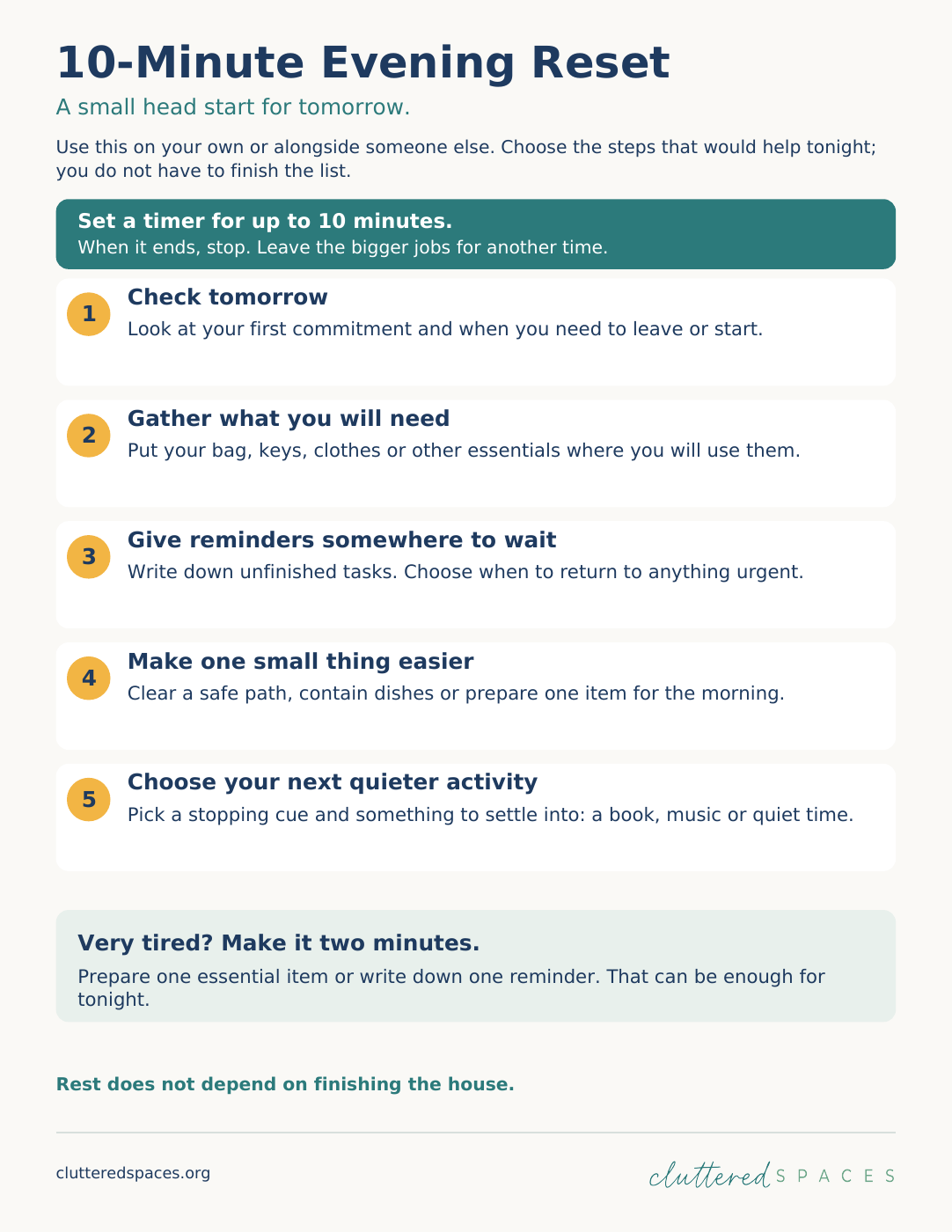
Open the full size to read on mobile
Open the chart to zoom in, or download the one-page PDF to print. No signup needed.
References
National Heart, Lung, and Blood Institute. Your Sleep/Wake Cycle; Sleep Phases and Stages; Healthy Sleep Habits. Body clock and sleep pressure, sleep stages, and sleep habits.
Van Veen, M. M., et al. (2010). Delayed circadian rhythm in adults with attention-deficit/hyperactivity disorder and chronic sleep-onset insomnia. Biological Psychiatry, 67(11), 1091–1096. Study record. A small observational study; its findings do not describe every adult with ADHD.
Watson, N. F., et al. (2015). Recommended amount of sleep for a healthy adult: A joint consensus statement of the American Academy of Sleep Medicine and Sleep Research Society. Sleep, 38(6), 843–844. Read the statement.
Edinger, J. D., et al. (2021). Behavioral and psychological treatments for chronic insomnia disorder in adults: An American Academy of Sleep Medicine clinical practice guideline. Journal of Clinical Sleep Medicine, 17(2), 255–262. Read the guideline.
National Heart, Lung, and Blood Institute. Insomnia: Treatment; Circadian Rhythm Disorders: Treatment; Sleep Apnea: Symptoms. Insomnia care, circadian treatment, and sleep apnea symptoms.
National Center for Complementary and Integrative Health. Melatonin: What You Need To Know. Supplement evidence and safety.
National Institute of Neurological Disorders and Stroke. Restless Legs Syndrome. Symptoms and care.
This article is for educational purposes only and is not medical advice. It is not a substitute for professional medical or mental health advice, diagnosis, or treatment. Talk with a qualified healthcare professional about sleep concerns, medication, or supplements.