
Executive Function Support for Teens
You ask whether there is homework. “Not much.” An hour later, there is a missing assignment, a document that will not open, and a project apparently due tomorrow. You are trying to help. Your teen is trying to get you to stop asking. Neither of you planned to spend the evening in a very small, very tense project-management meeting.
When schoolwork and daily responsibilities keep getting stuck, families often need more than another reminder. They need to see which part of the process is hard, choose support that fits, and give the teen a meaningful role in using it.
This guide brings those pieces together. Start with one recurring difficulty. You do not need to rebuild every routine, replace every app, or solve the entire semester tonight.
The work underneath the assignment
“Do your homework” can contain a surprising number of jobs: find the assignment, understand the directions, gather materials, choose where to begin, stay with it, manage frustration, and submit the finished work. Your teen may understand the subject while struggling with the process around it.
Executive functions help us hold information in mind, pause before acting, and adapt when something changes. Planning and managing tasks draw on these abilities together. Our executive function at home guide explains how they show up beyond schoolwork.
These abilities continue developing during adolescence, and their use varies with the task and circumstances. ADHD can make everyday attention and self-management more difficult. Sleep, stress, learning difficulties, sensory demands, and unclear instructions may also affect what a teen can do. An unfinished assignment does not tell you which explanation fits.
You can start by asking: “Show me where this stopped making sense or became hard to do.” The answer gives you a place to work together.
Begin with something your teen wants to change
Parents may want fewer missing assignments. A teen may want more free time, less arguing, or fewer reminders. Those goals can connect. “Let’s find a way for you to know what is left so I do not have to keep asking” is a more useful opening than a speech about future responsibility.
Choose a calm moment. Ask permission for a short conversation and make its scope clear: “Could we spend ten minutes figuring out what happens between opening the assignment and starting it?”
If your teen does not want a big planning conversation, offer a smaller choice: “Would it help to find the directions together, or would you rather show me the confusing part?” Give them time to answer. A pause is not automatically refusal.
Keep necessary family boundaries clear, including safety and respectful behavior. Within those boundaries, look for real choices about the method, location, order, or kind of help. Do not offer a choice if only one answer will be accepted.
Find one point where the process gets stuck
Watch one real task with your teen’s agreement. You are looking for the missing support, not collecting evidence for the next argument.
Finding the task: Are directions, due dates, and materials easy to locate?
Starting: Is there a first physical action, or another decision hiding inside “begin”?
Staying with it: Is the work understood, and is clarification available before frustration builds?
Switching: Is stopping the current activity planned, including how to return to it later?
Finishing: Does “done” include saving, submitting, and checking the submission status?
Choose the point that seems to be causing the most trouble. If the directions are unclear, a timer will not explain them. If the work is finished but never submitted, another lesson on the subject may miss the problem.
The five supports for schoolwork guide develops these practical questions into Start, Remember, Focus, Persist, and Finish supports.
Try one shared experiment with the Practice Map
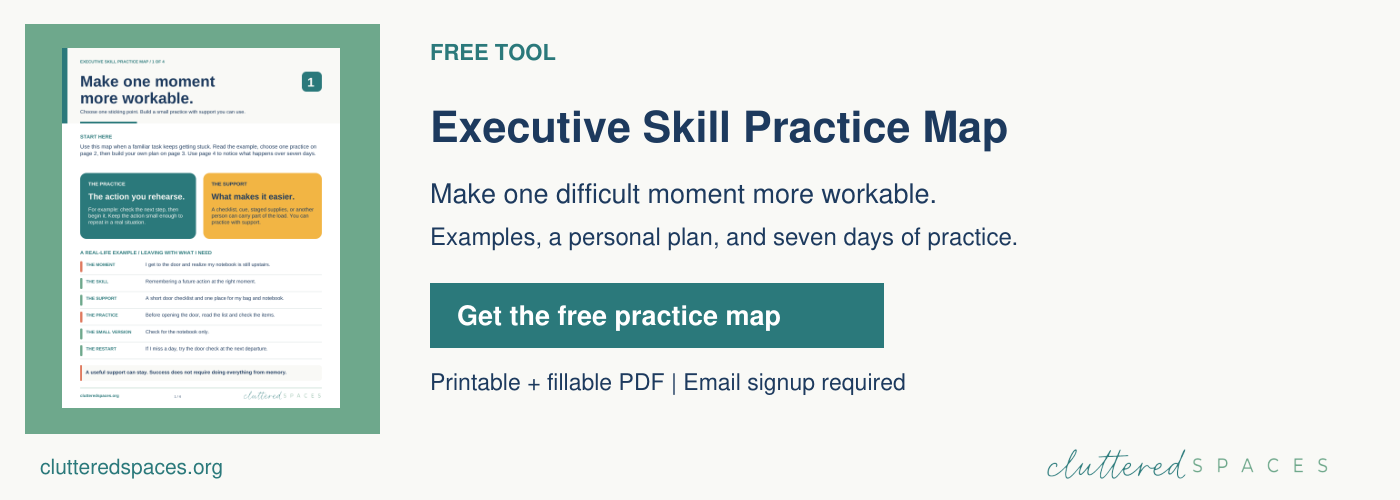
The Executive Skill Practice Map helps turn a broad frustration into one observable action and a short trial. It includes prompts for finding the specific barrier, choosing a skill to practice, making the plan visible, and reviewing a seven-day test. The practice guide links to the email signup for the printable and digitally fillable versions.
Use it when you both know something needs to change but the plan still sounds like “be more organized.” Let your teen choose or help define the target. The map should make the next action easier to see; it is not a report card for compliance.
First, describe a recent moment without a label: “The assignment was complete in the document, but it was not turned in.” Ask what made that last step difficult. Perhaps your teen closed the document and moved on before opening the submission page.
Then choose one practice action: “After saving the assignment, open the submission page and check its status before closing the school tabs.” Put that instruction where the action happens. Decide whether your teen wants a reminder, someone nearby, or a scheduled check-in while they practice.
Over the next week, notice attempts and what interrupted them. At the review, ask: “Did the cue appear at the right moment? Was the step clear? What should stay or change?” Seven days is an experiment, not a deadline for mastering executive function.
You can begin with a note on paper instead of downloading anything. Write the action, the cue, the agreed help, and when you will look at it together. That is enough for a first attempt.
Make schoolwork easier to enter
A useful starting action is something your teen can actually do: open the assignment page, find the rubric, or read the first direction. “Finish the project” is an outcome. It does not tell a tired person where to put their hands.
For a longer assignment, choose a checkpoint that makes progress visible. “Collect two possible sources” is clearer than “work on research.” Agree on a manageable work period and what will happen at the end: a break, a clarification question, or deciding whether to continue. A time limit should not quietly turn into “keep going until everything is done.”
Keep the information in as few reliable places as possible. Adding a planner, a whiteboard, three apps, and a parent’s handwritten list can create a second assignment: maintaining the organization system.
When subject knowledge is the barrier, bring in teaching or tutoring. When assignment access or school support is inconsistent, involve the teacher or relevant school staff. Ask what is happening during the school day and how agreed supports are actually being used. The CDC identifies organizational training as one school-based approach tested with children and adolescents with ADHD; it is more specific than simply telling a student to get organized.
What gaming can tell you about support
It can be bewildering to watch your teen manage a complicated game and then struggle to begin a short assignment. The difference is worth exploring with curiosity.
Games often make the next action, feedback, and progress visible. Schoolwork may require the student to build those supports before learning can begin. Our article on gaming focus and schoolwork explains why success in one setting does not settle what someone can do in another.
Ask a practical question: “What helps you know what to do next in the game?” You might borrow a visible goal or checkpoint. You do not have to turn homework into a game or decide that gaming needs no limits. The companion article on the structure games provide offers more detail.
For a screen transition, agree ahead of time on the stopping point, the warning cue, and the next activity. Consider whether the activity can actually be paused. A plan made during a calm conversation has a better chance of being understood than a new rule announced in the middle of a match.
Plan the switch as carefully as the start
A break can be useful and still be difficult to end. If a particular break repeatedly makes returning harder, treat that as something to investigate together. Try a different length, activity, or return cue and compare what happens.
The attention-shifting guide offers a transition map and cue cards. A simple version is to write down where the current activity stopped, what comes next, and the first action after the switch. “At 5:15, put the controller away and open the assignment page” gives more information than “homework soon.”
Allow for the transition itself. Moving from a conversation with friends to a frustrating task may involve disappointment, unfinished thoughts, or uncertainty. Acknowledge that experience while keeping the agreed next step visible.
Practice pausing outside the argument
An impulsive comment, purchase, or message can create trouble before there is much space to consider the result. Discussing the consequence afterward may be necessary, but the pause itself also needs a place to be practiced.
Our teen impulse-control guide includes the PAUSE resources. Practice with an ordinary, low-stakes example when everyone is calm. Notice the feeling or urge, use the guide to consider choices, and decide on a next action. The article explains the direct-download PAUSE guide and the email-gated Practice Map.
Do not turn the tool into something you demand a teen recite while upset. If the conversation is escalating, pause the discussion when it is safe to do so and agree on a time to return. Later, work out which cue or support might help before the next difficult moment.
Help without carrying every invisible job
Many parents become the person who checks, notices, remembers, prompts, and confirms. That can happen gradually, while trying to prevent one problem after another. It is exhausting, and the teen may never see how much work the parent is doing.
Name the roles for one routine. Your teen might own opening the portal and choosing the first assignment. You might be available for a ten-minute planning conversation. A teacher might need to clarify the directions. Make each responsibility specific enough that everyone knows when their part begins and ends.
Our guide to helping without becoming your teen’s executive function offers a support ladder and handoff questions. Start with the help needed now. Review whether to keep, change, or reduce one part after observing how the routine works.
Ongoing support can be appropriate. The aim is greater participation and ownership where possible, with help that fits the person. It is not a race to remove every reminder or prove that nobody needs anybody.
Make a plan for the week that goes sideways
A late night, illness, a difficult school day, or an unexpectedly large assignment can disrupt a routine. Decide in advance what a smaller version looks like.
That might mean checking what is due, choosing one priority, and asking the teacher a necessary question. It does not mean pretending unfinished work is complete or promising that a deadline no longer matters. It means staying connected to the situation and choosing a useful next action.
The minimum-version routines guide explains how to create a way back. When you review a missed attempt, ask what made the plan hard to use. Change the step or support before simply increasing the number of reminders.
Practice can also happen outside school. Packing for an activity, making lunch, or managing laundry gives teens meaningful daily responsibilities. Our independent living guide connects those tasks with support, practice, and a realistic handoff.
When the difficulty needs a wider conversation
If your teen is persistently distressed, sleep has changed substantially, school participation is deteriorating, or difficulties are affecting several parts of life, involve an appropriate healthcare or mental-health professional and the school as needed. Executive-function language should not become an explanation that prevents anyone from looking further.
Coaching can support routines, planning, and practical skill use. It does not diagnose a condition or replace treatment, subject teaching, or individualized school support. Different kinds of help can work alongside one another.
How Cluttered Spaces helps
We work with teens and families on the tasks that keep getting stuck: getting started, managing materials, moving between activities, following through, and taking more ownership of daily responsibilities.
We look at a real task with the teen, make the missing support visible, and practice a workable change. We also help families agree on what the teen owns, what support stays, and when to review the plan. The goal is progress that does not depend on one exhausted parent keeping the entire system in their head.
Start with one moment you would both like to make easier. Use the Executive Skill Practice Map guide to shape a small experiment, or bring that moment to a conversation with us. It is a useful place to begin.
Suggested next step: Explore Executive Function Coaching for Teens and Families.
References
Diamond, A. (2013). Executive functions. Annual Review of Psychology, 64, 135–168. Background on working memory, inhibition, cognitive flexibility, and factors affecting executive-function use.
National Institute of Mental Health. The Teen Brain: 7 Things to Know. Background on adolescent development, learning, stress, and sleep.
Centers for Disease Control and Prevention. ADHD in the Classroom. School-based support, including organizational training studied with children and adolescents.