
Why Impulse Control Is So Hard for Teenagers—and Why ADHD Makes It Harder
Your teenager knows they were supposed to stop before sending the message, buying the game upgrade, interrupting the teacher, driving too fast, or agreeing to something under pressure. Five minutes later, they may be able to explain exactly what would have been the better choice.
That gap can be maddening for everyone. If they knew better, why did they not do better?
Because impulse control is not just knowledge. It is the ability to interrupt an action long enough to use what you know—while emotion, urgency, reward, stress, and other people are competing for control of the moment.
1. Impulse control is not simply “knowing better”
Impulse control is often described as inhibitory control: the executive skill that helps a person stop, wait, filter a response, resist a distraction, or shift away from an immediate urge. It works with other skills, including working memory, emotional regulation, time awareness, flexible thinking, and the ability to hold a future goal in mind.
A teen may understand a rule when calm and still be unable to access that rule quickly enough when the situation changes. The problem is not always a missing lesson. Sometimes the lesson is present, but the system needed to retrieve and use it is not yet reliable.
2. Why adolescence makes the pause harder
Adolescence is a period of major brain and social development. The networks involved in planning, prioritizing, evaluating consequences, and controlling responses continue to mature through the teen years and into young adulthood. At the same time, rewards, novelty, emotion, and peer feedback can become especially powerful.
That does not mean teenagers are incapable of good judgment. Teens make thoughtful decisions every day. It means their judgment may be less consistent when the reward is immediate, the social stakes feel high, the body is activated, or the consequence is distant and abstract.
The same developmental drive that can lead to risky choices also supports healthy exploration: trying a new activity, speaking to a new group, applying for a job, or separating from parents. The goal is not to eliminate risk. It is to help teens distinguish a growth risk from a dangerous or costly impulse.
3. Why ADHD adds another layer of difficulty
ADHD is a neurodevelopmental condition that can include impulsivity as well as difficulties with attention and activity regulation. For some teens with ADHD, the interruption between urge and action is shorter, less noticeable, or harder to hold when something feels rewarding, frustrating, boring, unfair, or urgent.
ADHD can make several parts of the process less dependable at once:
• Inhibition: stopping an action or response that has already started.
• Working memory: keeping the rule, goal, or likely consequence available in the moment.
• Time awareness: giving future consequences enough weight compared with what is available now.
• Emotional regulation: staying able to choose when excitement, anger, embarrassment, or rejection spikes.
• Attention shifting: disengaging from the cue, person, screen, or thought that has captured attention.
This is why “Just think before you act” is usually inadequate. It describes the desired outcome but does not create the pause, recall the plan, lower the intensity, or make the better choice easier to reach.
4. What makes impulse control collapse in real life
Impulse control is not a fixed amount of willpower. A teen who manages it well in one setting may struggle in another because the demands and supports are different.
Common friction points
• Speed: texts, gaming, shopping, and social media allow an urge to become an action in seconds.
• Immediate reward: attention, laughter, relief, a purchase, or a win is available now; the downside arrives later.
• Peer presence: approval or fear of exclusion can outweigh a consequence that feels remote.
• Emotional intensity: anger, excitement, shame, anxiety, and rejection narrow the space for reflection.
• Low capacity: fatigue, hunger, sensory overload, stress, and accumulated demands reduce available control.
• An environment with no pause: saved payment information, unrestricted notifications, keys within reach, or an escalating group chat makes fast action frictionless.
Accountability still matters. A developmental or ADHD-related explanation is not permission to harm someone, ignore safety, or avoid repair. It tells us that consequences alone may not teach the missing skill. We also need practice, structure, and a safer environment.
5. Use PAUSE to create space between urge and action
PAUSE is not a demand to become calm instantly. It is a short external sequence that makes the hidden steps of self-control visible.
P — Pause your body. Stop moving. Put down the phone, food, card, keys, or other object. Take three slow breaths.
A — Ask. What am I about to do? Naming the action interrupts autopilot.
U — Understand the urge. What am I feeling? What do I need? The urge may be connected to hunger, fatigue, loneliness, boredom, anxiety, anger, or excitement.
S — See the next consequence. How will I feel in ten minutes? What will this affect tomorrow? Make the near future visible enough to compete with the immediate reward.
E — Execute a thoughtful choice. Choose yes, wait, change, or no. The goal is not always “no.” The goal is a choice rather than an automatic reaction.
Print the PAUSE visual anchor
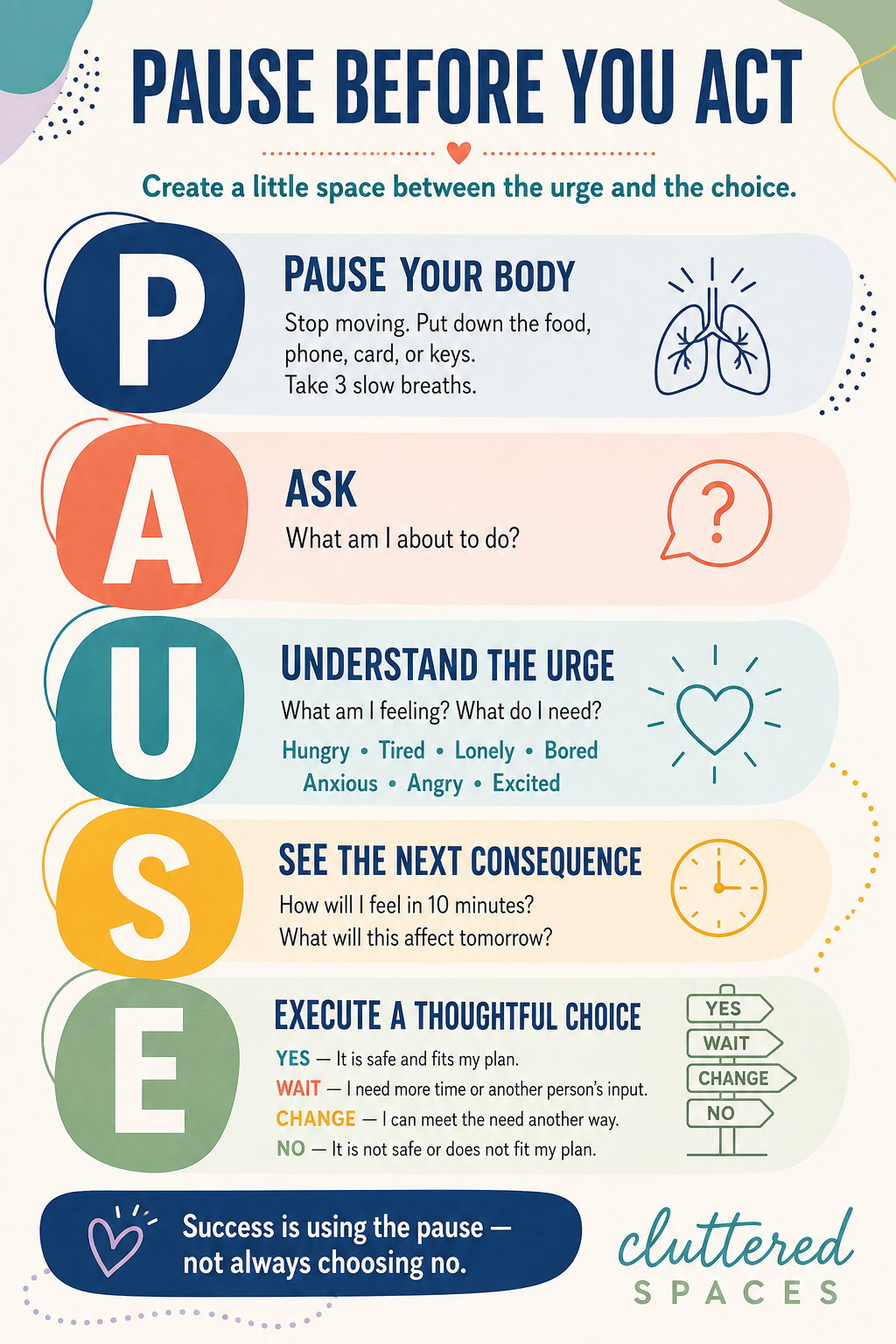
The one-page PAUSE Before You Act guide is a quick reference for the refrigerator, desk, homework space, or another place where decisions happen quickly. It is available as a direct print-ready PDF—no email address required.
6. Build the skill before the hard moment
A teen cannot practice a pause only after something has gone wrong. Start in lower-stakes situations, when the nervous system is calm enough to notice the sequence.
Choose one target. “Stop interrupting” is too broad. Try “wait until the other person finishes one sentence” or “put purchases on a 24-hour list.”
Find the earliest observable signal. A racing body, louder voice, faster typing, repeated checking, “I have to do it now,” or hiding the action may be the first cue.
Add friction to fast actions. Remove saved payment information, mute the group chat, keep keys in an agreed location, use an app limit, or require a second step before sending or buying.
Make the future visible. Use a short written prompt: “What will this cost tomorrow?” Abstract lectures are hard to retrieve; a visible cue can carry part of the mental load.
Rehearse the exact words. Practice “I need a minute,” “Let me check,” “I am leaving this chat,” or “I want it, but I am waiting.” Scripts reduce decision load.
Review without a character verdict. Ask where the sequence broke: Was the cue missed? Was the pause too late? Was the support unavailable? What needs to change next time?
A one-week impulse-control practice map
Pick one recurring situation—not every impulsive behavior—and complete these five lines together:
• The situation we are practicing
• The earliest signal
• The pause or barrier we will use
• The words or choice we will practice
• The review date and what we learned
Measure attempts, not perfection. A noticed urge, a two-minute delay, or a repaired mistake is evidence that part of the skill is becoming more visible.
Get the Teen PAUSE Practice Map
The companion two-page worksheet turns the visual framework into a plan a teen can use. Page one helps the teen work through one recurring situation, the need underneath the urge, the likely next consequence, and a chosen response. Page two provides a seven-day practice-and-review tracker.
Use it for one situation at a time. The tracker measures whether the teen noticed the urge and created any pause—not whether every choice was perfect. At the end of the week, review what made the pause easier or harder and adjust one part of the plan.
GET THE FREE PRACTICE MAP
Enter your email address below and we will send you the printable, digitally fillable Teen PAUSE Practice Map.
7. How parents can support without becoming the brake
Parents often respond to impulsivity by adding more words, more warnings, and more surveillance. That is understandable, especially when safety or trust has been affected. But a parent cannot remain the teen’s external brake forever.
Useful support is brief, predictable, and designed for handoff:
• Regulate first when possible. A flooded teen is unlikely to use a long explanation well.
• Use a short shared cue such as “Pause” or “ten-minute rule” instead of repeating the whole argument.
• Separate the skill conversation from the consequence conversation. Address safety, repair, or restitution clearly; analyze the executive-function breakdown later when everyone can think.
• Co-create barriers in advance. Controls imposed only during conflict may become another power struggle; agreed safeguards are easier to use.
• Return ownership gradually. The teen should help identify triggers, choose supports, practice scripts, and review what worked.
8. When additional help is appropriate
Executive-function coaching can help a teen identify patterns, externalize the steps, practice specific strategies, and build supports into real routines. Coaching does not diagnose or treat ADHD, anxiety, depression, trauma, substance use, or other clinical concerns.
Talk with a qualified health or mental-health professional when impulsivity is new, rapidly worsening, causing significant distress, or connected to dangerous driving, substance use, aggression, self-harm, suicidal thoughts, unsafe sexual behavior, stealing, major spending, or other serious risk. Immediate safety concerns require immediate professional or emergency support.
9. How Cluttered Spaces helps
Cluttered Spaces helps teens and families translate “use better judgment” into a process that can actually be practiced. We assess where the pause breaks down, reduce environmental friction, build visible supports, rehearse the next action, and review what the system needs after real life tests it.
The goal is not perfect self-control or constant parent monitoring. It is a teen who increasingly notices the moment, uses an appropriate support, makes a more intentional choice, and knows how to repair and restart after a mistake.
Suggested Next Step: Explore Executive Function Coaching
Sources and further reading
National Institute of Mental Health. The Teen Brain: 7 Things to Know.
Center on the Developing Child at Harvard University. A Guide to Executive Function.
Diamond, A. (2013). Executive Functions. Annual Review of Psychology, 64, 135–168.
Romer, D. (2010). Adolescent Risk Taking, Impulsivity, and Brain Development. Developmental Psychobiology, 52(3), 263–276.
Fosco, W. D., et al. (2019). The development of inhibitory control in adolescence and prospective relations with delinquency. Journal of Adolescence, 76, 37–47.