
Why Am I Avoiding This? ADHD and the Tasks That Feel Weirdly Impossible
There is an email you need to answer. It is not a dangerous email. It may not even be a particularly long email. You know it is there. You have thought about it in the shower, while driving, and at 2:13 in the morning.
You have also reorganized a drawer, researched three unrelated topics, and developed a surprisingly firm opinion about label makers. The email remains unanswered.
From the outside, this can look like procrastination. From the inside, it can feel more like standing in front of an invisible wall while also being fully aware that everyone else seems to think there is a door.
Avoidance is not proof that you do not care. Often, the opposite is true. The task matters enough to carry discomfort, uncertainty, effort, or the possibility of getting something wrong. ADHD can make those demands harder to organize and regulate. Avoidance becomes the quickest available exit.
Avoidance works for a minute
When you move away from an uncomfortable task, something happens immediately: you feel a little better. The email is still there, but the tension drops. The form is still incomplete, but you are no longer staring at the confusing question. The laundry is still on the chair, but at least nobody is asking you to make 47 tiny decisions about it right this second.
That relief is real. Your brain notices it. If stepping away reliably lowers discomfort, stepping away becomes easier to repeat. Unfortunately, avoidance buys relief on credit. The task often returns with interest: less time, more consequences, and an extra layer of shame.
This is why the answer is rarely a sterner lecture about responsibility. You probably already know the task matters. What you may not know is what the task is costing you before you even begin.
What ADHD can add to the task
Avoidance is not a separate ADHD diagnosis, and people avoid things for many reasons. Still, ADHD-related difficulties with attention, organization, follow-through, and emotional regulation can make certain tasks unusually expensive. Research has found a relationship between inattentive symptoms and general procrastination, while reviews also show that many adults with ADHD have meaningful difficulty regulating emotional responses.
A task may ask you to:
find a starting point when the instructions are vague
hold several steps in mind at once
estimate time without enough information
make a series of decisions with no obvious right answer
stay with boredom before any reward appears
switch away from something more engaging
risk criticism, disappointment, conflict, or bad news
remember where you stopped after an interruption
If a five-minute task requires twelve invisible executive-function moves, it is not really a five-minute task. It is a small project wearing a fake mustache.
The behavior is visible but the reason is not
Two people can avoid the same task for completely different reasons. One person does not call the dentist because the phone conversation feels unpredictable. Another forgets during office hours. Another expects bad news. Another cannot find the insurance card. Another has been told so many times that this should be easy that even thinking about it now carries shame.
The useful question is not simply, Why am I doing this again? It is, What happens inside this task that makes moving away feel safer or easier?
That question matters because the support has to match the friction. A timer does not solve fear of bad news. A better planner does not make an unclear request clear. A reward may help with boredom, but it will not decide what belongs in a crowded closet.
Common kinds of friction under avoidance
Unclear: You cannot see the first physical action, the finish line, or what “done” means.
Too large: The task is named as one item but contains many steps, decisions, or transitions.
Emotionally loaded: Beginning may bring up fear, shame, conflict, disappointment, grief, or the possibility of failure.
Boring or delayed: The effort is immediate and the payoff is distant, uncertain, or not especially rewarding.
Decision-heavy: Every item, sentence, appointment, or option creates another choice.
Physically or sensorily unpleasant: The space, noise, smell, temperature, materials, fatigue, or pain adds real cost.
Transition-heavy: Starting requires stopping something else, changing location, gathering supplies, or shifting mental gears.
If the task keeps defeating your first explanation, try using the Five Whys to find the friction underneath the visible problem.
Try the NEST Avoidance Reset
Do not begin by asking yourself to finish the whole task. First, spend two minutes finding out what is happening. The goal is information, not compliance. NEST gives you four places to look.
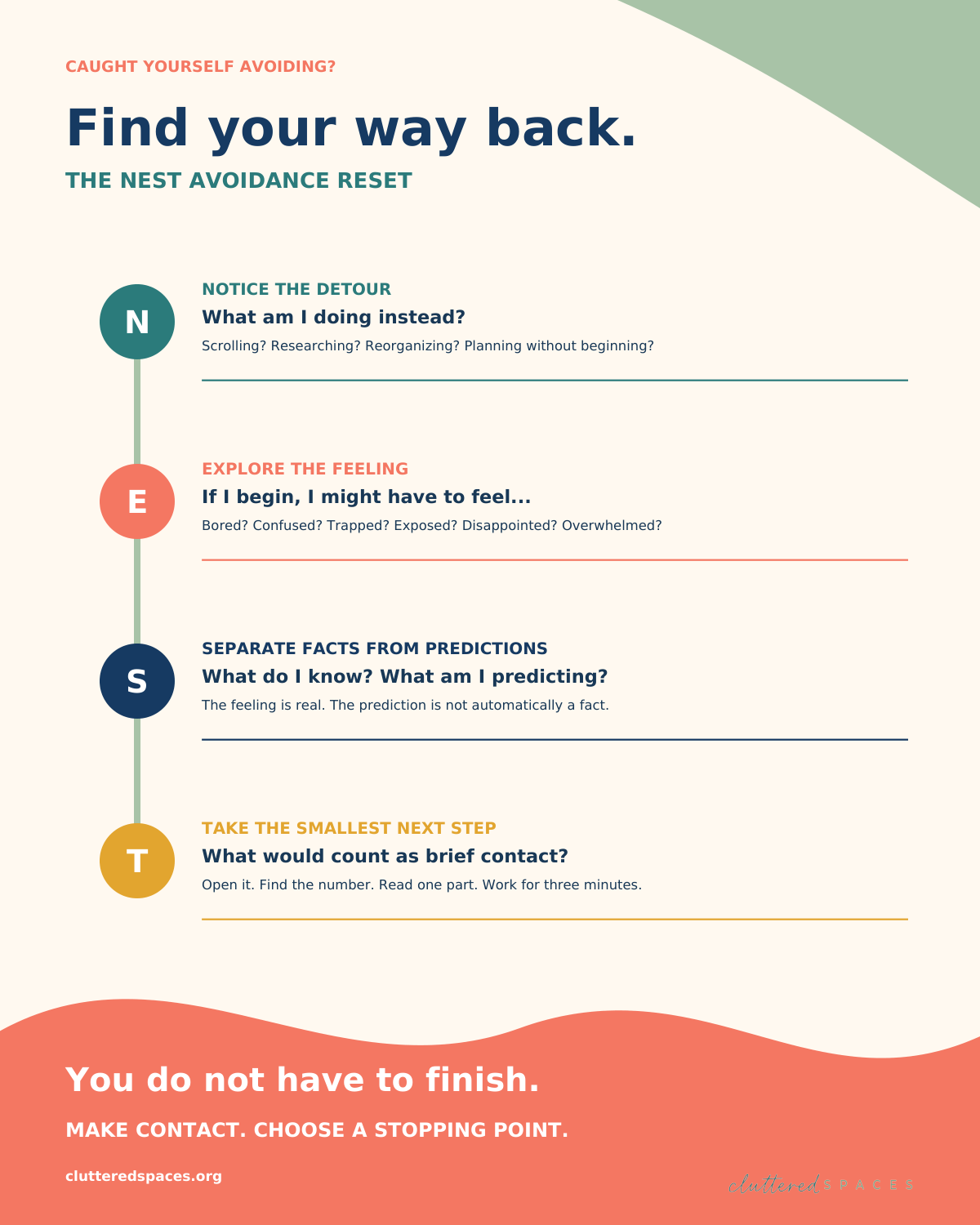
N — Notice the detour. Name the exact action you are avoiding and what you are doing instead. Make it observable: “Open the school portal” is more useful than “deal with school.”
E — Explore the feeling. Finish the sentence, “If I start, I might have to feel...” Bored, confused, trapped, embarrassed, disappointed, overwhelmed, or unsure are all legitimate data. You do not have to argue with the feeling to learn from it.
S — Separate facts from predictions. Ask what you know and what your brain is forecasting. “The form has six questions” is a fact. “I will mess it up and create a disaster” is a prediction. Then name the friction: Is the task unclear, too large, emotionally loaded, boring, decision-heavy, physically unpleasant, or hard to transition into?
T — Take the smallest next step. Remove one demand, then make contact instead of a lifetime commitment. Get the missing information, gather one supply, open the document, read the first question, or work for five minutes. Decide in advance when you may stop.
Contact counts even if you do not finish. This is not a trick in which five minutes secretly means until midnight. Keeping the promised stopping point helps make it safer to begin again next time.
Free NEST downloads
Keep NEST where you can find it. Download the free NEST Avoidance Reset. Print the full-page anchor chart for a desk, wall, or binder, or save the phone card for the next time your brain suddenly needs to alphabetize the spice drawer instead of opening the email. No inbox obstacle course required.
What this can look like in real life
The email
The friction is not typing. It is uncertainty about tone and fear that the reply will create more work. Reduce the demand by drafting two plain sentences without sending them. Ask another person to check whether the message says enough.
The laundry
The task called “laundry” includes finding clothes, sorting, carrying, switching loads, folding, deciding where everything goes, and remembering that wet clothes exist. Choose a minimum version: wash one needed load and use a clean-clothes basket. Folding is not a moral requirement.
The school assignment
The student says, “I don't want to do it.” Underneath that may be a confusing prompt, a fear of discovering how far behind they are, or the transition from gaming to writing. The first action may be opening the assignment beside a calm adult and identifying only what the teacher is asking for.
The appointment
The phone call carries uncertainty, waiting, and the chance of receiving difficult information. Write a two-line script, place the insurance card nearby, and make the call while someone supportive is present. Reaching voicemail still counts as contact.
Support works better than pressure
Pressure can create motion, especially when a deadline becomes urgent enough to drown out every competing signal. But living on emergency fuel is exhausting. It also teaches the brain that beginning only happens when the situation is frightening enough.
Useful support makes the next action easier to access. That might mean body doubling, a visible cue, a written first step, fewer choices, a shorter work period, a calmer space, or another person helping define what “enough” looks like.
The goal is not to remove every uncomfortable feeling before you act. That would leave all of us waiting a very long time. The goal is to lower the combined cognitive and emotional cost enough that you can choose your next move.
Sometimes avoidance is protecting something tender
A person who has struggled publicly, missed deadlines, disappointed people, or repeatedly been told they are not trying may learn to protect themselves from another painful result. If you do not start, you do not have to find out whether your effort will be enough.
This pattern can resemble self-sabotage, but the word can sound more intentional than the experience feels. When Not Trying Feels Safer explores that protective logic more closely.
Curiosity does not mean avoidance has no consequences. Bills, assignments, medical care, relationships, and household responsibilities still matter. It means you are more likely to change a pattern when you understand what keeps it in place.
When to look beyond ADHD
Avoidance can also be shaped by anxiety, depression, obsessive-compulsive symptoms, trauma, burnout, sleep problems, learning differences, pain, or other health concerns. Sometimes several things are happening at once.
Consider talking with a qualified health or mental-health professional when avoidance is new, rapidly worsening, tied to panic or compulsions, keeping you from eating or caring for yourself, interfering with medical care, threatening housing or finances, or shrinking your life in a significant way. Practical coaching can support routines and follow-through, but it does not replace diagnosis or treatment.
How Cluttered Spaces helps
Cluttered Spaces works with teens, young adults, adults, and families to identify the friction inside everyday tasks and build supports around the way the person actually functions. We may map the task, reduce decisions, adjust the environment, practice a first step, or work side by side until the process becomes easier to repeat.
The purpose is not to make someone comply with a better system. It is to co-create a more workable one and help the person build ownership over time.
What feels hard right now
Choose one thing you have been avoiding. Do not ask, “What is wrong with me?” Ask, “What is this task asking my brain, body, or emotions to carry?” Then remove one demand and make brief contact.
You do not have to become a person who never avoids anything. You are looking for a way back into the task that does not require panic, shame, or a brand-new personality.
Suggested next step: If avoidance keeps turning ordinary responsibilities into emergencies, learn how Executive Function Coaching can help you identify the friction, practice workable strategies, and build reliable ways to begin and return.
References
National Institute of Mental Health. Attention-Deficit/Hyperactivity Disorder (ADHD). Reviewed August 2026.
Niermann, H. C. M., & Scheres, A. (2014). The relation between procrastination and symptoms of attention-deficit hyperactivity disorder in undergraduate students. International Journal of Methods in Psychiatric Research, 23(4), 411–421.
Beheshti, A., Chavanon, M.-L., & Christiansen, H. (2020). Emotion dysregulation in adults with attention deficit hyperactivity disorder: A meta-analysis. BMC Psychiatry, 20, 120.
Soler-Gutiérrez, A.-M., Pérez-González, J.-C., & Mayas, J. (2023). Evidence of emotion dysregulation as a core symptom of adult ADHD: A systematic review. PLOS ONE, 18(1), e0280131.
Safren, S. A., et al. (2010). Cognitive behavioral therapy vs relaxation with educational support for medication-treated adults with ADHD and persistent symptoms: A randomized controlled trial. JAMA, 304(8), 875–880.