
Executive Function Skills Grow Through Practice—Not Pressure
The brain arrives prepared to develop executive function skills—but prepared is not the same as finished.
Working memory, inhibition, flexible thinking, planning, task initiation and self-monitoring all depend on brain systems that develop over time. Biology gives us the capacity to learn these skills. Experience helps build the pathways that make them more available, efficient and dependable.
That matters because difficulty with an executive skill is not evidence that someone is lazy, careless or unwilling. It is information. It tells us where the brain may need more practice, clearer support or a different environment.
The Brain Is Prepared, Not Preprogrammed
Human beings are born with biological systems designed to learn from repetition, feedback and experience. We do not arrive knowing how to organize a backpack, estimate time, pause before acting or begin an unpleasant task. Those abilities develop as we use them.
Executive function development continues through childhood, adolescence and young adulthood. Even later, the brain remains capable of change. Practice does not make every person perform the same way, and it does not erase ADHD, autism, depression, anxiety, trauma, sleep problems or other conditions that affect executive function. It can, however, strengthen a specific skill and help us build supports that make the skill easier to use.
Knowing What to Do Is Not the Same as Being Able to Do It
A person may understand exactly what needs to happen and still be unable to make it happen consistently.
They may know the assignment is due, know the laundry needs to move, know they should leave on time or know that interrupting will cause a problem. The missing piece is not necessarily knowledge. The demand may exceed the executive capacity available in that moment.
This is why repeated reminders, lectures and consequences often fail to build the skill we are asking for. Information can explain the expectation. It cannot substitute for guided practice.
Executive Skills Develop Through Use
If you want to become better at remembering the next step, you need repeated opportunities to capture and retrieve that step. If you want to become better at starting, you need repeated opportunities to practice the moment of beginning. If you want to strengthen inhibition, you need a pause you can use before the action—not only a discussion after it.
Practice should be specific enough that the brain knows what it is rehearsing. “Be more responsible” is not a practice plan. “Put completed work in the backpack before leaving the desk” is.
The goal is not to prove that you can do the entire task independently. The goal is to repeat one useful action often enough to learn from it.
Support Makes Practice Possible
We often treat support as the opposite of independence. In reality, appropriate support is how many skills become independent.
A checklist can support working memory. A timer can make time visible. A body double can help someone remain engaged. Preparing materials can lower the activation energy required to begin. A calm prompt can help a person notice the moment when inhibition is needed.
These supports do not do the learning for the person. They create conditions in which practice is possible.
Why You Need to Choose One Skill
“Executive function” is not one skill. It is a group of interrelated abilities, and a single difficult task may call on several of them at once.
Imagine that homework is not getting completed. The breakdown might be remembering the assignment, estimating how long it will take, transitioning away from a preferred activity, finding the materials, deciding where to begin, tolerating frustration or checking the work before submitting it.
If we try to improve all of those things at once, the practice becomes vague and overwhelming. We cannot tell what helped, what still needs support or what the person was actually rehearsing.
Choosing one skill creates a clear target. It lowers cognitive load, makes progress observable and gives feedback we can use. It does not mean the other skills are unimportant. It means we are giving one part of the process enough attention to change.
Drill Down Until the Problem Becomes Actionable
Many practice plans fail because they begin with a label instead of a solvable problem: “I procrastinate.” “She is disorganized.” “He needs better time management.” Those descriptions may be true, but they do not tell us what to practice.
This is where the Five Whys approach is useful. Ask what happened, then keep asking what made that step difficult until the answer points to an action you can test.
For example:
The laundry never gets put away.
Why? It stays in the basket.
Why? Putting it away feels like a large task.
Why? Clothes must be sorted, folded and carried to several places.
Why? There is no clear first step when energy is low.
Now the practice target can become: “When the dryer ends, hang five shirts.” That is observable, repeatable and small enough to test.
Do not stop drilling down merely because you found a familiar explanation such as ADHD, low motivation or poor organization. Those may explain the vulnerability, but they are not yet an actionable step. Continue until you can answer: What exactly will the person do, and what support will make that action easier?
Practice Starting Before Motivation Arrives
Waiting to feel motivated can keep a person trapped. Motivation often follows action rather than arriving before it.
Behavioral activation research supports the value of beginning with manageable, planned actions even when energy or motivation is low. For executive function practice, this means making the first action small enough to begin without requiring the full task to feel appealing.
You might open the document, carry the basket to the bedroom, place one bill beside the laptop or set a timer for three minutes. The first step is not a trick. It is the skill being practiced.
Make Internal Decisions External
Deciding what to do is only part of the work. The decision must still be available when it is time to act.
A person may decide in the morning to begin homework after a snack, place completed work in their backpack or start laundry before dinner. If that plan exists only in their mind, working memory must hold it while the rest of the day competes for attention.
Making the decision external reduces that demand.
An internal intention can become:
A written first step
A calendar block
An alarm labeled with the action
A checklist placed where the task happens
Materials prepared in advance
Shoes positioned beside the bed
A note attached to the object that needs attention
An agreement with a body double
A visible “done enough” definition
A predetermined restart step
The goal is not to add reminders everywhere. An external support should appear at the place and time when the decision is needed.
Instead of expecting yourself to decide again, ask: How can I make this decision visible before the difficult moment arrives?
This allows the environment to carry part of the planning and working-memory load. It also protects the practice plan from depending entirely on motivation, memory or decision-making capacity in the moment.
Create a Manageable Practice Loop
A useful practice loop is simple:
Notice the exact breakdown. Describe what happened without judgment.
Choose one executive skill. Identify the ability needed at that point.
Define one observable action. Make the practice target concrete.
Reduce the friction. Add the cue, support or environmental change that makes the action possible.
Make the decision external. Put the plan where it will be seen when the skill is needed.
Test it for seven days. Count attempts and collect information—not perfection.
Adjust. If it did not work, return to the Five Whys and make the action or support more precise.
The Right Level of Challenge Matters
Practice must be challenging enough to engage the skill but manageable enough to repeat. If the demand is far beyond current capacity, the person may be practicing overwhelm, avoidance or shame instead of the intended skill.
Reducing the task is not lowering the standard forever. It is finding the level at which learning can occur today.
Mistakes Are Part of Practice
A missed attempt is not proof that the plan failed. It is data. Perhaps the cue appeared too late. Perhaps the first step was still too large. Perhaps the support required another executive skill that was not available.
Curiosity allows us to improve the practice design. Shame usually makes the skill harder to access.
Progress Does Not Require Perfect Independence
Some people will always benefit from external supports. That does not make their progress less real. Glasses do not weaken vision; they make seeing possible. In the same way, calendars, visual cues, body doubling, prepared environments and collaborative routines can be legitimate parts of functioning well.
The goal is not to eliminate every support. The goal is to understand what helps a person act with greater consistency, agency and self-trust.
The brain is built to learn executive skills through experience. So if a skill matters, give it something better than pressure. Give it a clear target, compassionate support and enough useful repetitions to grow.
Try the Executive Skill Practice Map
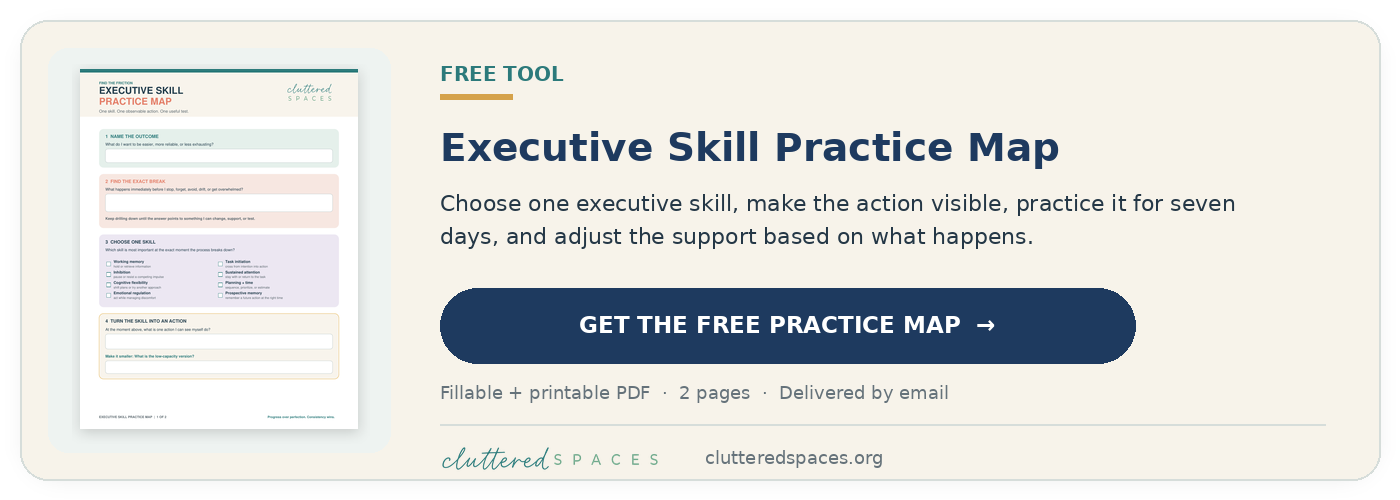
The Executive Skill Practice Map helps you move from a broad frustration to one skill, one observable action and one useful seven-day test. It includes space to use the Five Whys, choose a visible support and make the internal decision external. Both printable and digitally fillable versions are available by email below.
Suggested Next Step: Explore Executive Function Coaching
References
Barkley, R. A. (2012). Executive Functions: What They Are, How They Work, and Why They Evolved. Guilford Press.
Dimidjian, S., et al. (2006). Randomized trial of behavioral activation, cognitive therapy, and antidepressant medication in the acute treatment of adults with major depression. Journal of Consulting and Clinical Psychology, 74(4), 658–670.
Gustavson, D. E., et al. (2014). Genetic relations among procrastination, impulsivity, and goal-management ability. Psychological Science, 25(6), 1178–1188.
Gustavson, D. E., et al. (2015). Procrastination and the priority of short-term mood regulation. Journal of Research in Personality, 58, 35–45.
Jacobson, N. S., et al. (1996). A component analysis of cognitive-behavioral treatment for depression. Journal of Consulting and Clinical Psychology, 64(2), 295–304.
Rabin, L. A., Fogel, J., & Nutter-Upham, K. E. (2011). Academic procrastination in college students: The role of self-reported executive function. Journal of Clinical and Experimental Neuropsychology, 33(3), 344–357.