
Movement Helps ADHD - But First You Have to Get Started
Most people with ADHD have heard that exercise is good for them. They may even know from experience that they feel calmer, clearer, or more settled after they move.
And still, they may not be able to make themselves get up and do it.
That gap can be deeply frustrating. You know a walk might help, but you cannot seem to put on your shoes. You pay for the gym and sincerely intend to go, but getting there feels like a wall. You plan to exercise in the morning, then wake up and find that every part of the plan suddenly requires more energy and decision-making than you have.
It is easy to turn that experience into a judgment: If I really cared, I would do it. I must not want it badly enough.
But wanting to move and being able to initiate movement are not the same thing. ADHD can affect the very skills required to turn an intention into action. The problem may not be that you do not understand the benefits. The plan may simply require too much activation, too many decisions, or too many transitions before you receive any of those benefits.
Movement can support an ADHD brain. To make it useful, however, we also have to make it accessible.
Why Movement Can Help
Research suggests that physical activity can improve some ADHD symptoms and executive-function skills. The evidence is strongest in children and adolescents, although emerging research in adults also points to benefits, particularly for inhibitory control.
Some people notice that movement helps them settle physical restlessness or release tension. Others feel more alert and able to focus afterward. Movement can also support sleep, mood, memory, and general brain health. A single period of activity may create a short-term shift, while regular movement may provide broader benefits over time.
The effect will not be identical for every person, every symptom, or every kind of activity. Movement is not a cure for ADHD, and it is not a replacement for medication, therapy, coaching, accommodations, or other appropriate care. It is one more form of support—a way to give the brain and body useful input.
That distinction matters. “Exercise helps” should never become another way to blame someone for struggling. If movement is hard to access, the answer is not more shame. It is curiosity about what is making the start so difficult.
The Best Workout Is the One You Will Actually Do
There is no benefit to identifying the perfect workout if you dread it so much that you consistently avoid it.
The best workout is the one you will do.
That might be lifting weights, swimming, dancing, walking the dog, skating, gardening, hiking, shooting baskets, cleaning the house to loud music, or stretching on the bedroom floor. It may look like a structured class one day and a ten-minute walk while talking to a friend the next.
All movement counts.
This does not mean that every type or amount of movement has exactly the same physical effect. Public-health guidelines recommend a combination of aerobic and muscle-strengthening activity for the greatest overall health benefit. But some movement is more useful than none, and short periods of activity add up. A five-minute walk is not a failed thirty-minute workout. It is five minutes of movement.
For an ADHD brain, variety can be an asset. Instead of forcing yourself to choose one activity and repeat it indefinitely, find several things you genuinely enjoy—or at least do not dread. You might have one option that is social, one that is calming, one that is intense, and one that is easy to do at home.
On a high-energy day, you might hike or take a class. On a tired day, you might walk around the block. When you are restless, you may want music and intensity. When you are overwhelmed, gentle stretching or a quiet walk may be more regulating.
The goal is not to follow one perfect program. The goal is to have several workable ways to move.
You May Not Feel Motivated Until After You Begin
We tend to imagine that motivation comes first. We expect to feel ready, inspired, or determined—and then take action.
Sometimes that happens. Often it does not.
Motivation frequently grows after we begin. A small action gives us a change in sensation, a little evidence of progress, or the relief of no longer being stuck. That experience can make the next action feel more possible.
Human behavioral-activation research supports this practical idea. In clinical studies involving adults with depression, people benefited from deliberately scheduling and beginning meaningful or potentially rewarding activities—even when they did not initially feel like doing them.
These studies were not specifically about ADHD or exercise, and beginning an activity does not guarantee that motivation will appear. They do support a more realistic approach: you do not have to feel motivated to take the first small step. Motivation may grow after you begin, as you experience progress, enjoyment, relief, connection, or a sense of accomplishment.
This does not mean you should push through pain or bully yourself into exercising. It means you do not have to wait for enthusiasm before taking the first step. You can begin while feeling reluctant, flat, distracted, or undecided.
The first step should be small enough to take without needing a wave of motivation. Put on your shoes. Play one song. Walk to the end of the street. Stretch while the coffee brews. Start for five minutes, then decide whether you want to continue.
Sometimes starting will create momentum. Sometimes five minutes will remain five minutes. Both count.
When “Go Exercise” Contains Twenty Smaller Tasks
“Go work out” sounds like a single instruction. In practice, it may ask your brain to stop what it is already doing, remember the plan, choose an activity, estimate the time, find clothes, locate equipment, prepare water, travel somewhere, tolerate sensory discomfort, and begin before there is any immediate reward.
That is a significant executive-function demand.
The plan may also collide with time blindness, working-memory challenges, difficulty shifting attention, or an all-or-nothing expectation that makes a short workout feel pointless. If you have repeatedly planned to move and have not followed through, that does not automatically mean you need a stricter plan. It may mean the current plan has too much friction.
Try to notice where the process actually breaks down.
Do you forget until the day is nearly over? Does deciding what to do consume the small amount of energy you had? Are your shoes in one room and your headphones in another? Does changing clothes make the activity feel like a much larger production? Is the gym overstimulating? Do you postpone a short walk because it does not feel like “real” exercise?
Difficulty is information. Once you can see the point where the plan stalls, you can support that point instead of judging yourself for not getting past it.
Sometimes the barrier is initiation: you want to move, but the first step is not accessible. Sometimes you are postponing movement because another choice offers more immediate relief or reward. Those experiences can overlap, but they are not identical. Our article Why We Procrastinate Even When We Care looks more closely at what delay may be doing for us in the moment—and how to interrupt the cycle without shame.
Make the Decision Somewhere You Can See It
An intention that exists only inside your head has to compete with everything else asking for your attention. Externalizing the plan allows the environment to carry some of that mental load.
Instead of telling yourself, I need to move tomorrow, decide what that actually means:
After I finish my coffee, I will walk outside for ten minutes. If ten minutes feels impossible, I will walk for one song.
Put it on the calendar. Write it on the refrigerator. Set an alarm that names the action rather than one that simply says “exercise.” Place your shoes somewhere you will physically encounter them. Connect movement to something that already happens, such as school drop-off, lunch, the end of the workday, or feeding the dog.
The right cue is not the most sophisticated one. It is the one you notice at the moment you can act.
This is not about being rigid. A visible plan can still be changed. The value is that tomorrow’s version of you does not have to retrieve the intention, choose an activity, and define success from scratch.
When the Shoes Make the Decision Easier
My husband has always been far more diligent about going to the gym than I have, though I try.
For a long time, he went at five o’clock in the morning because it was the only time of day when nobody needed anything from him. It was a sensible decision—and still incredibly hard. Knowing that 5:00 a.m. was his best opportunity did not make getting out of bed at 5:00 a.m. feel good.
So every night, he packed his gym bag and put his tennis shoes beside the bed. He placed them exactly where his feet would land when he sat up in the morning.
At five o’clock, he did not have to lie there asking, Am I going to the gym? He did not have to get dressed and then wander through the house looking for his shoes. When he put his feet on the floor, he was literally standing on them.
He had changed the decision. Putting on his shoes had become the easiest next action. To abandon the plan, he had to deliberately step over or move the shoes that were already beneath his feet.
The shoes did not make him rested. They did not create limitless discipline or make an early alarm pleasant. They simply allowed the environment to do part of the remembering, prompting, and decision-making at a time when he was not functioning at his best.
That is what reducing cognitive load can look like. A good support does not have to create motivation. Sometimes it only needs to make the helpful action easier to access than the alternative.
Help Tomorrow’s Brain the Night Before
Preparation matters because initiation is often hardest at the exact moment when we expect ourselves to make every decision.
The night before, ask: What can I do now so moving tomorrow requires less thought?
Choose the activity. Check the weather. Put out clothes and shoes. Fill the water bottle. Charge the headphones. Download the podcast. Pack the gym bag and place it by the door. Text the friend who is meeting you. Decide which route, class, or video you will use.
Be concrete. “Get ready to work out” still leaves many decisions unresolved. “Put my walking shoes beside the coffee maker and set a 9:15 alarm labeled WALK ONE SONG” gives your brain a visible starting point.
You are not trying to manufacture willpower. You are reducing the number of barriers between the intention and the first movement.
Create a Version for the Day You Do Not Feel Like It
Many movement routines are designed for the imaginary day when nothing goes wrong. You slept well, the schedule held, your clothes were clean, and your energy matched the plan.
Real life needs more than one version.
Create a full version, a short version, and a minimum version before you need them.
A full version might be a forty-five-minute strength workout at the gym. The short version might be fifteen minutes with dumbbells at home. The minimum version might be one set of three familiar exercises.
A full walk might be three miles with a friend. The short version might be one loop around the neighborhood. The minimum version might be walking outside for the length of one song.
The minimum version is not cheating. It gives you a way to return when capacity is low. A routine that can shrink and restart is often more sustainable than one that only counts when completed perfectly.
Make Movement More Rewarding
Movement may eventually help you feel better, but that delayed benefit is not always enough to get an ADHD brain interested now. It is reasonable to add something immediate.
Listen to a favorite podcast only while walking. Choose music that changes your energy. Try new routes. Walk somewhere that gives you coffee, fresh air, or time with a friend. Take a class so the activity and time are already decided. Use body doubling by moving alongside another person, in person or remotely.
The reward does not need to be impressive. It needs to matter to you and arrive close enough to the action for your brain to connect the two.
Enjoyment is not a frivolous extra. If pleasure, novelty, connection, or competition helps you begin, it belongs in the plan.
Use Movement as Support, Not Just Exercise
Movement does not have to be a separate fitness project. It can be a tool you use during the day when your brain or body needs a shift.
A few minutes of movement before a demanding task may help you feel more alert. Movement between meetings can create a clearer transition. A short walk after a stressful interaction may help release tension. Dancing to one song may make it easier to begin a household reset.
Experiment with timing and notice what happens afterward. Do you feel calmer? More awake? Less restless? More able to choose the next action?
You are not grading your performance. You are learning what kinds of movement help your particular brain and when they are most useful.
Use Daily Anchors Instead of a Perfect Schedule
Movement does not have to happen at the same exact time every day to become part of your life. For many people with ADHD, a rigid schedule creates another standard to miss. Daily anchors can provide structure without requiring the day to unfold perfectly.
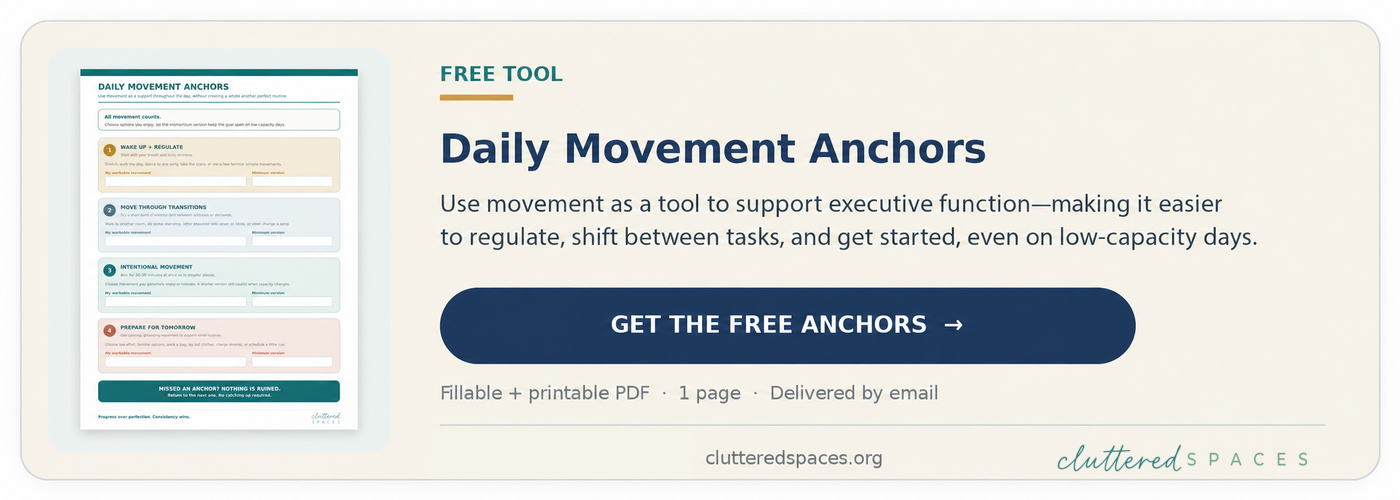
The Daily Movement Anchors chart helps you choose movement for four useful points in the day:
Wake up and regulate: movement that helps your brain and body come online.
Move through transitions: brief movement that helps you shift between activities or demands.
Intentional movement: a flexible goal of twenty to thirty minutes at once or in smaller pieces.
Prepare for tomorrow: an evening step that reduces the decisions required to move the next day.
For each anchor, you will choose a workable option and a minimum version for days when capacity is low. You are not expected to complete every anchor every day. If one passes, nothing is ruined. Return at the next one. There is no catching up required.
Get the Free Daily Movement Anchors Chart
Use the printable and fillable chart to create a flexible movement plan based on your routines, preferences, and current capacity. Enter your email below and we will send it directly to you.
Start With One Small Experiment
You do not need to build a complete fitness routine today.
Choose one form of movement you enjoy or tolerate. Decide when it could realistically happen. Write down the first physical action. Prepare what you can the night before. Choose the minimum version, and add one source of interest, reward, or support.
Then try it and get curious.
If the plan works, notice why. If it does not, notice where it became difficult. Change one source of friction and try again.
Movement can be an important part of ADHD regulation, but “exercise more” is not a complete strategy. The movement has to be appealing enough to choose, accessible enough to begin, and flexible enough to survive a real life.
Choose what you enjoy. Let every form of movement count. Put the plan where you can see it. Prepare before the hard moment arrives. And when motivation is nowhere to be found, remember that you do not need to feel ready to take one small step.
Sometimes the reward for beginning is finally feeling able to continue.
How Cluttered Spaces Helps
Cluttered Spaces combines executive-function coaching with environmental design and practical implementation. We help identify what makes a helpful routine difficult to begin, reduce the decisions and transitions surrounding it, and build visible supports that work in everyday life.
What feels hard right now?
If you know movement helps but cannot make it happen consistently, we can help you identify the friction and build a more workable starting plan.
Suggested next step: Explore Executive Function Coaching.