
Where to Start at Home After a Hospitalization or Health Crisis
Coming home can feel like a relief and a logistical ambush at the same time. There may be a bag by the door, papers on the table, new appointments on the calendar and a refrigerator that has not received the memo. Meanwhile, laundry,
meals, pets, bills and everyone else’s needs have continued without politely pausing.

If your home is not working the way it usually does, that is not proof that you are failing. A health crisis can change energy, mobility, attention, memory and the amount of help available—sometimes all at once. The most useful starting point is not restoring the whole household. It is making the next day more workable.
This article offers practical household support, not medical advice or emergency guidance. Keep medication questions, symptoms, follow-up care and discharge instructions with the person’s healthcare team. If something feels urgent or unsafe, contact the appropriate healthcare provider or emergency service.
Why ordinary household tasks can suddenly feel so complicated
A home runs on hundreds of small decisions: what matters first, where something goes, who needs to know, what happens next and when to stop one task and begin another. These decisions rely on executive functions such as prioritizing, starting, remembering, sequencing, shifting attention and coordinating with other people.
After a hospitalization or health crisis, those demands often increase at the same time that capacity decreases. A person may be tired, grieving a change in ability, adapting to disability or trying to follow unfamiliar routines. A caregiver may be managing work, sleep loss, appointments and worry while also keeping the household moving. Research on transitions from hospital to home has repeatedly found that patients and caregivers can face substantial coordination work and unmet needs after discharge.
This is why “just make a list” may not be enough. The list itself still has to be prioritized, remembered, updated and shared. If you want a deeper explanation of that hidden workload, executive function at home helps explain why familiar tasks can become unreliable when capacity changes.
The difficulty is real. It is also workable when the household is reduced to a smaller set of clear decisions.
Use the Six-Part Coming Home Plan
The goal is to stabilize the essentials, reduce what must be held in memory and rebuild one repeatable routine. You can remember the plan as:
Today → Wait → Show → Share → Rebuild → Adjust
You do not have to complete all six parts in one sitting. One decision that prevents tomorrow’s problem counts as progress.
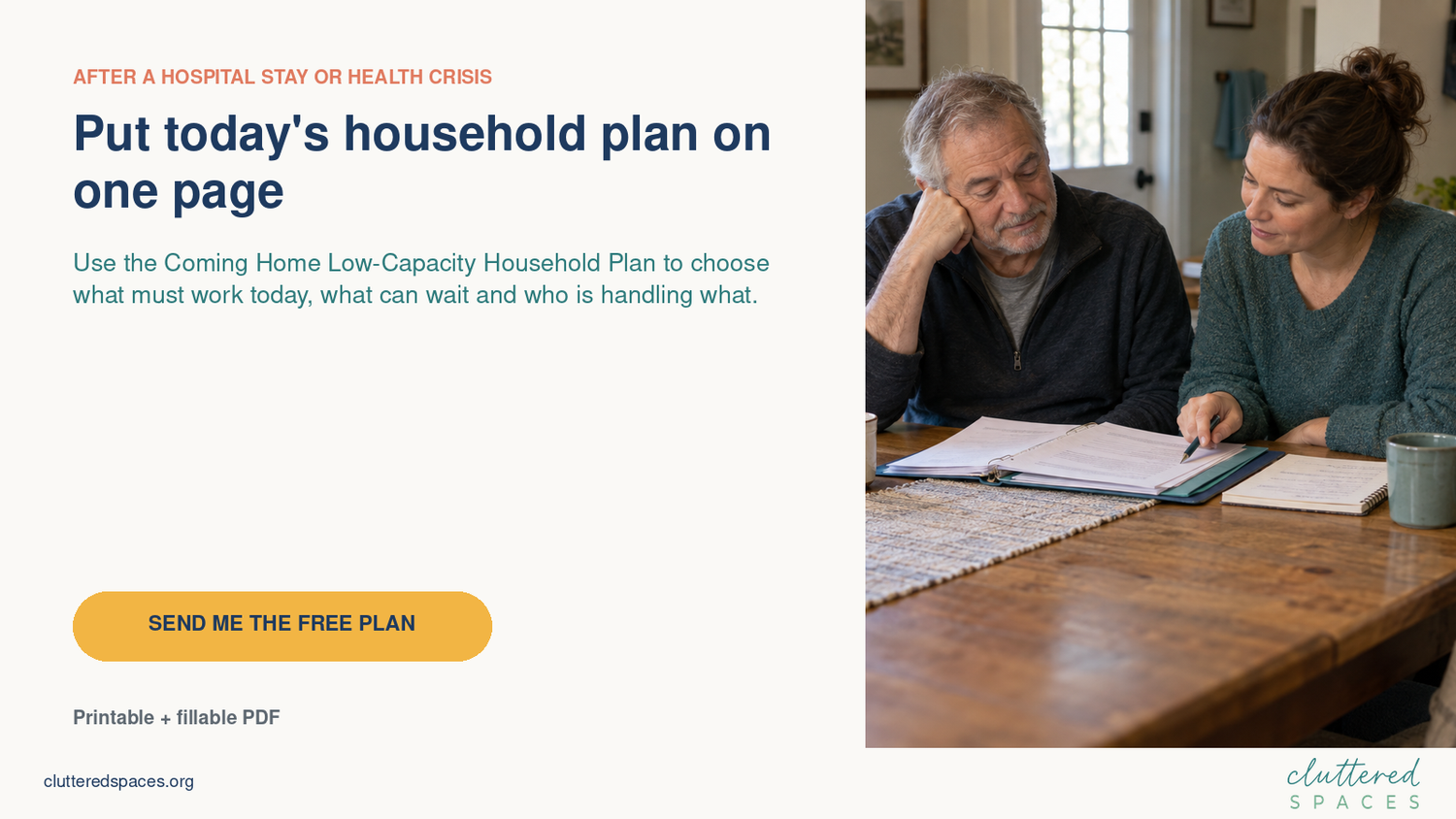
If it would help to get these decisions out of your head, use the Coming Home Low-Capacity Household Plan. The printable and fillable versions give you one place for today’s essentials, what can wait, what must stay visible, who is handling each responsibility and the first system to rebuild. Start with one box if that is all the capacity available today.
1. Today: What must work for basic safety and daily function?
Start with the next 24 hours, not the state of the entire house.
Ask:
- What does the healthcare team say must happen today?
- What will help the person eat, drink, rest and move through essential spaces as safely as possible?
- Are there time-sensitive prescriptions, supplies, transportation needs or follow-up calls?
- Do children, pets or other household members have needs that cannot be postponed?
A “today” list might include picking up a prescription, clearing a path to the bathroom, placing water within reach, arranging one simple meal and confirming tomorrow’s ride. It probably does not include sorting the linen closet.
If several things feel equally urgent, choose the task that protects health, access or tomorrow’s essential appointment first. For medical priorities, use the discharge instructions and healthcare team—not household guesswork.
2. Wait: What can pause without creating a larger problem?
Some tasks are important but not important today. Naming them as “not now” removes them from the competition for attention.
Consider pausing:
- folding clean laundry
- non-urgent returns and donations
- deep cleaning
- optional events or errands
- paperwork without an immediate deadline
- organizing projects that create more decisions before they create relief
This is not giving up on the household. It is protecting limited capacity from being spent on work that can safely wait.
A useful test is: If this waits three days, will it create a safety issue, missed deadline or much larger problem? If not, let it wait. A clean basket of clothes is still a functioning clothing system. It is simply having a casual week.
3. Show: What needs to be visible instead of remembered?
Memory is a poor storage system when people are tired, stressed or managing unfamiliar instructions. Move essential information into the environment.
Choose one visible home base. It might be:
- a clipboard on the kitchen counter
- a whiteboard near the exit
- one shared calendar
- a paper folder labeled Current
- a single note in a shared phone app
Keep only the active information there: today’s essential tasks, the next appointment, current contact numbers, questions for the healthcare team and who is doing what. Avoid scattering reminders across five apps, three sticky-note colors and one envelope everyone is afraid to move.
Visibility does not mean displaying private medical information to everyone who enters the home. It means placing the right cue where the person responsible will encounter it.
4. Share: What can another person temporarily own or support?
“Let me know if you need anything” is kind, but it leaves the person with the work of noticing, choosing, asking and coordinating. Specific ownership is easier to use.
Try assigning a whole, bounded responsibility:
- “Alex handles dinners through Friday.”
- “Maya is the appointment driver this week.”
- “Jordan checks the mail and puts medical and insurance papers in the blue folder.”
- “Sam handles morning pet care; Lee handles evening pet care.”
The word owns does not mean permanent control. It means that, for an agreed period, one person is responsible for noticing and following through. The person recovering should not have to issue a fresh reminder at every step.
For shared work, define the handoff. “I’ll wash; you put clean clothes in the bedroom basket” is easier to act on than “we should do laundry.” The same clarity that helps in a crisis can also make sharing household responsibilities more sustainable over time.
5. Rebuild: What is the first small household system to restore?
Do not rebuild everything at once. Choose the recurring task whose failure creates the most friction.
Common first systems include:
- one reliable meal each day
- a place for current papers
- a simple laundry loop
- a supply restock list
- a morning or evening pet-care handoff
- an appointment and transportation check
Then make the system smaller than your ambition.
For meals, the first system might be a visible list of six low-effort options plus one person responsible for groceries. For laundry, it might be one hamper, one wash day and no folding requirement. For paperwork, it might be three folders: Current, Waiting and File Later.
The best system is not the one that looks impressive on a good day. It is the one people can still recognize and use after a poor night’s sleep or an interrupted week. That is the same principle behind home systems that last: design for the capacity that actually exists.
6. Adjust: How should support change as capacity changes?
Capacity may improve, fluctuate or change in ways no one expected. Build in a short check rather than assuming today’s arrangement should continue forever.
Once or twice a week, ask:
- What is working without repeated reminders?
- What is taking more energy than expected?
- What still needs another person to own it?
- What can return to the recovering person, in a smaller or adapted form?
- What support should continue for now?
Returning responsibility gradually can be more sustainable than handing the whole household back at once. Someone might resume choosing meals before shopping or cooking. They might manage one appointment while another person continues transportation. Support can step down in parts.
This is capacity-building: working beside a person, adjusting the environment and creating systems they can increasingly use—not taking permanent ownership of their home. Home function coaching can provide that kind of collaborative implementation when knowing what to do is not enough to make it happen.
The minimum version for very low-capacity days
On a day when even this plan feels too large, use the minimum version:
- One essential: What must happen before sleep?
- One visible cue: Where will the reminder live?
- One named helper: Who is responsible for the next action?
- One protected pause: What are we officially not doing today?
Example:
- Essential: confirm tomorrow’s follow-up ride.
- Visible cue: appointment card beside the keys.
- Helper: Chris confirms the driver by 6 p.m.
- Pause: laundry waits until Thursday.
That is a household plan. Small does not make it unserious.
Progress should survive interruption
Health recovery and caregiving rarely unfold in a perfectly straight line. A useful system expects interruption.
Build easy restart points:
- keep current papers in one place
- write the next action on the outside of the folder
- use short checklists instead of relying on a long explanation
- leave supplies where the task happens
- decide in advance what the minimum version will be
- schedule a brief household check-in rather than continuous coordination
If a hard day interrupts the routine, restart from the next visible action. You do not have to recreate the entire plan or “catch up” before moving forward.
If you want the six decisions in front of you, get the printable and fillable Coming Home Low-Capacity Household Plan. It is designed for the first days home, when a short visible plan is more useful than another long list to remember.
When the household needs hands-on support
Sometimes the plan is clear, but the family does not have enough capacity to set it up alone. Cluttered Spaces offers coaching and hands-on implementation: assessing what must work now, resetting the highest-friction area, building practical systems and helping the household sustain them as capacity changes.
That may look like setting up a paperwork home base, simplifying a meal or laundry loop, coordinating shared responsibilities or working side by side to make essential spaces usable. It is not a cleaning service, medical care or permanent household management. The aim is a workable system the person or family can continue using.
For a broader look at supporting a household through illness, caregiving changes, bereavement, relocation and other disruptions, read Home and Household Support During Major Life Transitions.
References
Diamond, A. (2013). “Executive Functions.” Annual Review of Psychology, 64, 135–168.
AARP and National Alliance for Caregiving. (2025). Caregiving in the U.S. 2025.
This article offers practical household support, not medical advice or emergency guidance. Keep medication questions, symptoms, follow-up care and discharge instructions with the person’s healthcare team. If something feels urgent or unsafe, contact the appropriate healthcare provider or emergency service.
Why ordinary household tasks can suddenly feel so complicated
A home runs on hundreds of small decisions: what matters first, where something goes, who needs to know, what happens next and when to stop one task and begin another. These decisions rely on executive functions such as prioritizing, starting, remembering, sequencing, shifting attention and coordinating with other people.
After a hospitalization or health crisis, those demands often increase at the same time that capacity decreases. A person may be tired, grieving a change in ability, adapting to disability or trying to follow unfamiliar routines. A caregiver may be managing work, sleep loss, appointments and worry while also keeping the household moving. Research on transitions from hospital to home has repeatedly found that patients and caregivers can face substantial coordination work and unmet needs after discharge.
This is why “just make a list” may not be enough. The list itself still has to be prioritized, remembered, updated and shared. If you want a deeper explanation of that hidden workload, executive function at home helps explain why familiar tasks can become unreliable when capacity changes.
The difficulty is real. It is also workable when the household is reduced to a smaller set of clear decisions.
Use the Six-Part Coming Home Plan
The goal is to stabilize the essentials, reduce what must be held in memory and rebuild one repeatable routine. You can remember the plan as:
Today → Wait → Show → Share → Rebuild → Adjust
You do not have to complete all six parts in one sitting. One decision that prevents tomorrow’s problem counts as progress.
If it would help to get these decisions out of your head, use the Coming Home Low-Capacity Household Plan. The printable and fillable versions give you one place for today’s essentials, what can wait, what must stay visible, who is handling each responsibility and the first system to rebuild. Start with one box if that is all the capacity available today.
1. Today: What must work for basic safety and daily function?
Start with the next 24 hours, not the state of the entire house.
Ask:
- What does the healthcare team say must happen today?
- What will help the person eat, drink, rest and move through essential spaces as safely as possible?
- Are there time-sensitive prescriptions, supplies, transportation needs or follow-up calls?
- Do children, pets or other household members have needs that cannot be postponed?
A “today” list might include picking up a prescription, clearing a path to the bathroom, placing water within reach, arranging one simple meal and confirming tomorrow’s ride. It probably does not include sorting the linen closet.
If several things feel equally urgent, choose the task that protects health, access or tomorrow’s essential appointment first. For medical priorities, use the discharge instructions and healthcare team—not household guesswork.
2. Wait: What can pause without creating a larger problem?
Some tasks are important but not important today. Naming them as “not now” removes them from the competition for attention.
Consider pausing:
- folding clean laundry
- non-urgent returns and donations
- deep cleaning
- optional events or errands
- paperwork without an immediate deadline
- organizing projects that create more decisions before they create relief
This is not giving up on the household. It is protecting limited capacity from being spent on work that can safely wait.
A useful test is: If this waits three days, will it create a safety issue, missed deadline or much larger problem? If not, let it wait. A clean basket of clothes is still a functioning clothing system. It is simply having a casual week.
3. Show: What needs to be visible instead of remembered?
Memory is a poor storage system when people are tired, stressed or managing unfamiliar instructions. Move essential information into the environment.
Choose one visible home base. It might be:
- a clipboard on the kitchen counter
- a whiteboard near the exit
- one shared calendar
- a paper folder labeled Current
- a single note in a shared phone app
Keep only the active information there: today’s essential tasks, the next appointment, current contact numbers, questions for the healthcare team and who is doing what. Avoid scattering reminders across five apps, three sticky-note colors and one envelope everyone is afraid to move.
Visibility does not mean displaying private medical information to everyone who enters the home. It means placing the right cue where the person responsible will encounter it.
4. Share: What can another person temporarily own or support?
“Let me know if you need anything” is kind, but it leaves the person with the work of noticing, choosing, asking and coordinating. Specific ownership is easier to use.
Try assigning a whole, bounded responsibility:
- “Alex handles dinners through Friday.”
- “Maya is the appointment driver this week.”
- “Jordan checks the mail and puts medical and insurance papers in the blue folder.”
- “Sam handles morning pet care; Lee handles evening pet care.”
The word owns does not mean permanent control. It means that, for an agreed period, one person is responsible for noticing and following through. The person recovering should not have to issue a fresh reminder at every step.
For shared work, define the handoff. “I’ll wash; you put clean clothes in the bedroom basket” is easier to act on than “we should do laundry.” The same clarity that helps in a crisis can also make sharing household responsibilities more sustainable over time.
5. Rebuild: What is the first small household system to restore?
Do not rebuild everything at once. Choose the recurring task whose failure creates the most friction.
Common first systems include:
- one reliable meal each day
- a place for current papers
- a simple laundry loop
- a supply restock list
- a morning or evening pet-care handoff
- an appointment and transportation check
Then make the system smaller than your ambition.
For meals, the first system might be a visible list of six low-effort options plus one person responsible for groceries. For laundry, it might be one hamper, one wash day and no folding requirement. For paperwork, it might be three folders: Current, Waiting and File Later.
The best system is not the one that looks impressive on a good day. It is the one people can still recognize and use after a poor night’s sleep or an interrupted week. That is the same principle behind home systems that last: design for the capacity that actually exists.
6. Adjust: How should support change as capacity changes?
Capacity may improve, fluctuate or change in ways no one expected. Build in a short check rather than assuming today’s arrangement should continue forever.
Once or twice a week, ask:
- What is working without repeated reminders?
- What is taking more energy than expected?
- What still needs another person to own it?
- What can return to the recovering person, in a smaller or adapted form?
- What support should continue for now?
Returning responsibility gradually can be more sustainable than handing the whole household back at once. Someone might resume choosing meals before shopping or cooking. They might manage one appointment while another person continues transportation. Support can step down in parts.
This is capacity-building: working beside a person, adjusting the environment and creating systems they can increasingly use—not taking permanent ownership of their home. Home function coaching can provide that kind of collaborative implementation when knowing what to do is not enough to make it happen.
The minimum version for very low-capacity days
On a day when even this plan feels too large, use the minimum version:
- One essential: What must happen before sleep?
- One visible cue: Where will the reminder live?
- One named helper: Who is responsible for the next action?
- One protected pause: What are we officially not doing today?
Example:
- Essential: confirm tomorrow’s follow-up ride.
- Visible cue: appointment card beside the keys.
- Helper: Chris confirms the driver by 6 p.m.
- Pause: laundry waits until Thursday.
That is a household plan. Small does not make it unserious.
Progress should survive interruption
Health recovery and caregiving rarely unfold in a perfectly straight line. A useful system expects interruption.
Build easy restart points:
- keep current papers in one place
- write the next action on the outside of the folder
- use short checklists instead of relying on a long explanation
- leave supplies where the task happens
- decide in advance what the minimum version will be
- schedule a brief household check-in rather than continuous coordination
If a hard day interrupts the routine, restart from the next visible action. You do not have to recreate the entire plan or “catch up” before moving forward.
If you want the six decisions in front of you, get the printable and fillable Coming Home Low-Capacity Household Plan. It is designed for the first days home, when a short visible plan is more useful than another long list to remember.
When the household needs hands-on support
Sometimes the plan is clear, but the family does not have enough capacity to set it up alone. Cluttered Spaces offers coaching and hands-on implementation: assessing what must work now, resetting the highest-friction area, building practical systems and helping the household sustain them as capacity changes.
That may look like setting up a paperwork home base, simplifying a meal or laundry loop, coordinating shared responsibilities or working side by side to make essential spaces usable. It is not a cleaning service, medical care or permanent household management. The aim is a workable system the person or family can continue using.
For a broader look at supporting a household through illness, caregiving changes, bereavement, relocation and other disruptions, read Home and Household Support During Major Life Transitions.
> Suggested next step
If the home needs practical, collaborative help after a hospitalization or change in capacity, explore > Life Transition & Crisis Support> . We can work beside you to stabilize essentials, reduce mental load and build systems that match the capacity available now.
References
- Agency for Healthcare Research and Quality. IDEAL Discharge Planning Overview, Process, and Checklist.
- Agency for Healthcare Research and Quality, Patient Safety Network. Hospital Discharge Planning.
- Callister, C., et al. (2020). “Burden of Caregiver Responsibilities After Hospital Discharge of Older Adults.” JAMA Network Open, 3(6), e201269.
- Diamond, A. (2013). “Executive Functions.” Annual Review of Psychology, 64, 135–168.
- American Occupational Therapy Association. (2020). “Occupational Therapy Practice Framework: Domain and Process—Fourth Edition.” American Journal of Occupational Therapy, 74(Supplement 2).
- AARP and National Alliance for Caregiving. (2025). Caregiving in the U.S. 2025.