
What Do We Actually Do When We Come to Your House?
Maybe the kitchen has become a place to put things instead of a place to make dinner. There is paperwork you need to deal with, laundry you keep moving, and a household project you would very much like to stop thinking about. You know something needs to change. You are less sure what kind of help to ask for.

Having someone clear the space could bring real relief. But what happens next week? And while talking through a plan can help, the conversation does not move the laundry.
Home Function Coaching combines executive function coaching with hands-on practical support in your home. We work on the real problem, in the place where it is happening, while helping you build the skills and systems you will need after we leave.
That might mean clearing a usable section of the kitchen, sorting paperwork together, making a phone call you have been avoiding, or working out how laundry will get from the dryer to somewhere you can find it.
How will you maintain this when we leave?
We ask that question from the beginning. It shapes what we work on, how we organize it, which skills we practice, and what support needs to remain.
What working together looks like
PLAN → RESET + WORK → BUILD → HAND OFF → CHECK IN ↺
We choose a useful goal, make the situation manageable enough to work on, practice skills during the work, and create a clear handoff. Then we check what happened in real life. What we learn takes us back to PLAN.
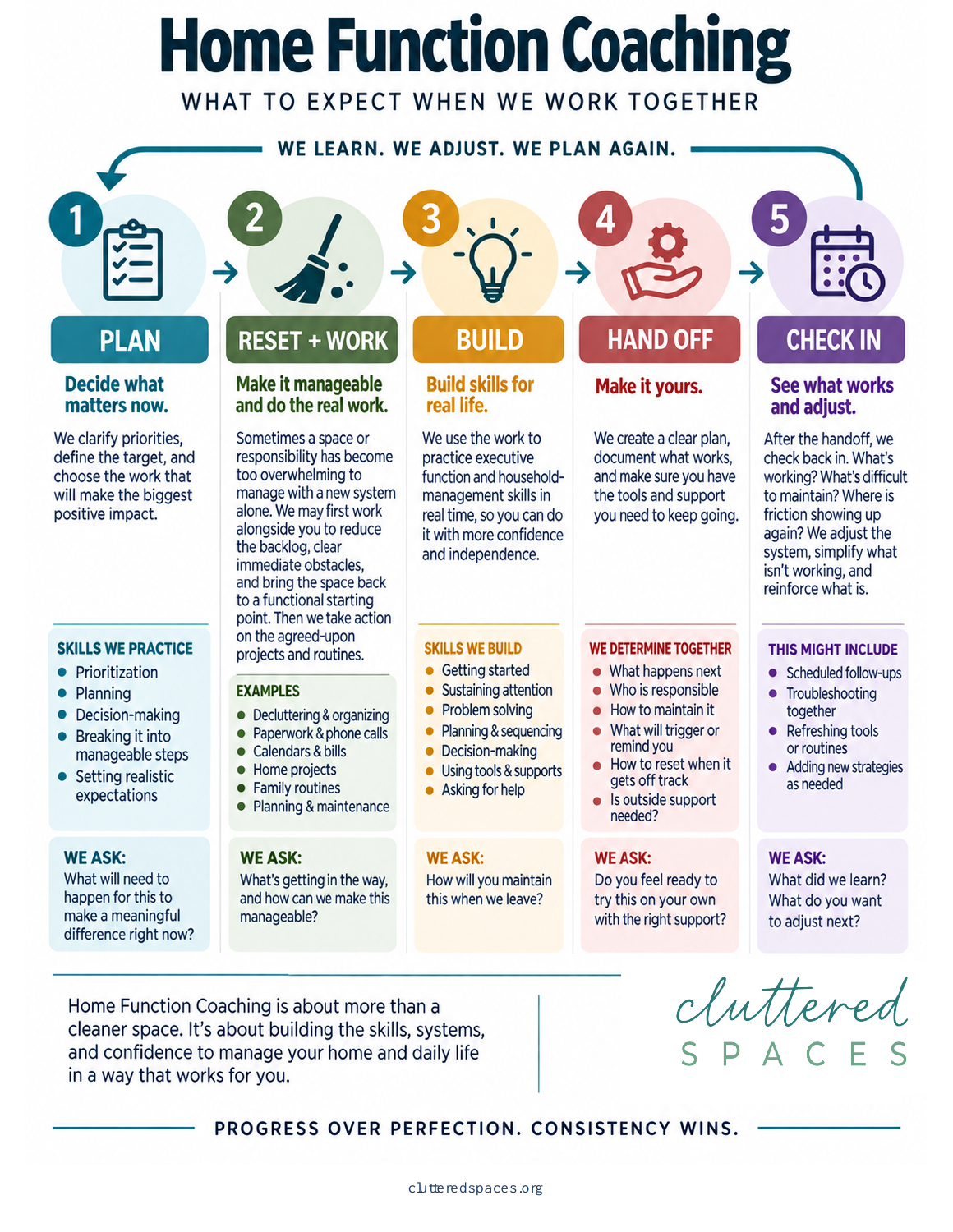
Free printable: Home Function Coaching Process
This visual guide explains the five stages and the questions we work through together. Use it before your first visit to understand what to expect, share it with a family member, or keep it nearby while we plan a household project.
For example, if laundry is the starting point, use the guide to talk about the current backlog, what a manageable routine could look like, and who will handle each part after the session.
Print and keep: Download the free Home Function Coaching Process printable (PDF). No email signup required.
Why we work side by side
You may know perfectly well that the mail needs opening. The difficult part may be choosing where to begin, deciding what each envelope requires, keeping track of the next step, or staying with it when something feels confusing.
Those are some of the everyday demands behind executive function at home. Knowing what needs doing and being able to move through it are not always the same experience.
Working beside you lets us respond at the moment the task gets stuck. We might break a pile into smaller groups, write down the next action, help you prepare for a call, or pause to make one decision together. Sometimes we use body doubling: another person is present while you do the task. Sometimes you need more active help, including physical work.
You remain involved in the choices and work whenever possible. Participation can mean sorting alongside us, choosing priorities while seated, trying one step, or telling us what will and will not work for you. We adapt to your energy, mobility, attention, and comfort. You do not have to keep pace with someone else to have ownership of your home.
Being part of the progress matters
In our experience, working beside a client while they stay involved in the decisions often helps build momentum for getting unstuck. You get to experience yourself starting, choosing, and making progress with support. That can make the next step feel more possible.
Breaking tasks into smaller steps, recording next actions, and practicing strategies are also part of skills-based treatment research for adults with ADHD. That research informs these practical choices; it does not directly test home coaching.
Ownership matters too. Research on motivation points to the value of having a real say, feeling capable, and feeling supported. In your home, that means your priorities guide the work, your preferences shape the system, and we help you notice what you have accomplished. You do not have to develop a passion for sorting mail. Having a reason you care about and a next step you can manage is a useful place to start.
With a paperwork backlog, you might choose which bill to address while we help sort the papers and prepare for the call. By the end, you have both a completed task and a next step you helped create.
Momentum is an invitation, not a demand to keep going until you are exhausted. We can stop at the agreed point, make the next start clear, and leave room for a break.
The five stages, in a real home
1. PLAN: Decide what matters now
We start with what you want to be easier. “I want to make breakfast without clearing the counter first” gives us something more useful to work toward than “I need to get organized.”
Together, we look at where the task stops, what already helps, and what you can reasonably manage. We choose a scope and a stopping point. The entire house does not have to become today's project.
If the kitchen is the priority, we might agree to restore one food-preparation area and make a workable plan for dishes. Reorganizing the holiday serving platters can wait. They have been patient this long.
2. RESET + WORK: Create a workable place to begin
Sometimes the current situation is already beyond what a new routine can reasonably handle. A laundry schedule cannot absorb every overdue load overnight. A mail tray cannot resolve months of unanswered paperwork.
A reset is a do-over: reducing the backlog, removing immediate obstacles, and restoring basic function. You may need substantial hands-on help to reach that starting point. Asking you to “maintain better” before then skips the very thing making maintenance difficult.
We might clear a work surface together, contain trash and dishes, sort a backlog into manageable groups, or identify the paperwork that needs attention first. We may also help you find appropriate outside support when a job needs a different professional.
The reset is not the finish line. It creates a workable place to begin. From there, we do the agreed work: organizing, making calls, setting up routines, planning household systems, or tackling the next part of a project.
3. BUILD: Practice skills while doing the real work
The real work gives us a place to practice. If you lose your place halfway through sorting the mail, we can figure out what would help right there, with the mail still in front of us.
With paperwork: choose what needs attention first, put the steps in order, and record the next action instead of trying to remember it. A written reminder carries some of the memory work.
With laundry: choose one manageable load, use a cue for the transfer, and agree where clean clothes will go. We practice starting, returning attention to the task, and following through to a useful stopping point.
With meals: choose a few realistic options, check what is already available, and make a shopping list. When the week changes, we practice adjusting the plan instead of losing the whole plan.
With a difficult decision: slow down, identify what is making it hard, compare a small number of options, and decide what is good enough. If frustration rises, we can pause, change the size of the task, or ask for help.
We also practice what to do when you feel frustrated, lose your place, or discover the first plan will not work. That may mean trying another approach, handing part of the job to someone else, or asking for help. These are everyday ways to practice problem solving, managing emotions, and staying with a goal. Nobody needs an executive function vocabulary quiz before tackling the kitchen.
This is where Executive Function Coaching and Independent Living & Daily Skills meet everyday household responsibilities.
4. HAND OFF: Make it yours
A handoff is a plan for ownership, not an abrupt “Good luck!” at the door. We try the system with you, make the next step clear, and identify the help that will still be available.
We match the help to you and the task you are learning. This is sometimes called scaffolding: enough support to make the next step manageable, with room to take on more as you are ready. That might mean working through a task together, then having you lead while we stay available, and eventually stepping back. Some clients are ready to take ownership of the task after we set up and practice the system. Others benefit from a more gradual handoff.
Before wrapping up, we determine:
What happens next, and who owns that step?
What needs to happen regularly, and what counts as enough?
What reminder, checklist, or other support will make starting easier?
Does another family member have an agreed role?
Should anything be automated or handled by outside help?
What happens when the routine gets off track?
For laundry, that might mean one person starts the wash, another handles the transfer, and each family member puts their own clothes into accessible bins. If folding is where everything stops, we can consider which clothes actually need folding. Our ADHD-friendly home organization guide explores ways to make the physical system easier to use.
The handoff also needs a reset plan: “What do I do when this gets messy again?” A smaller version might be washing the clothes needed for the next two days, then asking for help with the remaining backlog. Getting back in should not require catching up on everything first.
5. CHECK IN: Learn what happened and adjust
We agree on how and when to check in based on the support you need. For one client, that may mean weekly check-ins that become monthly, then quarterly as the routine becomes more manageable. Another may be ready for us to step away and reach out again when needed. These are possibilities, not a required schedule or a deadline for independence. We adjust the pace together, and support can increase again when circumstances change.
At each check-in, we want to hear about the ordinary week, including the parts that did not go as planned.
Did the system work? Was it maintainable? Where did friction show up? Was it too complicated, was a support missing, or did the household need something different?
Perhaps the reminder appeared while you were driving. Perhaps the bin was convenient for one person but difficult for another to reach. Perhaps a routine depended on someone who was never available at that time.
A system breaking down is not automatically failure. It is information.
CHECK IN brings us back to PLAN. We use what happened to choose the next adjustment: fewer steps, a different location, a smaller routine, clearer ownership, or additional support. These stages can overlap within a session and repeat as your needs change.
Maintenance does not mean doing everything yourself
“How will you maintain this when we leave?” does not mean “How will you personally do every household task?”
A realistic maintenance plan might include tasks you do yourself, shared family responsibilities, routines, checklists, reminders, automation, or body doubling. It may also include a cleaning service, laundry service, handyman, lawn care, pest control, or another appropriate professional or community resource.
We can help you identify what needs outside help, compare practical options, prepare questions, and work through the steps of making contact. We consider what is accessible, affordable, and actually available.
Household leadership means knowing what needs to happen and creating a workable plan for how it will happen. You can have ownership while sharing the work.
We are always happy to come back and help when you need us. Getting unstuck once does not mean you will never get stuck again. You may need another reset in the same area, help with a different responsibility, or a new plan when life changes. Reaching out again does not undo the progress you have made.
Our role is coaching and practical support to help you build and maintain a workable plan. We can return for check-ins, troubleshooting, and resets. For ongoing cleaning or household management, we help you identify who will handle those responsibilities and what support you need.
The aim is a maintenance plan you understand and can use with the right support. Our article on building systems that work after help leaves looks more closely at that question.
So is this organizing or executive function coaching?
It combines both, with practical daily-living skill development. We match the balance of hands-on help and coaching to your situation, paying attention to today’s task and what will help the next time it needs doing.
Professional services overlap, and many organizers also teach skills and provide hands-on support. The useful question is what kind of help your situation needs.
You do not have to organize the problem before asking for help
You can start with “The kitchen is not working,” “I cannot face this paperwork,” or “We need mornings to feel less difficult.” That gives us somewhere to begin.
Cluttered Spaces works alongside teens, adults, and families in Metro Atlanta. Together, we can identify a useful first step, make room to work, and build a plan that fits the people who live in your home.
You can also keep the free Home Function Coaching Process printable above as a guide for that first conversation.
Suggested next step
If your home or household routines have become difficult to manage, explore Home Function & Organization. We can look at what is getting stuck, what needs a reset, and which combination of hands-on help, coaching, and ongoing supports makes sense for you.
References
Center on the Developing Child at Harvard University. (2017). Building the Skills Adults Need for Life: A Guide for Practitioners. Background on practical skill development and reducing stress in service delivery.
Administration for Community Living. Person-Centered Planning. Background on keeping the person’s goals, choices, participation, and support needs central to planning.
Safren, S. A., et al. (2010). Cognitive Behavioral Therapy vs Relaxation With Educational Support for Medication-Treated Adults With ADHD and Persistent Symptoms: A Randomized Controlled Trial. JAMA, 304(8), 875–880. Clinical background on a treatment package that includes planning, breaking tasks into steps, and strategies for distractions.
Ryan, R. M., & Deci, E. L. (2000). Self-Determination Theory and the Facilitation of Intrinsic Motivation, Social Development, and Well-Being. American Psychologist, 55(1), 68–78. Background on choice, a sense of capability, and supportive relationships in motivation.
These resources inform the principles discussed here. The ADHD study evaluated psychotherapy, not home coaching or body doubling. Our observation about momentum comes from our work with clients; these sources do not directly test that observation or the Cluttered Spaces five-stage model.